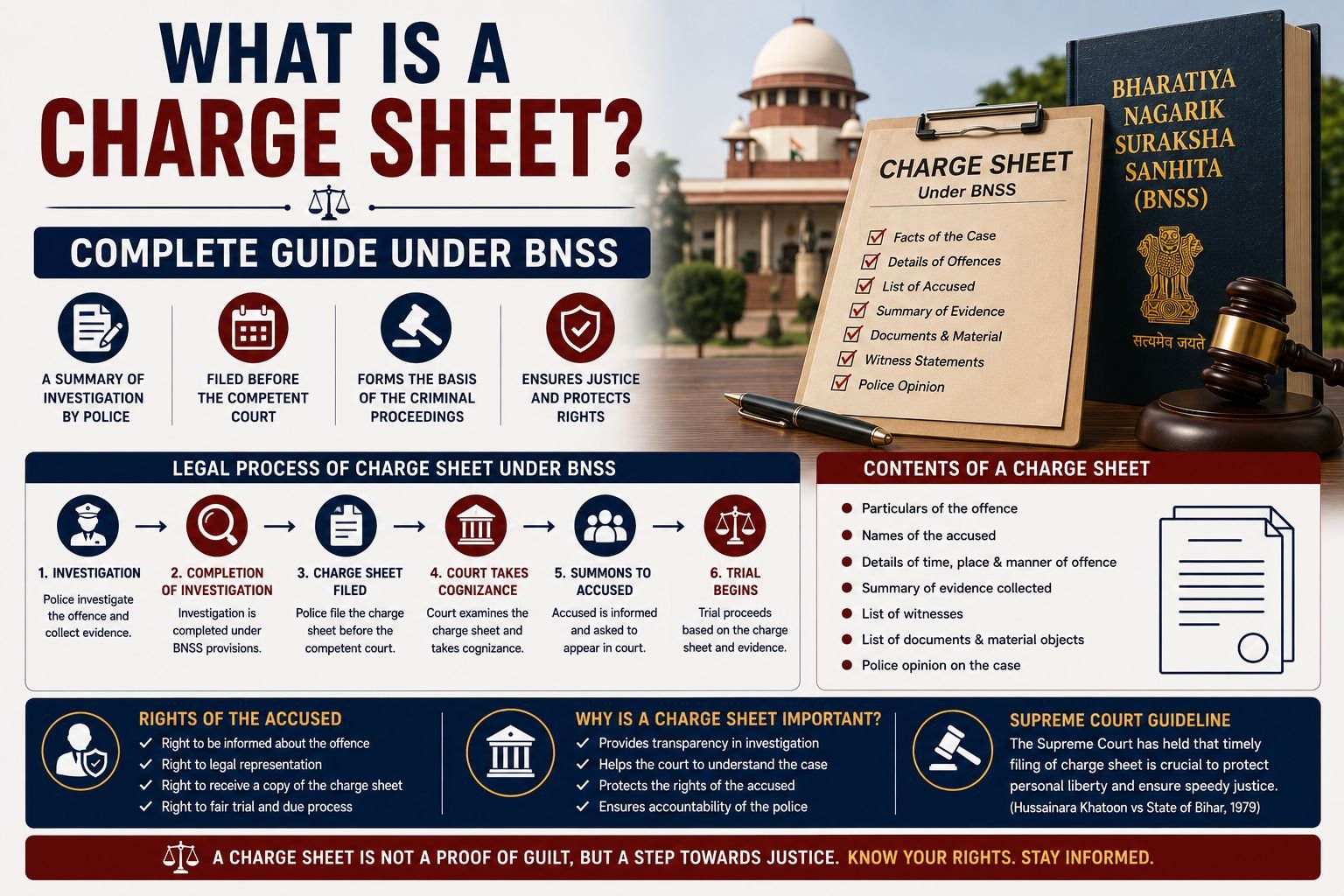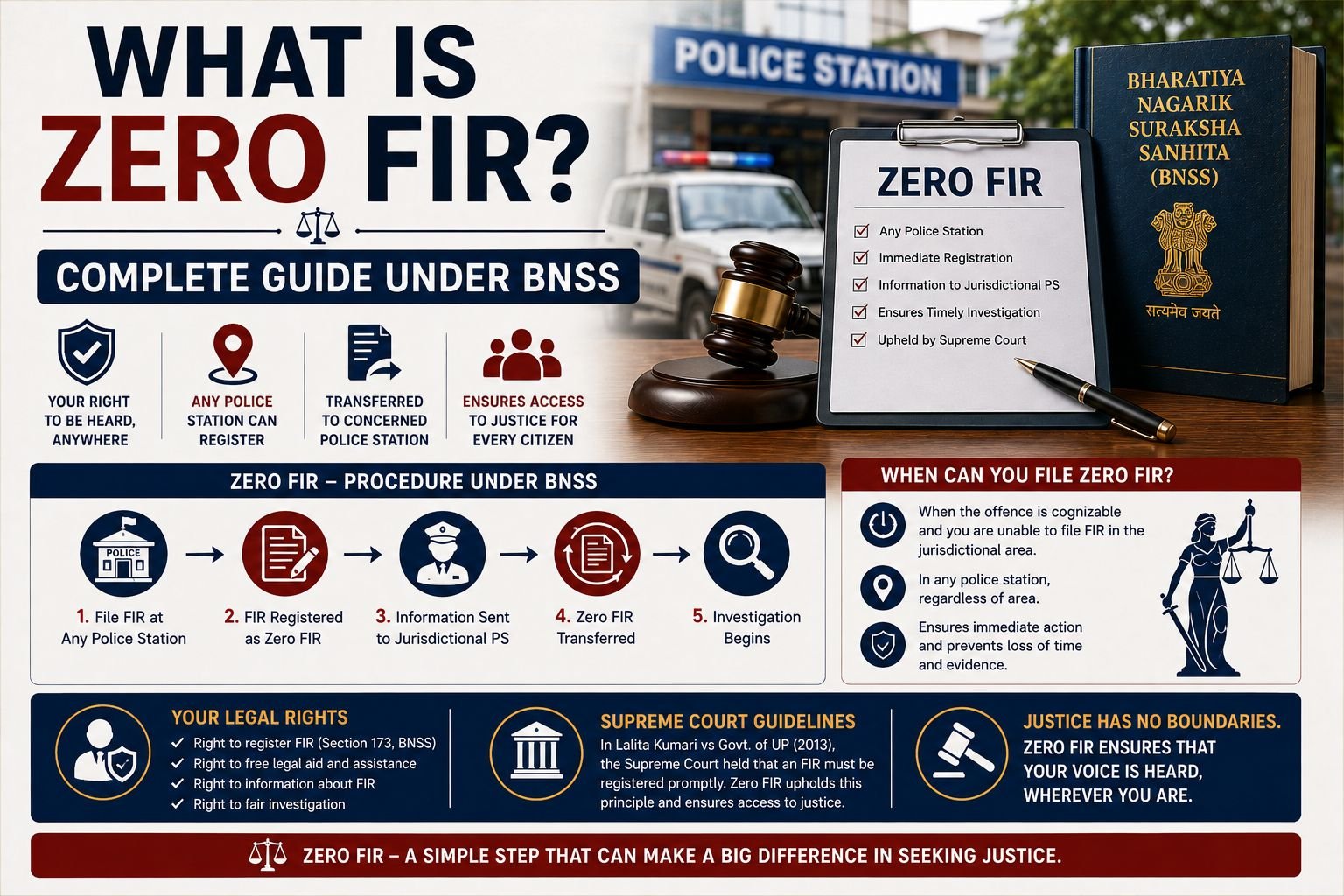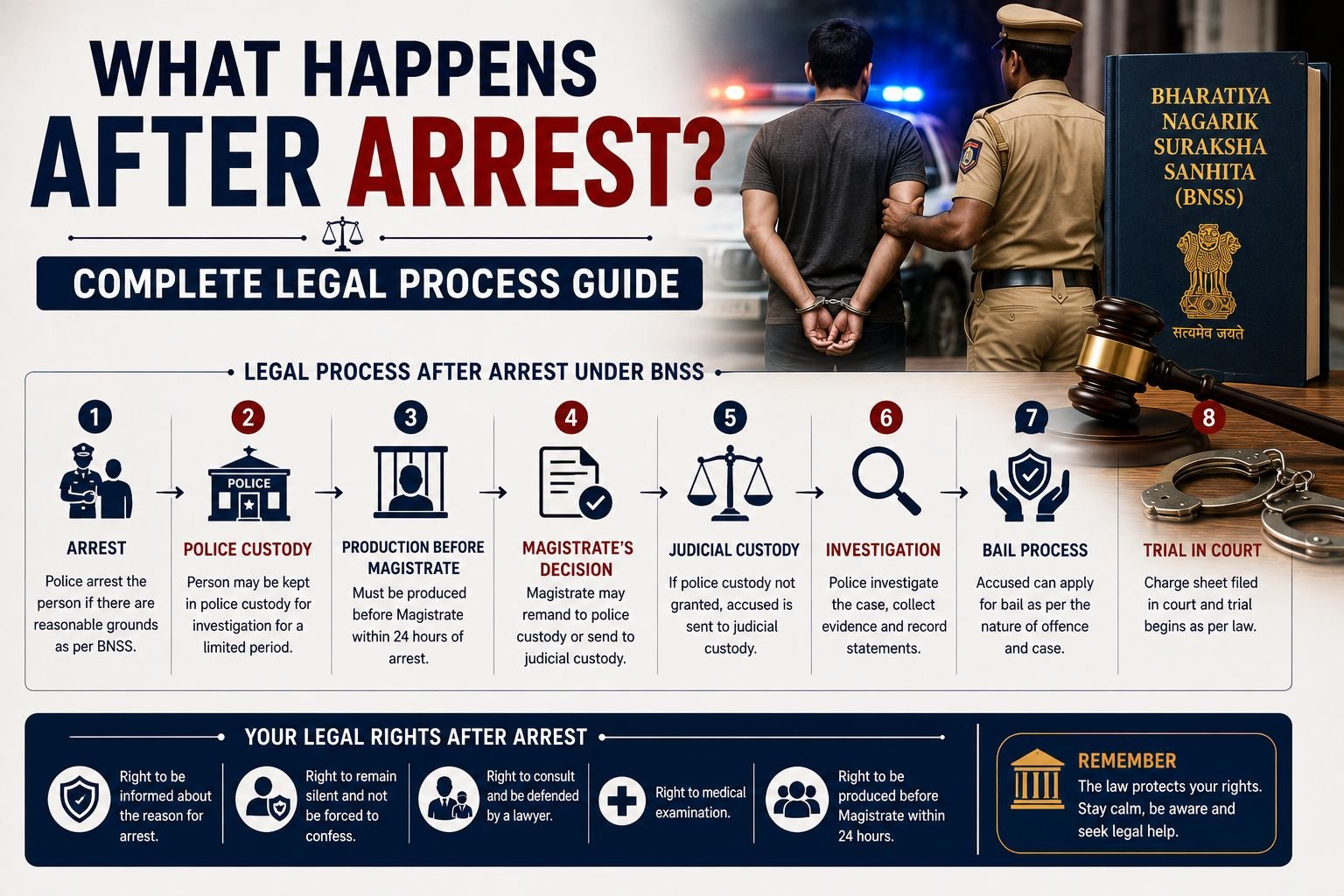
Being arrested in a criminal case does not mean that an accused person can be kept in custody indefinitely. Indian criminal law recognizes the importance of personal liberty and requires investigating agencies to complete their investigation within the time prescribed by law. If they fail to do so, the accused may acquire a valuable legal right known as default bail, also referred to as statutory bail.
Default bail is different from regular bail or anticipatory bail because it is not granted based on the merits of the case. Instead, it arises due to the failure of the investigating agency to file the charge sheet or final report within the statutory time limit prescribed under the Bharatiya Nagarik Suraksha Sanhita, 2023 (BNSS).
The concept of default bail ensures that investigating agencies conduct investigations efficiently while safeguarding the constitutional right to personal liberty. Courts have repeatedly held that this right is an important safeguard against prolonged and unjustified detention.
Whether you are an accused person, a family member, a law student, or a legal professional, understanding default bail can help you appreciate the balance between effective criminal investigation and the protection of individual rights.
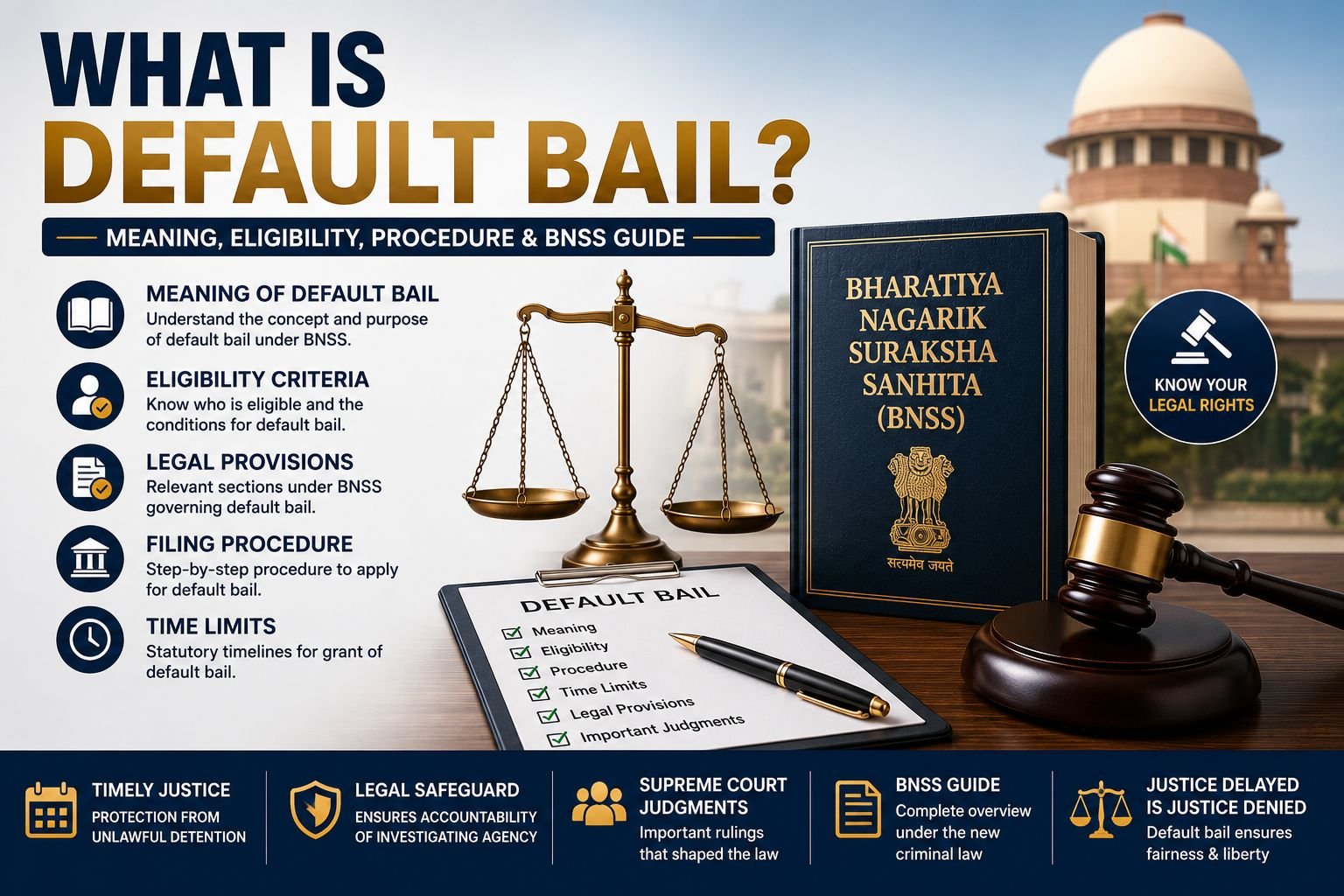
In this comprehensive guide, we will explain:
- What default bail means.
- The legal provisions under the BNSS.
- When an accused becomes entitled to default bail.
- Eligibility criteria.
- Time limits for filing the charge sheet.
- Procedure for applying for default bail.
- Important Supreme Court judgments.
- Differences between default, regular, and anticipatory bail.
- Frequently asked questions.
What is Default Bail?
Default bail is a statutory right available to an accused person when the investigating agency fails to complete the investigation and file the charge sheet (or final report) within the period prescribed by law.
Unlike regular bail, where the court considers factors such as the seriousness of the offence, evidence, and possibility of absconding, default bail is based on the prosecution’s failure to complete the investigation within the statutory time limit.
Once the legal requirements are satisfied, the accused may become entitled to be released on bail, subject to fulfilling the conditions imposed by the court.
Default bail is therefore considered a safeguard against unnecessary and prolonged detention during the investigation stage.
Meaning of Default Bail
The term default bail refers to bail granted because of the “default” of the investigating agency in completing the investigation within the prescribed period.
It is commonly known as statutory bail because the right arises directly from the provisions of the law rather than the discretion of the court.
In simple terms:
- The accused is arrested.
- The investigation begins.
- The law prescribes a maximum period to complete the investigation.
- If the investigating agency fails to file the charge sheet within that period, the accused may claim default bail, provided the legal requirements are met.
Thus, the right to default bail is based on procedural safeguards rather than the merits of the allegations.
Why is Default Bail Important?
Default bail serves an important role in India’s criminal justice system by balancing the interests of the investigation with the fundamental rights of the accused.
1. Protects Personal Liberty
One of the primary objectives of default bail is to prevent an accused person from remaining in custody indefinitely while the investigation is pending.
2. Ensures Timely Investigation
The statutory time limits encourage investigating agencies to complete investigations efficiently and avoid unnecessary delays.
3. Prevents Arbitrary Detention
Without such safeguards, an accused could remain in custody for extended periods without the investigation being completed.
4. Upholds Rule of Law
Default bail reinforces the principle that investigative authorities must act within the legal framework established by Parliament.
5. Protects Fair Trial Rights
Timely investigation contributes to a fair criminal justice process by reducing unnecessary delays and uncertainty.
Constitutional Basis of Default Bail
Although default bail is provided under the BNSS, its foundation lies in the constitutional protection of personal liberty.
Article 21 of the Constitution
Article 21 guarantees that no person shall be deprived of life or personal liberty except according to the procedure established by law.
The Supreme Court has repeatedly emphasized that prolonged detention without completing the investigation may infringe this constitutional guarantee unless authorised in accordance with law.
Default bail therefore acts as an important procedural safeguard that supports the constitutional value of personal liberty.
Legal Provisions Relating to Default Bail Under BNSS
The Bharatiya Nagarik Suraksha Sanhita, 2023 (BNSS) prescribes the maximum period for completing an investigation while an accused remains in custody before the filing of the charge sheet.
If the investigation is not completed within the prescribed statutory period, and the accused satisfies the legal requirements, they may seek default bail.
The provisions specify:
- The maximum period for investigation in custody.
- The circumstances in which the right arises.
- The powers of the court.
- The conditions for release.
Since procedural requirements are important, the accused should make the application promptly after the statutory right accrues.
Default Bail vs Regular Bail
Although both result in the release of an accused from custody, they differ significantly.
| Basis | Default Bail | Regular Bail |
|---|---|---|
| Reason | Delay in filing charge sheet | Court considers merits of the case |
| Nature | Statutory right, subject to legal requirements | Judicial discretion |
| Stage | During investigation | After arrest during investigation or trial |
| Consideration | Delay by investigating agency | Gravity of offence, evidence, and other factors |
| Purpose | Prevent prolonged detention | Secure release pending proceedings |
Default Bail vs Anticipatory Bail
Default bail and anticipatory bail operate at different stages of criminal proceedings.
| Basis | Default Bail | Anticipatory Bail |
|---|---|---|
| Stage | After arrest | Before arrest |
| Purpose | Release due to delay in investigation | Protection against anticipated arrest |
| Basis | Failure to file charge sheet within statutory period | Reasonable apprehension of arrest |
| Custody | Applicant is already in custody | Applicant has not yet been arrested |
Key Features of Default Bail
Some important characteristics of default bail include:
- It arises due to the investigating agency’s failure to complete the investigation within the prescribed time.
- It is commonly known as statutory bail.
- It becomes available only after the statutory period has expired and the legal conditions are fulfilled.
- It is different from both regular bail and anticipatory bail.
- The accused must apply before the right is defeated in accordance with law.
- Release remains subject to compliance with bail conditions imposed by the court.
- Grant of default bail does not amount to an acquittal.
- Criminal proceedings continue even after release on default bail.
Common Misconceptions About Default Bail
Many people misunderstand the concept of default bail. Some common misconceptions include:
Myth 1: Default bail means the accused is innocent.
Reality: Default bail does not determine guilt or innocence. It only provides release from custody because the investigation was not completed within the prescribed period.
Myth 2: Default bail automatically ends the criminal case.
Reality: The investigation and subsequent trial may continue even after default bail is granted.
Myth 3: Default bail is available in every criminal case.
Reality: It is available only when the statutory conditions prescribed under the BNSS are fulfilled.
Myth 4: Default bail cannot be cancelled.
Reality: Like other forms of bail, default bail may be cancelled by the court in appropriate circumstances recognised by law.
Why You Should Understand Default Bail
Understanding the law relating to default bail is important because it:
- Helps accused persons understand their legal rights.
- Promotes awareness of procedural safeguards.
- Encourages timely investigation by law enforcement agencies.
- Protects constitutional guarantees of personal liberty.
- Assists lawyers, students, and families in navigating criminal proceedings.
When Can an Accused Claim Default Bail?
An accused person may become entitled to default bail when the investigating agency fails to complete the investigation and file the charge sheet (or final report) within the statutory period prescribed under the BNSS.
The right does not arise immediately after arrest. It becomes available only after:
- The accused is in lawful custody.
- The statutory investigation period expires.
- The investigating agency has not filed the charge sheet within that period.
- The accused applies for default bail and is prepared to comply with the conditions imposed by the court.
The court then considers whether the legal requirements for granting default bail have been satisfied.
Statutory Time Limits Under BNSS
The BNSS prescribes specific time limits within which the investigating agency is expected to complete its investigation while the accused remains in custody.
Generally, the statutory periods are:
- 60 days for certain offences punishable with imprisonment below the higher statutory threshold.
- 90 days for more serious offences punishable with death, life imprisonment, or imprisonment of ten years or more (subject to the applicable statutory provisions).
If the investigation is not completed within the applicable period, the accused may acquire the right to seek default bail.
Understanding the 60-Day Rule
The 60-day period generally applies to offences where the prescribed punishment falls within the category specified under the BNSS.
Example
A person is arrested for an offence where the applicable statutory investigation period is 60 days.
If:
- The accused remains in custody,
- The investigation is not completed, and
- No charge sheet is filed within 60 days,
the accused may become entitled to apply for default bail, subject to fulfilling the legal requirements.
Understanding the 90-Day Rule
The 90-day period generally applies to more serious offences carrying severe punishments.
Example
Suppose a person is arrested for an offence punishable with life imprisonment.
If the investigating agency does not file the charge sheet within 90 days, the accused may seek default bail, provided the statutory conditions are fulfilled.
When Does the Statutory Period Begin?
One of the most frequently asked questions concerns the calculation of the statutory period.
Generally, the period begins from the date on which the accused is first remanded to judicial or authorised custody in accordance with law.
The exact method of calculation depends on the applicable statutory provisions and judicial interpretation.
How is the Investigation Period Calculated?
While calculating the statutory period, courts generally consider:
- Date of arrest.
- Date of first remand.
- Number of days spent in authorised custody.
- Date of filing of the charge sheet.
Accurate calculation is important because even a short delay may affect whether the right to default bail has accrued.
When Does the Right to Default Bail Arise?
The right ordinarily arises when:
- The statutory period has expired.
- The charge sheet has not been filed.
- The accused applies for default bail.
- The accused is willing to furnish the required bail bond or comply with the bail conditions.
Merely because the investigation is delayed does not automatically release the accused. An application before the competent court is generally required.
Eligibility Criteria for Default Bail
Not every accused person automatically qualifies for default bail.
The following conditions are generally relevant:
1. Lawful Arrest
The applicant must have been arrested and kept in lawful custody.
2. Expiry of the Statutory Period
The prescribed investigation period must have expired.
3. Charge Sheet Not Filed
The investigating agency must not have filed the charge sheet before the statutory right is exercised.
4. Application Before the Court
The accused must file an application before the competent court seeking default bail.
5. Readiness to Furnish Bail Bond
The accused should be prepared to comply with the bail conditions and furnish the required bail bond or sureties, if directed by the court.
Offences in Which Default Bail May Be Claimed
Default bail is linked to the statutory investigation period rather than to a particular category of offences.
It may become relevant in:
- Economic offences.
- Property offences.
- Serious criminal offences.
- Certain special law offences, subject to the provisions of those special statutes.
- Other cases where the applicable investigation period expires without filing of the charge sheet.
However, some special laws prescribe different investigation periods or additional requirements.
Cases Where Default Bail May Not Be Available
Default bail is not available in every situation.
For example, the right may not arise where:
- The charge sheet has been filed within the statutory period.
- The accused has not yet completed the required period in custody.
- The application does not satisfy the statutory requirements.
- A special statute provides a different legal framework or extended investigation period, where applicable.
Each case depends on its own facts and the governing law.
Can the Police Seek More Time?
In certain categories of cases governed by special statutes, the prosecution may seek an extension of the investigation period where the law expressly permits it.
Whether such an extension can be granted depends upon:
- The applicable legislation.
- Judicial satisfaction.
- Compliance with statutory requirements.
Courts examine these requests carefully before granting any extension.
Does Filing an Incomplete Charge Sheet Defeat Default Bail?
Questions often arise regarding incomplete or supplementary investigations.
Whether the filing of a particular report satisfies the statutory requirement depends on:
- The nature of the report.
- Compliance with the procedural law.
- Judicial interpretation.
Courts decide such issues based on the facts of each case and the applicable legal principles.
Is Default Bail an Automatic Right?
No.
Although default bail is often described as a statutory right, release is not automatic.
The accused generally needs to:
- Apply before the competent court.
- Demonstrate that the statutory conditions have been fulfilled.
- Be prepared to furnish bail bonds and comply with the court’s conditions.
The court then considers whether the legal requirements for default bail have been met.
Important Conditions While Granting Default Bail
Courts may impose conditions such as:
- Furnishing a personal bond.
- Providing one or more sureties, where required.
- Appearing before the court as directed.
- Cooperating with the investigation.
- Not influencing witnesses.
- Not tampering with evidence.
- Informing the court before changing address, if directed.
Failure to comply with these conditions may have legal consequences.
Practical Examples
Example 1
A person is arrested for an offence where the applicable investigation period is 60 days.
If no charge sheet is filed within those 60 days and the accused promptly applies for default bail while complying with the legal requirements, the court may consider granting default bail.
Example 2
A person is arrested for a serious offence carrying a statutory investigation period of 90 days.
If the investigating agency files the charge sheet on the 75th day, the right to default bail would generally not arise because the charge sheet was filed within the prescribed period.
Example 3
An accused remains in custody after expiry of the statutory period, no charge sheet has been filed, and an application for default bail is submitted before the competent court along with readiness to furnish bail. The court will examine whether the statutory conditions have been fulfilled before deciding the application.
Common Mistakes That Affect Default Bail Applications
Applicants and their families should avoid these common mistakes:
- Incorrectly calculating the statutory period.
- Assuming default bail is automatic.
- Delaying the filing of the application after the statutory right accrues.
- Failing to produce necessary documents before the court.
- Not arranging sureties or bail bonds in advance, where required.
- Confusing default bail with regular or anticipatory bail.
- Relying solely on verbal legal advice without verifying the applicable statutory provisions.
Step-by-Step Procedure to Apply for Default Bail
Once the statutory period for completing the investigation has expired and the investigating agency has not filed the charge sheet within the prescribed time, the accused may apply for default bail before the competent court.
The process generally involves the following steps.
Step 1: Confirm Eligibility
Before filing the application, verify that:
- The accused is in lawful custody.
- The statutory investigation period has expired.
- No charge sheet has been filed within the prescribed period.
- The accused is prepared to furnish bail bonds and comply with the court’s conditions.
A careful review of the case records is important before proceeding.
Step 2: Consult a Criminal Lawyer
Although a person may apply through legal aid or in accordance with law, seeking advice from an experienced criminal lawyer can help ensure that the application is properly prepared and supported.
A lawyer can:
- Verify the statutory period.
- Examine court records.
- Prepare the bail application.
- Represent the accused during the hearing.
- Respond to objections raised by the prosecution.
Step 3: Prepare the Default Bail Application
The application should clearly state:
- Name of the accused.
- FIR number.
- Police station.
- Relevant offences.
- Date of arrest.
- Date of first remand.
- Applicable statutory investigation period.
- Date on which the statutory period expired.
- Confirmation that no charge sheet has been filed within the prescribed period.
- Prayer requesting release on default bail.
The application should be accurate and supported by the relevant documents.
Step 4: Attach Supporting Documents
The court may require supporting documents, depending on the facts of the case.
Commonly attached documents include:
- Copy of the FIR.
- Remand order.
- Arrest memo.
- Custody records.
- Identity proof.
- Address proof.
- Vakalatnama (where applicable).
- Affidavit, if required.
- Other relevant court documents.
Step 5: File the Application Before the Competent Court
The application should be filed before the court having jurisdiction over the criminal case.
After filing, the court generally:
- Registers the application.
- Fixes a hearing date.
- Issues notice where required.
- Hears both parties before passing an order.
Which Court Has Jurisdiction?
The court that hears a default bail application depends on the stage of the proceedings and the nature of the offence.
Generally, applications may be filed before:
- Judicial Magistrate.
- Chief Judicial Magistrate.
- Sessions Court.
- High Court (where legally permissible).
Jurisdiction depends upon the applicable provisions of the BNSS and the court before which the accused is produced.
Documents Required for Default Bail
Although the exact requirements may differ from case to case, the following documents are commonly required.
Essential Documents
- Bail application.
- FIR copy.
- Arrest memo.
- Remand orders.
- Identity proof.
- Address proof.
- Copy of previous court orders (if any).
- Vakalatnama.
- Affidavit, where applicable.
Additional documents may be required depending on the facts of the case.
Drafting the Bail Application
A properly drafted application improves clarity and assists the court in understanding the basis of the request.
The application generally includes:
Case Details
- Court name.
- Case number.
- FIR number.
- Police station.
Details of the Applicant
- Name.
- Father’s or mother’s name (where required).
- Residential address.
- Occupation.
Grounds for Seeking Default Bail
The application should explain:
- Date of arrest.
- Period spent in custody.
- Statutory period applicable.
- Failure to file the charge sheet.
- Entitlement to default bail under the applicable provisions.
Prayer
The application concludes by requesting the court to release the accused on default bail upon such terms and conditions as the court considers appropriate.
Court Hearing Process
After the application is filed, the court hears submissions from both the defence and the prosecution.
The court generally considers:
- Date of arrest.
- Date of first remand.
- Applicable statutory period.
- Whether the charge sheet has been filed.
- Compliance with legal requirements.
- Objections raised by the prosecution.
The court then passes an order allowing or rejecting the application based on the applicable law and facts.
What Does the Court Verify?
Before granting default bail, the court may verify:
- Whether the accused remained in lawful custody.
- Whether the statutory period has expired.
- Whether the charge sheet was filed within time.
- Whether the applicant has invoked the right in accordance with law.
- Whether the applicant is prepared to furnish bail bonds.
Bail Bond and Sureties
If default bail is granted, the court usually directs the accused to execute a bail bond.
Depending on the circumstances, the court may also require one or more sureties.
A bail bond is an undertaking by the accused to:
- Appear before the court.
- Comply with all bail conditions.
- Cooperate with the investigation.
- Attend future hearings.
Common Conditions Imposed by the Court
While granting default bail, the court may impose conditions such as:
- Furnishing a personal bond.
- Providing sureties.
- Appearing before the investigating officer when required.
- Appearing before the court on scheduled dates.
- Not leaving the jurisdiction without permission, where directed.
- Not tampering with evidence.
- Not threatening or influencing witnesses.
- Informing the court about any change of address.
The exact conditions vary depending on the circumstances of each case.
What Happens After Default Bail Is Granted?
Once the bail bond and other formalities are completed, the accused is released from custody.
However, release on default bail does not end the criminal proceedings.
The accused must continue to:
- Attend court hearings.
- Cooperate with the investigation.
- Follow all bail conditions.
- Comply with future court directions.
The prosecution may continue the investigation and file the charge sheet in accordance with law.
Can Default Bail Be Cancelled?
Yes.
Like other forms of bail, default bail may be cancelled by a competent court on legally recognised grounds.
Examples include:
- Violation of bail conditions.
- Attempting to influence witnesses.
- Tampering with evidence.
- Absconding.
- Failure to appear before the court.
- Misuse of the liberty granted by the court.
Cancellation is not automatic and requires an appropriate legal process.
Rights of an Accused Released on Default Bail
After release, the accused continues to enjoy several legal rights, including:
- The right to a fair trial.
- The right to legal representation.
- The presumption of innocence until proven guilty.
- Protection against unlawful detention.
- The right to receive copies of documents as permitted by law.
- The right to challenge adverse orders before higher courts.
Responsibilities of the Accused
Release on default bail also carries important responsibilities.
The accused should:
- Obey all bail conditions.
- Attend every court hearing.
- Cooperate with investigators.
- Avoid committing any further offence.
- Keep the court informed of any change of address if required.
- Refrain from contacting or intimidating witnesses.
Failure to comply with these obligations may lead to legal consequences, including an application for cancellation of bail.
Practical Illustration
Example 1
An accused is arrested and remanded to judicial custody. The statutory investigation period expires, but the investigating agency has not filed the charge sheet.
The accused files an application for default bail, furnishes the required bail bond, and satisfies the court that the statutory conditions have been fulfilled. The court may grant default bail.
Example 2
An accused files a default bail application after the statutory period has expired, but it is established that the charge sheet had already been filed within the prescribed time. In such a situation, the court may reject the application because the statutory right did not arise.
Common Mistakes While Filing a Default Bail Application
Applicants should avoid the following errors:
- Miscalculating the statutory investigation period.
- Filing the application before the statutory period has expired.
- Failing to produce relevant court records.
- Not arranging bail bonds or sureties in advance.
- Confusing default bail with regular bail.
- Ignoring court notices or hearing dates.
- Violating interim court directions during the proceedings.
Tips for a Strong Default Bail Application
- Verify all dates carefully.
- Attach complete documentation.
- Ensure the statutory period has actually expired.
- File the application promptly after the right accrues.
- Clearly explain the legal basis for the claim.
- Seek professional legal assistance where necessary.
- Be prepared to comply with all bail conditions.
Important Supreme Court Judgments on Default Bail
The Supreme Court of India has repeatedly recognised default bail as an important statutory right that protects the constitutional guarantee of personal liberty. Several landmark judgments explain how this right should be interpreted.
1. Uday Mohanlal Acharya v. State of Maharashtra (2001)
Principle
The Supreme Court held that once the statutory right to default bail accrues and the accused applies for bail while being prepared to furnish bail bonds, the right cannot ordinarily be defeated by subsequently filing the charge sheet.
Importance
This judgment clarified the nature of default bail as a valuable statutory right available to the accused once the prescribed conditions are fulfilled.
2. Sanjay Dutt v. State through CBI (1994)
Principle
The Court discussed the circumstances under which the right to statutory bail becomes available after expiry of the prescribed investigation period.
Importance
The decision remains one of the foundational judgments explaining the concept of default bail under criminal procedure.
3. Rakesh Kumar Paul v. State of Assam (2017)
Principle
The Supreme Court examined the interpretation of the statutory investigation period and reaffirmed that provisions relating to personal liberty should receive a liberal interpretation where appropriate.
Importance
The judgment clarified the application of statutory time limits in certain categories of offences.
4. Bikramjit Singh v. State of Punjab (2020)
Principle
The Court reaffirmed that default bail is an important statutory right and emphasised that courts should protect this right once it has accrued in accordance with law.
Importance
The judgment strengthened the jurisprudence surrounding statutory bail and procedural safeguards.
5. M. Ravindran v. Intelligence Officer (2021)
Principle
The Supreme Court explained when the right to default bail arises and the circumstances in which it may be exercised by the accused.
Importance
The decision provides detailed guidance on the exercise of the right to default bail and its interaction with the filing of the charge sheet.
Default Bail Under CrPC vs BNSS
The concept of default bail existed under the Code of Criminal Procedure, 1973 (CrPC) and continues under the Bharatiya Nagarik Suraksha Sanhita, 2023 (BNSS).
While the procedural framework has been updated under the BNSS, the underlying objective remains the same—to ensure that investigating agencies complete investigations within the prescribed period while protecting personal liberty.
| Basis | CrPC | BNSS |
|---|---|---|
| Governing Law | Code of Criminal Procedure, 1973 | Bharatiya Nagarik Suraksha Sanhita, 2023 |
| Objective | Prevent prolonged detention | Prevent prolonged detention |
| Statutory Time Limits | Prescribed under CrPC | Prescribed under BNSS |
| Investigation | Must be completed within statutory period | Must be completed within statutory period |
| Right of Accused | Statutory right subject to conditions | Statutory right subject to conditions |
| Court’s Role | Examine compliance with statutory provisions | Examine compliance with statutory provisions |
Advantages of Default Bail
Default bail serves several important functions within the criminal justice system.
1. Protects Personal Liberty
The principal objective is to prevent prolonged detention without completion of the investigation.
2. Promotes Timely Investigation
The statutory investigation period encourages investigating agencies to complete investigations efficiently.
3. Prevents Misuse of Custodial Detention
Investigating agencies cannot keep an accused in custody indefinitely without complying with procedural requirements.
4. Upholds Constitutional Values
Default bail supports the constitutional protection of life and personal liberty under Article 21.
5. Encourages Accountability
Investigating officers remain accountable for completing investigations within the time prescribed by law.
6. Strengthens Fair Trial Rights
Timely investigation reduces unnecessary delay and contributes to a fair criminal justice process.
7. Prevents Arbitrary Exercise of Power
The statutory framework places reasonable limits on investigative detention and reinforces judicial oversight.
Limitations of Default Bail
Despite its importance, default bail is subject to several limitations.
1. Not Available Automatically
The accused must generally apply before the competent court after the statutory conditions are fulfilled.
2. Subject to Statutory Requirements
Every legal requirement must be satisfied before the court grants default bail.
3. Criminal Proceedings Continue
Release on default bail does not terminate the investigation or the trial.
4. Bail Conditions Apply
The accused must comply with all conditions imposed by the court after release.
5. Bail May Be Cancelled
Misuse of liberty or violation of bail conditions may lead to cancellation of default bail.
6. Special Laws May Differ
Certain special statutes provide different investigation periods or additional procedural safeguards, which may affect the availability of default bail.
Common Legal Issues in Default Bail Cases
Courts frequently deal with disputes concerning:
- Calculation of the statutory investigation period.
- Date of first remand.
- Timing of filing the charge sheet.
- Applicability of special statutes.
- Readiness of the accused to furnish bail.
- Validity of prosecution objections.
- Compliance with procedural requirements.
Each issue is decided based on the applicable law and the facts of the individual case.
Practical Examples
Example 1 – Charge Sheet Filed Within Time
An accused is arrested for an offence carrying a statutory investigation period of 90 days.
The investigating agency files the charge sheet on the 82nd day.
Since the charge sheet was filed within the prescribed period, the right to default bail would generally not arise.
Example 2 – Delay Beyond the Statutory Period
An accused remains in custody beyond the applicable statutory period, and the investigating agency has not filed the charge sheet.
The accused files a default bail application and is prepared to furnish the required bail bond.
The court may consider granting default bail if the statutory conditions have been fulfilled.
Example 3 – Violation of Bail Conditions
An accused is released on default bail but subsequently attempts to influence prosecution witnesses.
The prosecution may seek cancellation of bail, and the court will decide the application based on the facts and applicable legal principles.
Role of a Criminal Lawyer in Default Bail Matters
A criminal lawyer plays an important role in ensuring that the accused’s statutory rights are effectively protected.
A lawyer can assist by:
- Calculating the statutory investigation period.
- Examining custody and remand records.
- Preparing the default bail application.
- Collecting relevant documents.
- Representing the accused before the court.
- Responding to prosecution objections.
- Advising on compliance with bail conditions.
- Assisting in subsequent proceedings.
Timely legal advice can be particularly important where the statutory period is close to expiring.
Tips for Accused Persons and Family Members
If a family member has been arrested, consider the following practical steps:
- Keep copies of the FIR and remand orders.
- Record the date of arrest and first remand.
- Monitor the expiry of the statutory investigation period.
- Consult an experienced criminal lawyer promptly.
- Gather identity and address proof for bail documentation.
- Arrange sureties in advance, where required.
- Attend court hearings regularly.
- Ensure strict compliance with all bail conditions after release.
Common Mistakes to Avoid
Applicants should avoid:
- Miscalculating the statutory period.
- Waiting too long after the right accrues.
- Filing an incomplete application.
- Producing incorrect custody records.
- Ignoring court directions.
- Violating bail conditions after release.
- Assuming that default bail ends the criminal case.
Does Default Bail Mean the Case Is Over?
No.
Default bail only results in the release of the accused from custody because the statutory investigation period has expired without completion of the investigation in accordance with law.
The prosecution may continue the investigation and file the charge sheet if legally permissible.
The criminal trial also continues according to the applicable legal procedure.
Frequently Asked Questions (FAQs)
1. What is default bail?
Default bail, also known as statutory bail, is the right of an accused person to seek release on bail when the investigating agency fails to file the charge sheet within the statutory period prescribed under the BNSS.
2. What is another name for default bail?
Default bail is commonly referred to as statutory bail because the right arises directly from the provisions of the law.
3. Is default bail a legal right?
Yes. Default bail is a statutory right that becomes available when the legal requirements prescribed under the BNSS are fulfilled.
4. Is default bail the same as regular bail?
No. Regular bail is granted after considering factors such as the nature of the offence and the facts of the case, whereas default bail is based on the investigating agency’s failure to complete the investigation within the statutory period.
5. Is default bail the same as anticipatory bail?
No. Anticipatory bail is sought before arrest, while default bail can be claimed only after arrest and after the statutory conditions are satisfied.
6. When does the right to default bail arise?
The right generally arises when the prescribed investigation period expires without the investigating agency filing the charge sheet, provided the other legal conditions are fulfilled.
7. What are the statutory time limits for default bail?
The BNSS generally provides investigation periods of 60 days or 90 days, depending on the nature and punishment of the offence, subject to the applicable legal provisions.
8. How is the investigation period calculated?
The statutory period is calculated in accordance with the provisions of the BNSS and judicial interpretation, generally from the date the accused is first remanded to authorised custody.
9. Does default bail mean the accused is innocent?
No. Default bail does not determine the guilt or innocence of the accused. It only relates to release from custody because of non-compliance with the statutory investigation timeline.
10. Does default bail end the criminal case?
No. The investigation and trial may continue even after the accused is released on default bail.
11. Which court can grant default bail?
Depending on the facts of the case and jurisdiction, the application may be considered by the appropriate Magistrate, Sessions Court, or another competent court as provided by law.
12. Can default bail be rejected?
Yes. If the statutory requirements are not fulfilled or the application is otherwise not maintainable, the court may reject the application.
13. Is filing an application necessary?
Yes. Default bail is not automatic. The accused generally needs to apply before the competent court.
14. What documents are required for default bail?
Common documents include the FIR, remand orders, arrest memo, bail application, identity proof, and other relevant records depending on the facts of the case.
15. Can default bail be cancelled?
Yes. Like other forms of bail, default bail may be cancelled by a competent court on legally recognised grounds, such as violation of bail conditions.
16. What happens after default bail is granted?
The accused is released from custody after complying with the bail conditions, but must continue to attend court and cooperate with the legal process.
17. Can the police continue the investigation after default bail?
Yes. Grant of default bail does not prevent the investigating agency from continuing the investigation or filing the charge sheet in accordance with law.
18. Can the accused leave the city after getting default bail?
The accused must comply with the conditions imposed by the court. If the bail order restricts travel, prior permission may be required.
19. Is a lawyer necessary for applying for default bail?
Although legal representation is not mandatory in every situation, assistance from a qualified criminal lawyer can help ensure compliance with procedural requirements.
20. Can default bail be granted in serious offences?
Yes. Default bail may be available even in serious offences if the statutory conditions prescribed by law are satisfied.
21. What is a bail bond?
A bail bond is an undertaking by the accused to comply with the conditions imposed by the court and to appear whenever required.
22. What is the role of sureties?
A surety assures the court that the accused will comply with the bail conditions and appear before the court when required.
23. Can default bail be granted if the charge sheet is filed within the statutory period?
Generally, no. If the investigating agency files the charge sheet within the prescribed period, the statutory right to default bail ordinarily does not arise.
24. What is the constitutional basis of default bail?
The concept is closely linked to Article 21 of the Constitution of India, which protects the right to life and personal liberty.
25. Can an accused apply for regular bail after default bail is refused?
Yes. Subject to the facts of the case and applicable law, an accused may pursue other legal remedies, including an application for regular bail where appropriate.
26. What is the difference between default bail and interim bail?
Default bail arises because the statutory investigation period has expired without filing the charge sheet, whereas interim bail is a temporary relief granted for a limited period in appropriate circumstances.
27. Can the prosecution oppose default bail?
Yes. The prosecution may oppose the application by raising legal or factual objections. The court decides the matter based on the applicable law and evidence.
28. Does default bail apply to every criminal case?
No. It applies only where the statutory requirements under the BNSS or other applicable laws are satisfied.
29. What happens if the accused violates bail conditions?
The prosecution may seek cancellation of bail, and the court will decide the application according to law.
30. Where can I get legal help for default bail?
You may consult an experienced criminal lawyer or seek assistance through legal aid services available under the Legal Services Authorities Act, 1987, if eligible.
Conclusion
Default bail is an important safeguard in India’s criminal justice system, ensuring that investigating agencies complete investigations within the time prescribed by law. It balances the State’s duty to investigate offences with the individual’s constitutional right to personal liberty. Unlike regular bail, default bail is based on procedural compliance rather than the merits of the allegations.
Understanding when the right to default bail arises, how the statutory time limits operate, and the correct procedure for filing an application can help accused persons and their families protect their legal rights. However, because procedural requirements are crucial, it is advisable to seek legal guidance wherever necessary. Even after default bail is granted, the investigation and trial continue, and the accused must comply with all conditions imposed by the court.