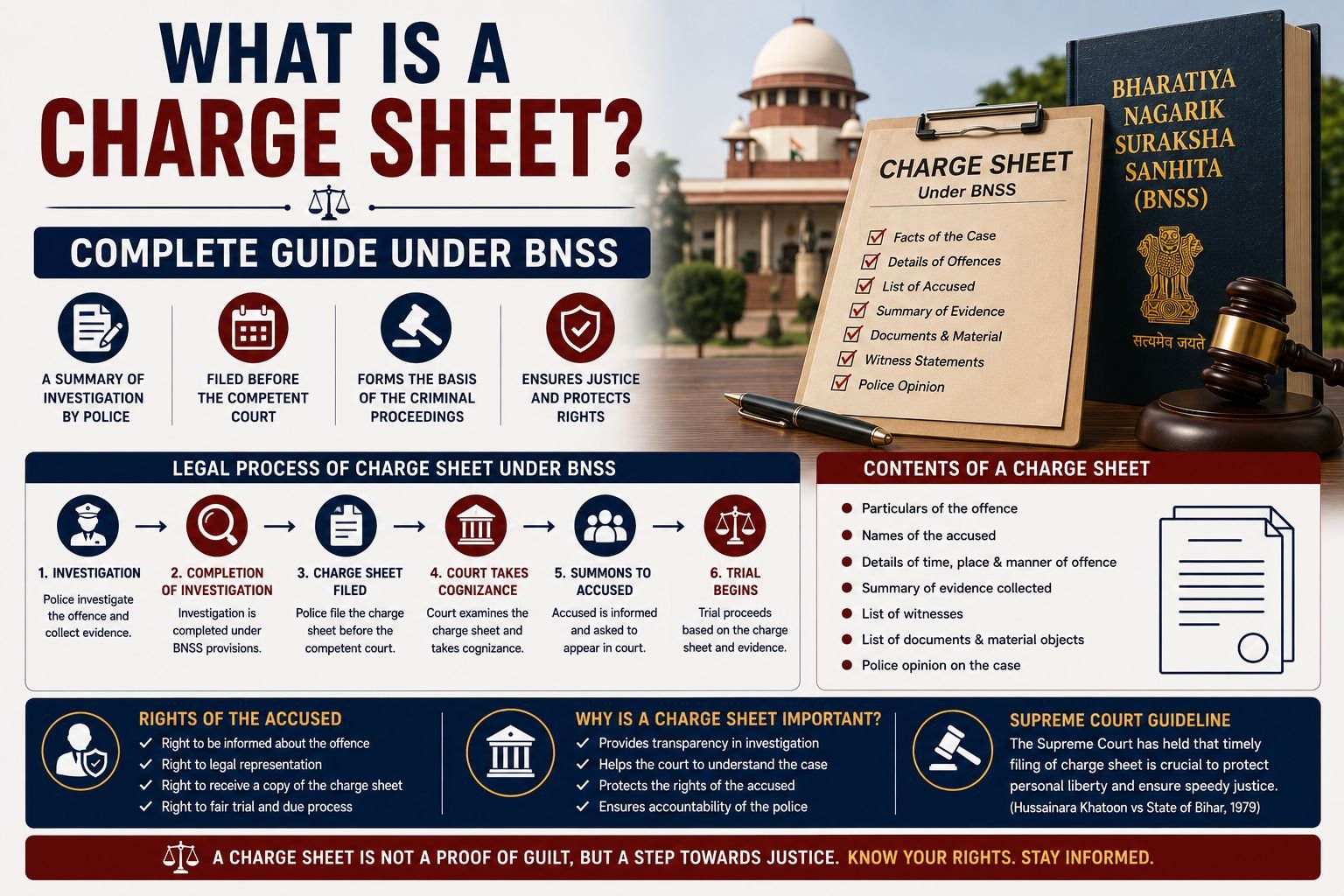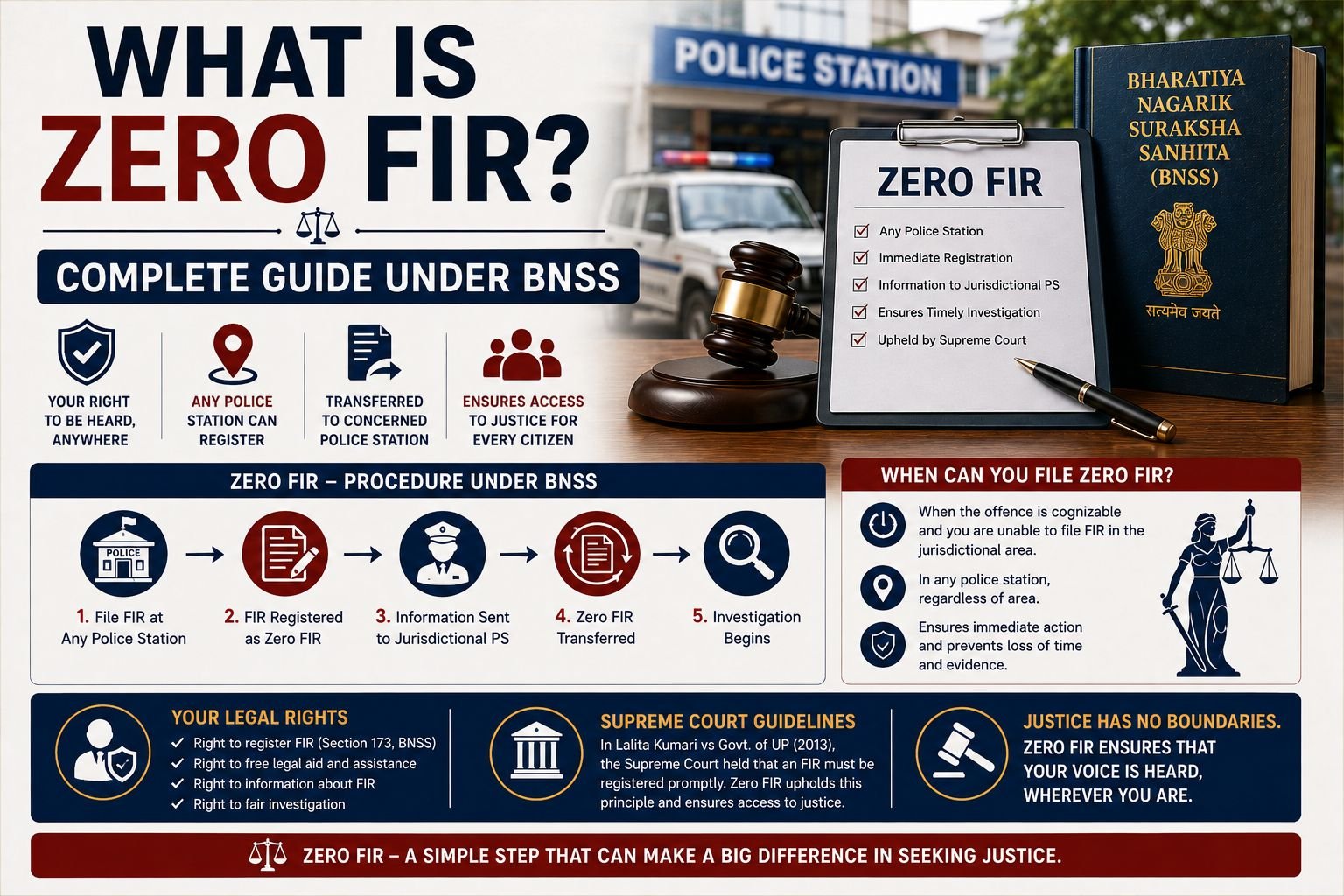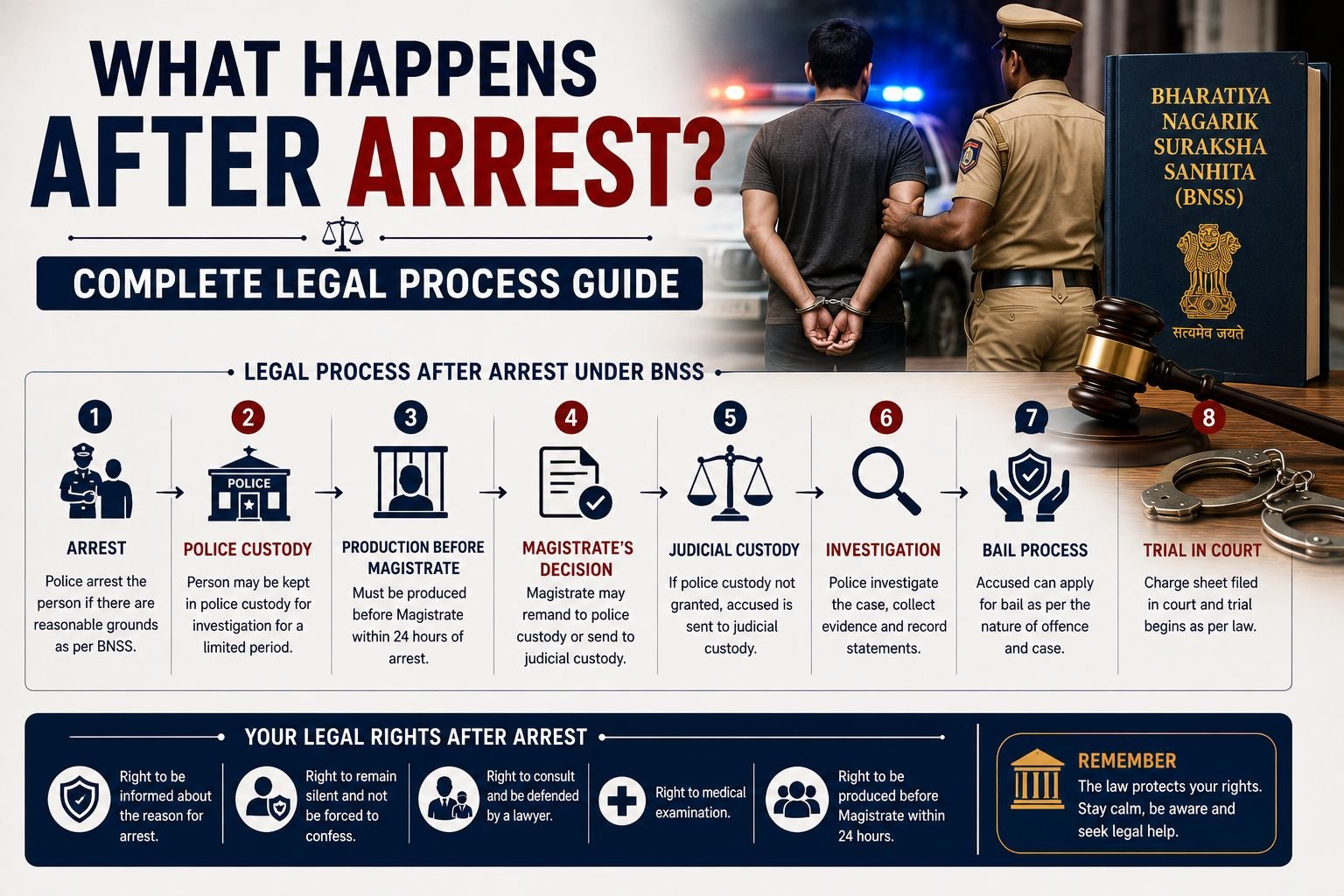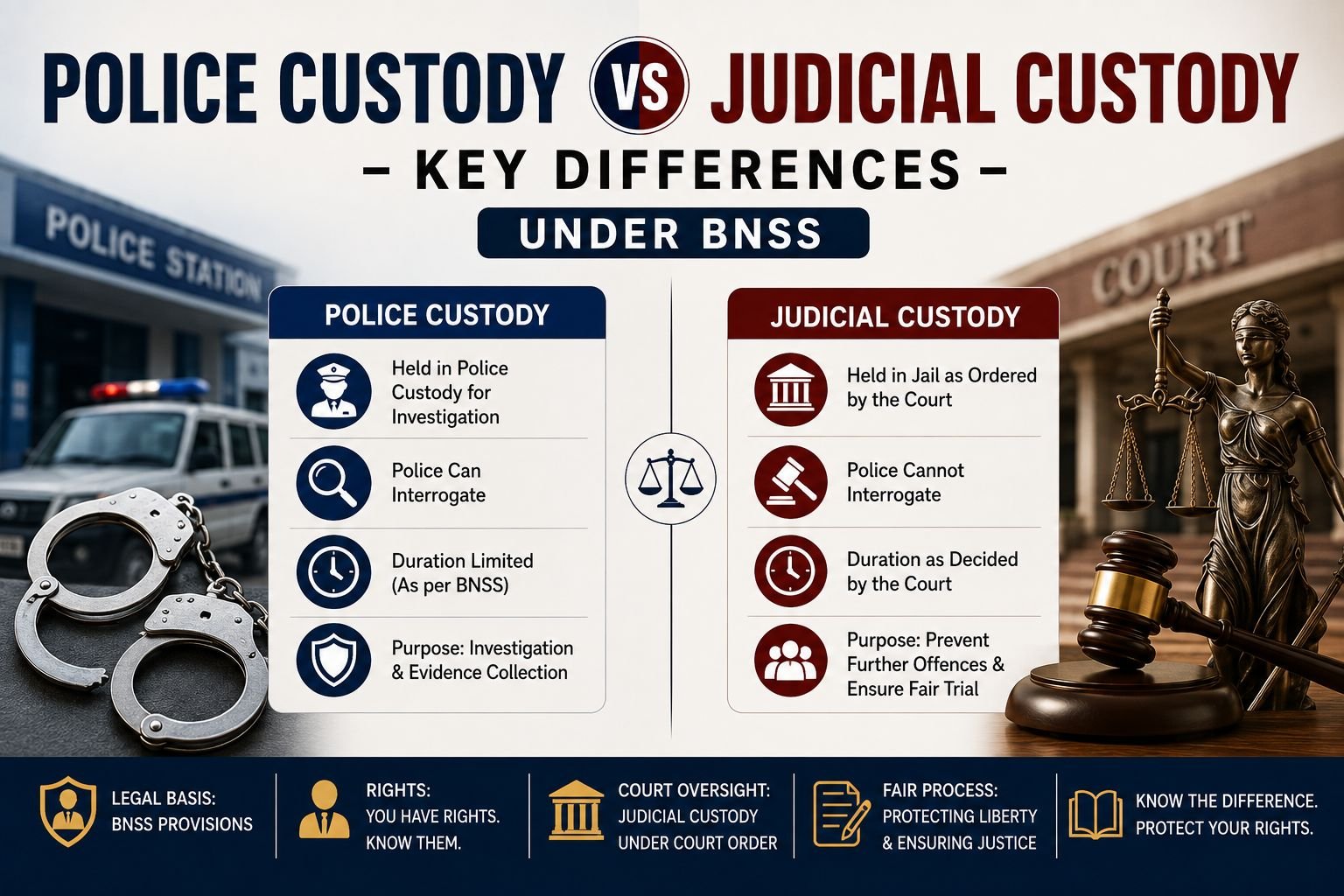

An arrest can be a frightening experience for the accused as well as their family members. However, it is important to understand that an arrest does not mean that a person is guilty of a crime. Every individual arrested in India is protected by the Constitution of India, the Bharatiya Nagarik Suraksha Sanhita, 2023 (BNSS), and various landmark judgments of the Supreme Court. These laws ensure that the police cannot misuse their powers and that every arrested person is treated fairly and with dignity.
The criminal justice system is based on the principle of “innocent until proven guilty.” Therefore, even after an arrest, an accused person continues to enjoy several legal and constitutional rights. These rights protect individuals against illegal detention, custodial violence, forced confessions, and arbitrary police action.
In this guide, you will learn about the rights of an arrested person in India, the legal procedure after arrest, important constitutional safeguards, Supreme Court guidelines, and the remedies available if these rights are violated.
Why Are the Rights of an Arrested Person Important?
The purpose of granting legal rights to an arrested person is to ensure that investigations are conducted fairly while protecting individual liberty. The Constitution guarantees that no person shall be deprived of life or personal liberty except according to the procedure established by law.
These safeguards help:
- Prevent illegal arrests.
- Protect against custodial torture.
- Ensure transparency in police investigations.
- Provide access to legal representation.
- Prevent abuse of police powers.
- Promote a fair criminal justice system.
Every police officer is legally required to respect these rights while making an arrest and conducting an investigation.
Right to Be Informed of the Grounds of Arrest
One of the most fundamental rights of an arrested person is the right to know why they have been arrested.
The police must clearly inform the arrested person about the offence for which they are being arrested. This information should be communicated in a language that the person understands, enabling them to prepare their legal defence.
If the arrest relates to a bailable offence, the accused should also be informed of their right to seek bail.
This safeguard ensures transparency and protects individuals from arbitrary or secret arrests.
Right to Be Produced Before a Magistrate Within 24 Hours
Under the BNSS, every arrested person must generally be produced before the nearest Magistrate within 24 hours of arrest, excluding the time necessary for travel.
The purpose of this requirement is to ensure judicial supervision over police action.
When the accused is produced before the Magistrate, the court examines:
- Whether the arrest was lawful.
- Whether police custody is necessary.
- Whether judicial custody should be ordered.
- Whether the accused should be released on bail, where permissible.
- Whether the rights of the accused have been respected.
The police cannot continue to detain a person beyond the legally permissible period without obtaining judicial authorization.
Right to Legal Representation
Every arrested person has the right to consult and be defended by a lawyer of their choice.
A criminal lawyer can:
- Explain the allegations.
- Advise the accused regarding their legal rights.
- Apply for bail.
- Challenge unlawful arrest or detention.
- Represent the accused before the Magistrate and higher courts.
- Ensure that the investigation follows due process.
If an accused person cannot afford legal representation, they may be entitled to free legal aid through the National Legal Services Authority (NALSA) or the relevant State Legal Services Authority, subject to eligibility.
Right to Inform a Family Member or Friend
An arrested person has the right to have a family member, relative, friend, or another nominated person informed about the arrest.
The police should:
- Record the name of the person informed.
- Mention the time of communication.
- Ensure that the information is conveyed promptly.
This safeguard helps prevent secret detention and enables family members to arrange legal assistance or other necessary support.
Right to an Arrest Memo
The police are required to prepare an arrest memo, which serves as an official record of the arrest.
The arrest memo generally contains:
- Name of the accused.
- Date and time of arrest.
- Place of arrest.
- Name and designation of the arresting officer.
- Details of witnesses to the arrest.
- Signature of the arrested person, where applicable.
The arrest memo promotes accountability and transparency in police procedures.
Right to Medical Examination
Medical examination is an important safeguard available to arrested persons.
A medical examination may be conducted:
- At the time of arrest.
- During custody where necessary.
- Before or after police custody in appropriate cases.
Medical examination helps:
- Record existing injuries.
- Detect injuries sustained during custody.
- Protect the health of the accused.
- Preserve medical evidence relevant to the investigation.
Authorities are responsible for ensuring that an arrested person receives necessary medical care while in custody.
Right Against Illegal Detention
No person can be detained arbitrarily or indefinitely.
The police must:
- Follow the procedure prescribed by the BNSS.
- Produce the accused before the Magistrate within the prescribed time.
- Obtain judicial authorization for continued detention.
If these legal requirements are violated, the accused may seek appropriate remedies before the competent court.
Right Against Custodial Torture and Inhuman Treatment
An arrested person has the right to be treated with dignity and humanity.
Police officers cannot:
- Torture the accused.
- Inflict physical or mental abuse.
- Force a confession through unlawful means.
- Use degrading or cruel treatment.
Custodial violence is prohibited by law, and allegations of such conduct may be investigated by the appropriate authorities.
Right Against Self-Incrimination
The Constitution protects an accused from being compelled to become a witness against themselves.
This means:
- The accused cannot be forced to confess.
- Statements obtained through coercion may not be legally admissible.
- The investigation must respect constitutional safeguards.
While the accused is expected to cooperate with lawful investigation, constitutional protections continue to apply.
Right to Apply for Bail
Depending on the nature of the offence, an arrested person may apply for bail.
The available forms of bail include:
- Regular Bail.
- Interim Bail.
- Default Bail.
- Anticipatory Bail (before arrest).
While deciding bail applications, courts generally consider:
- Nature of the offence.
- Seriousness of allegations.
- Possibility of absconding.
- Risk of influencing witnesses.
- Stage of investigation.
Bail decisions are made based on the facts and applicable law.
Rights During Police Custody
If the Magistrate grants police custody, the accused continues to enjoy legal protections.
These include:
- Right to legal representation.
- Protection against torture.
- Medical examination where required.
- Humane treatment.
- Judicial oversight.
- Production before the Magistrate whenever required.
Police custody does not suspend constitutional rights.
Rights During Judicial Custody
Judicial custody means the accused is detained in jail under the supervision of prison authorities.
During judicial custody, the accused generally has the right to:
- Meet legal counsel in accordance with applicable rules.
- Receive medical treatment.
- Meet family members, subject to prison regulations.
- Apply for bail.
- Be treated with dignity and humanity.
If the police require further interrogation, they must obtain permission from the court.
Important Supreme Court Judgments
D.K. Basu v. State of West Bengal (1997)
This landmark judgment established comprehensive guidelines regarding arrest and detention.
The Supreme Court directed that:
- Arrest memos should be prepared.
- Family members should be informed.
- Medical examinations should be conducted.
- Proper police records should be maintained.
These safeguards continue to play an important role in preventing custodial abuse.
Joginder Kumar v. State of Uttar Pradesh (1994)
The Court held that:
- Arrest should not be made routinely.
- Police must justify the necessity of arrest.
- Personal liberty is a valuable constitutional right.
The judgment emphasized responsible use of police powers.
Arnesh Kumar v. State of Bihar (2014)
The Supreme Court clarified that:
- Registration of an FIR does not automatically require arrest.
- Police officers must assess whether arrest is legally necessary.
- Personal liberty must be respected during criminal investigations.
This judgment significantly reduced unnecessary arrests in appropriate cases.
What Should You Do If Your Rights Are Violated?
If an arrested person’s legal rights are violated, they may:
- Inform their lawyer immediately.
- Raise the issue before the Magistrate.
- Approach the High Court or Supreme Court where appropriate.
- File complaints before the competent authorities.
- Seek compensation or other legal remedies in appropriate cases.
Prompt legal action can help protect constitutional rights and ensure accountability.
Frequently Asked Questions
Can police arrest a person without informing the reason?
No. The arrested person must be informed of the grounds of arrest.
Can an arrested person contact a lawyer?
Yes. Every arrested person has the right to consult and be defended by a lawyer.
Can family members be informed after an arrest?
Yes. The police should promptly inform a nominated relative, friend, or other authorized person.
Is medical examination compulsory?
Medical examination may be conducted where required by law or the circumstances of the case.
Does arrest mean conviction?
No. Every accused person is presumed innocent until proven guilty by a competent court.
Can an arrested person apply for bail?
Yes. Where legally permissible, the accused may apply for bail before the appropriate court.
Can police keep someone in custody indefinitely?
No. Continued detention requires judicial authorization in accordance with the BNSS.
Can the accused meet family members in judicial custody?
Yes, subject to prison rules and applicable legal procedures.
What if the police use force unlawfully?
The accused may seek appropriate legal remedies before the competent court and other authorities.
Can free legal aid be obtained?
Eligible persons may receive free legal aid through NALSA or the relevant State Legal Services Authority.
Conclusion
The rights of an arrested person in India are fundamental protections that uphold the rule of law and safeguard personal liberty. The Bharatiya Nagarik Suraksha Sanhita, 2023 (BNSS), constitutional guarantees, and landmark Supreme Court judgments ensure that every arrest is carried out according to due process and that individuals are protected against arbitrary detention, custodial violence, and abuse of authority.
Understanding these rights empowers citizens to respond appropriately if they or someone they know is arrested. From the right to know the grounds of arrest and consult a lawyer to the right to be produced before a Magistrate within the prescribed time, these safeguards help maintain fairness throughout the criminal justice process. If any of these rights are violated, seeking immediate advice from an experienced criminal lawyer is essential to protect legal interests and pursue the remedies available under the law.