When a person is arrested in connection with a criminal case, they may be placed either in police custody or judicial custody, depending on the stage of the investigation and the orders of the court. Although these terms are often used interchangeably, they have distinct legal meanings and consequences. Understanding the difference is essential for accused persons, victims, legal professionals, and anyone seeking to understand the criminal justice system in India.
The Bharatiya Nagarik Suraksha Sanhita, 2023 (BNSS), which replaced the Code of Criminal Procedure (CrPC), governs the procedure relating to arrest, custody, investigation, and production before a Magistrate. It also provides safeguards to ensure that an accused person’s constitutional and legal rights are protected during the investigation.
This guide explains the meaning of police custody and judicial custody, their key differences, duration, legal rights of the accused, important Supreme Court judgments, and answers to frequently asked questions.
What is Police Custody?
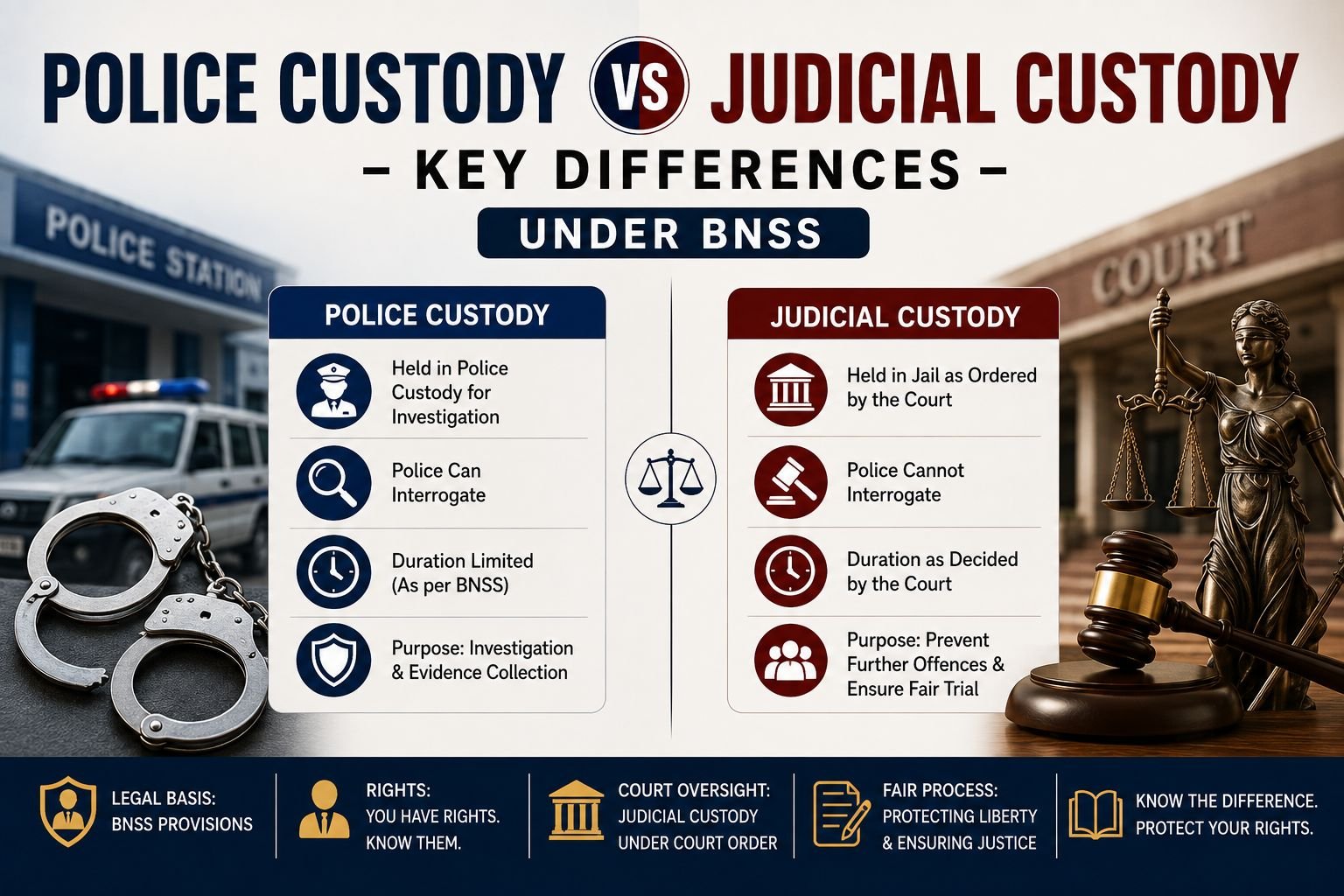
Police custody means that an arrested person is kept in the custody and control of the police for the purpose of investigation. During this period, the investigating agency may question the accused, collect evidence, recover stolen property, or verify facts connected with the case.
Police custody is not automatic. After an arrest, the accused must be produced before the nearest Magistrate within 24 hours, excluding the time required for travel, as required by law. If the police believe that custodial interrogation is necessary, they must seek permission from the Magistrate. The Magistrate examines the facts and decides whether police custody is justified.
Police custody is generally sought when investigators need to:
- Interrogate the accused.
- Recover incriminating material.
- Identify co-accused.
- Verify statements.
- Trace stolen property or weapons.
- Gather additional evidence.
Even while in police custody, the accused retains important constitutional and statutory rights, including the right to legal representation and protection against unlawful treatment.
What is Judicial Custody?
Judicial custody means that an accused person is detained under the orders of a court and kept in a jail or other authorised correctional facility under the supervision of prison authorities, not the police.
In judicial custody, the police do not have unrestricted access to the accused for interrogation. If further questioning is required, the investigating agency must obtain permission from the court.
Judicial custody is generally ordered when:
- Police custody is not necessary.
- The period of police custody has ended.
- The investigation is continuing.
- The accused is remanded pending trial.
- Bail has been refused or not granted.
Unlike police custody, the primary purpose of judicial custody is to ensure the presence of the accused during investigation or trial while safeguarding their rights under judicial supervision.
Police Custody vs Judicial Custody – Key Differences
The following table highlights the major distinctions between police custody and judicial custody.
| Basis | Police Custody | Judicial Custody |
|---|---|---|
| Meaning | Custody under the control of the police | Custody under the supervision of the court |
| Authority | Police, with the Magistrate’s permission | Magistrate orders detention in jail |
| Place of Detention | Police station or authorised lock-up | Jail or correctional facility |
| Purpose | Investigation and interrogation | Safe detention during investigation or trial |
| Control Over Accused | Police authorities | Prison authorities |
| Interrogation | Police may interrogate the accused | Police require court permission for further interrogation |
| Duration | Limited period as permitted by law | May continue as authorised by the court |
| Investigation | Active investigation is carried out | Investigation may continue, but the accused remains in jail |
| Bail | Bail may be sought where legally permissible | Bail may also be sought during judicial custody |
| Court Supervision | Closely monitored by the Magistrate | Continues under judicial supervision |
Duration of Police and Judicial Custody Under BNSS
The BNSS lays down safeguards regarding custody to prevent arbitrary detention.
After arrest:
- The accused must generally be produced before the Magistrate within 24 hours, excluding travel time.
- Police custody can only be granted by the Magistrate after considering the facts of the case and the requirements of the investigation.
- Judicial custody may continue for such period as authorised by the court in accordance with the BNSS and other applicable laws.
Every extension of custody is subject to judicial scrutiny, ensuring that the investigating agency acts lawfully and that the rights of the accused are protected.
Rights of an Accused During Custody
Whether a person is in police custody or judicial custody, they continue to enjoy important constitutional and legal protections.
These include:
Right to Know the Grounds of Arrest
The arrested person must be informed of the reasons for their arrest.
Right to Legal Representation
An accused has the right to consult and be defended by a lawyer of their choice.
Protection Against Torture
The police cannot subject an accused to torture, coercion, or inhuman treatment. Confessions obtained through unlawful methods may not be legally admissible.
Medical Examination
Medical examination may be conducted where required by law, helping ensure the health and safety of the accused and documenting any injuries.
Production Before a Magistrate
No person can be detained in police custody beyond the legally permitted period without being produced before a Magistrate.
Right to Inform Family
The arrested person is generally entitled to have a relative, friend, or another nominated person informed about the arrest, subject to applicable legal procedures.
Can Police Interrogate a Person in Judicial Custody?
Yes, but not as a matter of right.
If the police wish to question an accused who is already in judicial custody, they must obtain the permission of the competent court. The court considers whether such interrogation is necessary and whether appropriate safeguards are in place.
Can Bail Be Granted During Custody?
Yes. Being in police custody or judicial custody does not automatically prevent an accused from applying for bail.
The court considers factors such as:
- Nature and gravity of the offence.
- Applicable legal provisions.
- Risk of absconding.
- Possibility of tampering with evidence.
- Likelihood of influencing witnesses.
The grant or refusal of bail depends on the facts of each case and the relevant provisions of law.
Important Supreme Court Judgments
D.K. Basu v. State of West Bengal (1997)
This landmark judgment laid down important safeguards to prevent custodial abuse.
The Court directed that:
- Arrest procedures should be transparent.
- Arrest memos should be prepared.
- Family members should be informed.
- Medical examinations should be conducted where required.
These guidelines continue to protect the rights of arrested persons.
Joginder Kumar v. State of Uttar Pradesh (1994)
The Supreme Court held that:
- Arrest should not be made routinely.
- Police must have valid reasons for arrest.
- Personal liberty is a fundamental constitutional value.
The judgment emphasised that the power to arrest must be exercised responsibly.
Arnesh Kumar v. State of Bihar (2014)
The Court clarified that arrest is not mandatory in every criminal case merely because an FIR has been registered.
Police must consider:
- Necessity of arrest.
- Nature of the allegations.
- Statutory safeguards.
This judgment aims to prevent unnecessary arrests and protect individual liberty.
Common Misconceptions
Myth 1: Police Custody Means the Person Is Guilty
Reality: Custody is only part of the investigation process. Guilt can be determined only after a fair trial.
Myth 2: Judicial Custody Is a Punishment
Reality: Judicial custody is preventive detention authorised by the court and is not the same as a sentence imposed after conviction.
Myth 3: Police Can Keep an Accused Indefinitely
Reality: Police custody is subject to statutory limits and judicial oversight. The accused must be produced before the Magistrate within the time prescribed by law.
Myth 4: A Lawyer Cannot Meet an Accused During Police Custody
Reality: An accused has the right to legal representation, though meetings may be regulated in accordance with law and court directions.
Frequently Asked Questions
1. What is the main difference between police custody and judicial custody?
Police custody places the accused under the control of the police for investigation, whereas judicial custody places the accused in jail under the supervision of prison authorities pursuant to a court order.
2. Who decides whether a person should be sent to police custody?
Only a Magistrate can authorise police custody after considering the request made by the investigating agency.
3. Can police question an accused during judicial custody?
Yes, but only with the permission of the court.
4. Is judicial custody the same as imprisonment after conviction?
No. Judicial custody is a form of detention during investigation or trial and is different from a sentence imposed after conviction.
5. Can bail be granted during judicial custody?
Yes. If the law permits and the court is satisfied, bail may be granted.
6. Can police custody be extended?
Police custody can be granted only in accordance with the limits and conditions prescribed under the BNSS and subject to the Magistrate’s approval.
7. Can an accused meet family members during custody?
Meetings are generally governed by applicable prison rules, court orders, and legal procedures.
8. What happens after police custody ends?
The accused may be released on bail if granted, remanded to judicial custody, or dealt with in accordance with the orders of the competent court.
9. Can custody orders be challenged?
Yes. Appropriate legal remedies may be available before the competent court depending on the facts and circumstances of the case.
10. Is a lawyer necessary during custody proceedings?
While it is not mandatory to engage a particular lawyer, legal representation is an important constitutional right and is strongly advisable.
Conclusion
Understanding the distinction between police custody and judicial custody is essential for anyone involved in a criminal case. Police custody is primarily intended to facilitate investigation and interrogation under the supervision of the Magistrate, whereas judicial custody ensures that the accused remains under court-authorised detention in a jail while the investigation or trial continues.
The BNSS incorporates procedural safeguards to protect the rights of arrested persons and to ensure that custody is not misused. Judicial oversight, the right to legal representation, protection against unlawful detention, and the requirement to produce an accused before a Magistrate are all fundamental safeguards within India’s criminal justice system.
If you or someone you know has been arrested or remanded to custody, it is advisable to consult an experienced criminal lawyer to understand the applicable legal provisions, available remedies, and the appropriate course of action based on the facts of the case.