After filing a First Information Report (FIR), many people want to know what happens next. Questions such as “Has the police started the investigation?”, “Has the accused been arrested?”, “Has a charge sheet been filed?”, or “Can I check my FIR status online?” are common among victims, complainants, and their families.
With the increasing digitization of police services under the Crime and Criminal Tracking Network & Systems (CCTNS) and various State Police portals, it has become easier in many parts of India to track the status of an FIR online. However, the availability of online FIR status depends on the State, the type of offence, and the information that can legally be disclosed.
Under the Bharatiya Nagarik Suraksha Sanhita, 2023 (BNSS), police investigations are governed by procedural safeguards that ensure both transparency and the protection of individual rights. While not every investigation update may be publicly accessible, citizens can often obtain basic information regarding the progress of their FIR through official channels.
This guide explains how to check FIR status online, the information required, official methods for tracking FIRs, common issues faced by users, and the legal remedies available if investigation updates are delayed.
In this article, you will learn:
- What is FIR status?
- Can FIR status be checked online?
- Who can check FIR status?
- Information required for tracking.
- Difference between FIR status and case status.
- Online and offline methods of checking FIR status.
- Legal rights of victims.
- Frequently asked questions.
What is FIR Status?
FIR status refers to the current stage of a First Information Report after it has been registered by the police.
The status may indicate:
- Whether the FIR has been registered.
- Which police station is handling the case.
- Whether the investigation has commenced.
- Whether the case has been transferred.
- Whether a charge sheet has been filed.
- Whether the investigation is still pending.
- Whether the case has been closed, where applicable.
The exact details available online vary depending on the State Police system and applicable legal restrictions.
Why Checking FIR Status is Important
Tracking the status of an FIR helps complainants remain informed about the progress of their case.
Some important reasons include:
1. Monitoring the Investigation
It helps victims know whether the police have initiated and are continuing the investigation.
2. Following Important Developments
Status updates may indicate major developments such as:
- Assignment of an investigating officer.
- Transfer of the case.
- Filing of a charge sheet.
- Completion of investigation.
3. Ensuring Transparency
Online tracking systems promote transparency and improve public confidence in the criminal justice process.
4. Saving Time
Instead of making repeated visits to the police station, complainants may be able to access basic information through official online portals.
5. Protecting Legal Rights
Knowing the progress of the investigation enables victims to seek appropriate legal remedies if there is an unreasonable delay.
Can FIR Status Be Checked Online?
Yes, in many States and Union Territories, FIR status can be checked online through official police websites or digital platforms.
Depending on the State, online services may allow users to:
- Verify FIR registration.
- View basic FIR details.
- Check investigation status.
- Track case progress.
- Download certain public documents, where permitted.
- Access related police services.
However, sensitive information relating to ongoing investigations may not be publicly available.
Legal Framework Under BNSS
The Bharatiya Nagarik Suraksha Sanhita, 2023 (BNSS) governs criminal procedure in India, including:
- Registration of FIRs.
- Police investigations.
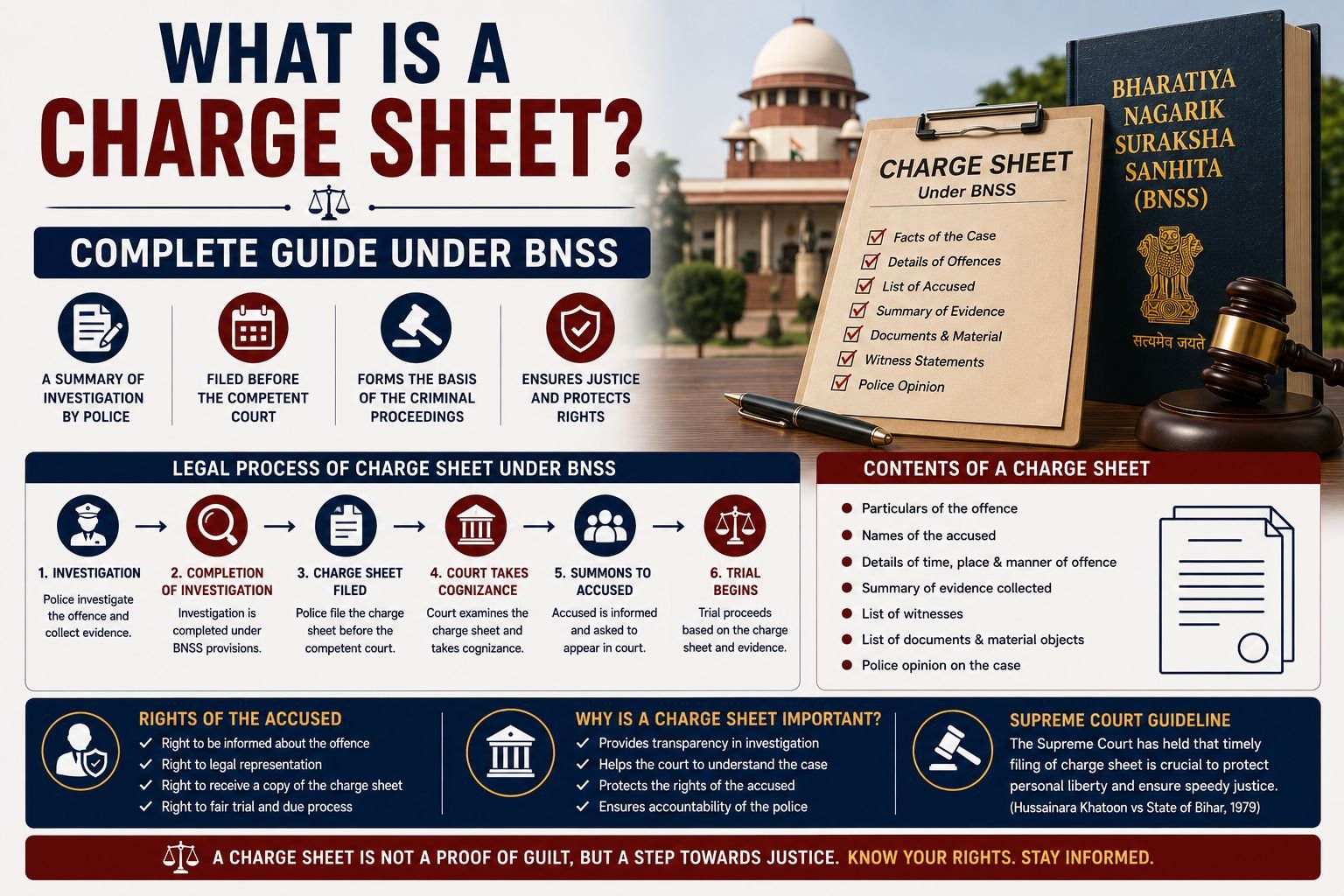
- Filing of charge sheets.
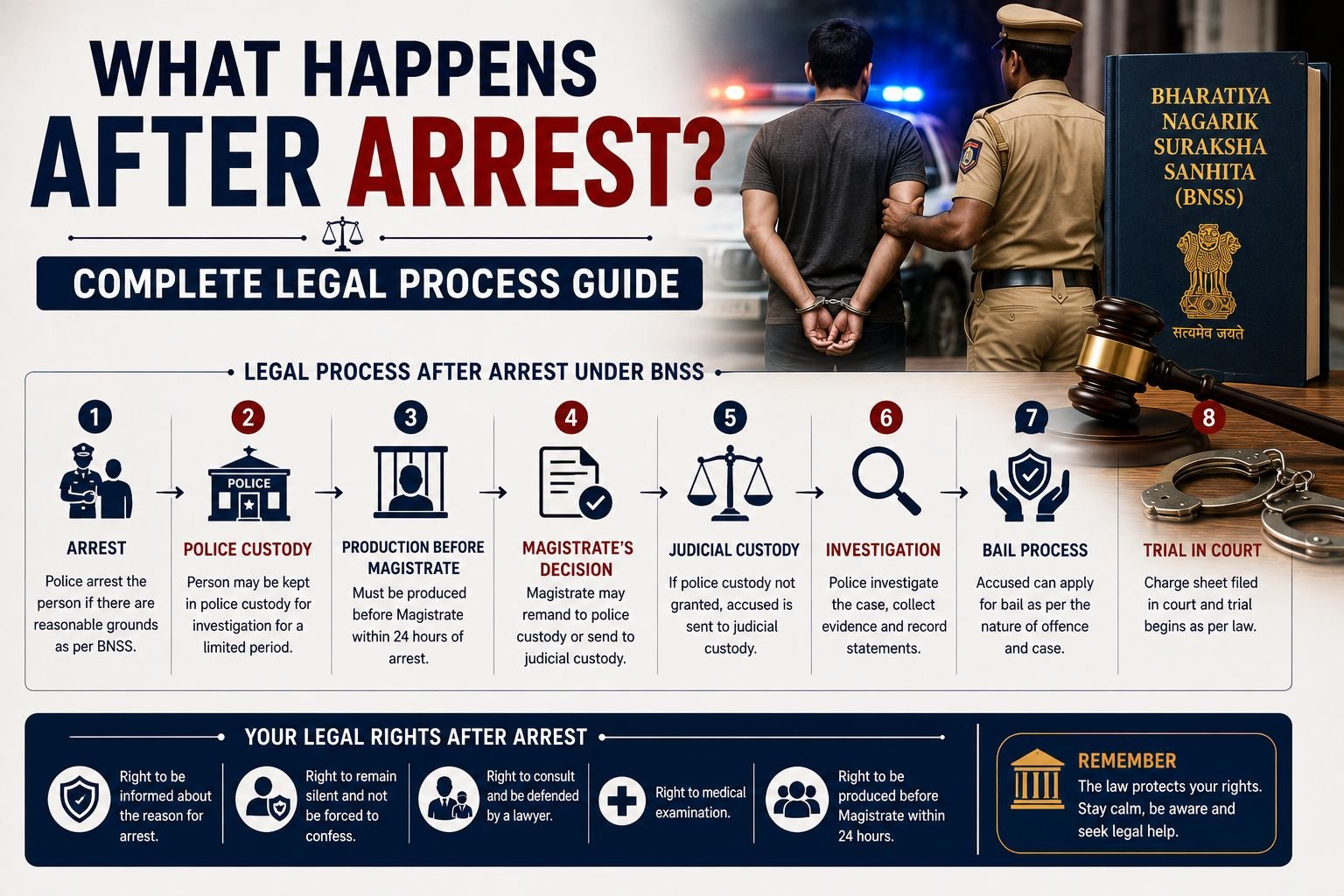
- Arrest procedures.
- Search and seizure.
- Criminal trials.
While the BNSS provides the legal framework for investigations, the publication and online availability of FIR information are also governed by administrative rules, privacy considerations, and State Police policies.
Who Can Check FIR Status?
Generally, FIR status may be checked by:
- The informant.
- The victim.
- An authorised representative.
- A legal guardian, where applicable.
- An advocate representing the concerned party.
Some information may also be available to the general public depending on the policies of the respective State Police.
However, access to detailed investigation records is usually restricted to protect the integrity of the investigation.
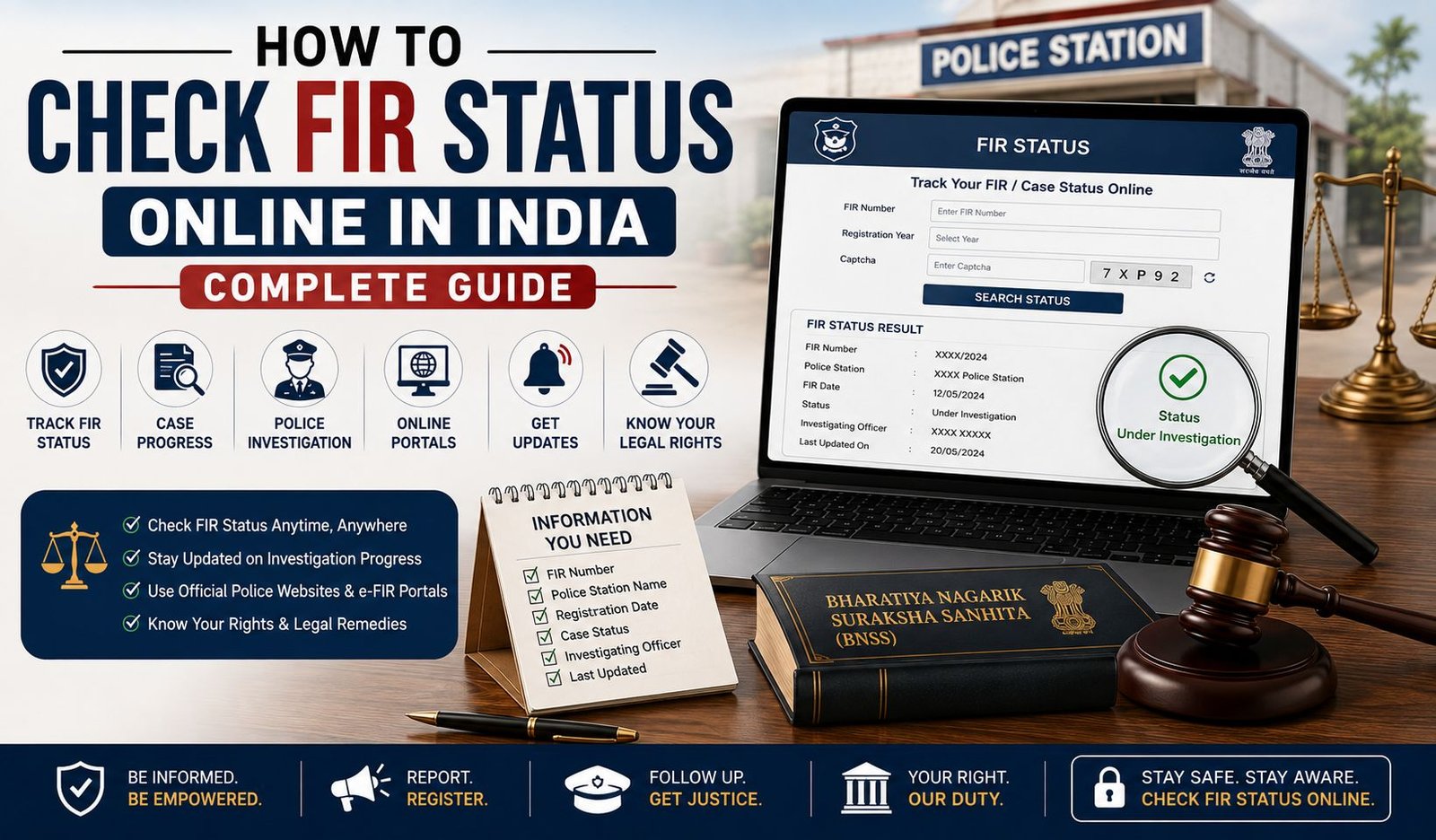
Information Required to Check FIR Status
To check an FIR status online, you may need one or more of the following details:
- FIR Number.
- Police Station Name.
- State or Union Territory.
- District.
- Year of Registration.
- Date of FIR.
- Name of the complainant (where required).
- Mobile number or registered credentials (if applicable).
The exact requirements vary depending on the State Police portal.
Understanding the FIR Number
Every registered FIR is assigned a unique identification number.
An FIR number generally consists of:
- Serial number.
- Year of registration.
- Police station details.
For example:
FIR No. 145/2026
This number is one of the most important details required for tracking the status of an FIR.
Always preserve your copy of the FIR, as it contains this information.
Difference Between FIR Status and Case Status
Many people mistakenly believe that FIR status and court case status are the same.
They are different.
| FIR Status | Court Case Status |
|---|---|
| Maintained by the Police | Maintained by the Court |
| Relates to Investigation | Relates to Judicial Proceedings |
| Begins After FIR Registration | Begins After Filing of Charge Sheet or Complaint |
| Shows Investigation Progress | Shows Court Hearings and Orders |
| Updated by Police Authorities | Updated by Court Authorities |
Understanding this distinction helps avoid confusion while tracking criminal proceedings.
Benefits of Checking FIR Status Online
Online tracking offers several advantages.
Convenience
Citizens can access information without repeatedly visiting the police station.
Faster Access
Basic case details may be available within minutes.
Better Transparency
Online systems reduce uncertainty by allowing complainants to monitor important developments.
Reduced Paperwork
Many services can be accessed electronically, reducing the need for physical applications.
Improved Communication
Some portals provide contact information for the investigating officer or police station.
Limitations of Online FIR Status
Although online services are useful, they also have limitations.
For example:
- Not all States provide identical services.
- Some FIRs may not appear online immediately.
- Sensitive investigation details are generally withheld.
- Certain offences may have restricted public access.
- Technical issues may delay updates.
Therefore, online information should be viewed as a supplementary source rather than a complete investigation record.
Common Terms Used While Checking FIR Status
Understanding common terminology makes tracking easier.
Registered
The FIR has been officially recorded by the police.
Under Investigation
The police are collecting evidence, recording statements, and examining the facts.
Charge Sheet Filed
The investigation has been completed, and the police have filed a charge sheet before the competent court.
Closure Report Submitted
The investigating agency has concluded that sufficient evidence is unavailable and has submitted a closure report before the court.
Pending Investigation
The investigation is still in progress.
Transferred
The FIR has been transferred to another police station or investigating agency having jurisdiction.
Who Maintains Online FIR Records?
Depending on the State, online FIR information may be maintained by:
- State Police Departments.
- Crime and Criminal Tracking Network & Systems (CCTNS).
- Commissionerate Police.
- Cyber Crime Units.
- Special Investigation Units.
Different States may have different online systems and procedures.
Can Every FIR Be Viewed Online?
No.
Certain FIRs may not be publicly accessible due to:
- National security concerns.
- Protection of victims.
- Juvenile justice laws.
- Sexual offence cases.
- Ongoing sensitive investigations.
- Court directions restricting disclosure.
Access to detailed records is subject to applicable laws and official policies.
Common Misconceptions
Myth 1: Every FIR Is Available Online
Reality: Many FIRs are available through official portals, but access depends on the State, the nature of the offence, and applicable legal restrictions.
Myth 2: FIR Status Shows Every Investigation Detail
Reality: Online portals generally display only limited information. Confidential investigative material is usually not disclosed publicly.
Myth 3: FIR Status and Court Case Status Are the Same
Reality: FIR status relates to the police investigation, whereas court case status relates to judicial proceedings after the matter reaches the court.
Practical Tips Before Checking FIR Status
Before accessing an online portal:
- Keep your FIR number ready.
- Verify the police station name.
- Check the correct State Police website.
- Preserve your FIR copy.
- Avoid using unofficial websites claiming to provide FIR details.
- Keep your registration year and district information available.
Using official sources helps ensure that the information is authentic and up to date.
Overview Table
| Particular | Details |
|---|---|
| Focus Topic | How to Check FIR Status Online |
| Governed By | Bharatiya Nagarik Suraksha Sanhita, 2023 (BNSS) |
| Status Available Through | State Police Portals, CCTNS (where applicable) |
| Information Required | FIR Number, Police Station, Year, District |
| Investigation Status | Available subject to State policies |
| Court Case Status | Checked separately through court portals |
| Cost | Generally free through official platforms |
Step-by-Step Process to Check FIR Status Online
Checking your FIR status online is simple if your State Police department provides this facility. The exact interface may differ from one State to another, but the overall process is generally similar.
Step 1 – Keep Your FIR Details Ready
Before visiting an official portal, keep the following information available:
- FIR Number
- Year of FIR registration
- Name of the Police Station
- District
- State or Union Territory
- Name of the complainant (if required)
- Registered mobile number (where applicable)
Having accurate information helps you locate your FIR quickly.
Step 2 – Visit the Official State Police Website
Most State Police departments provide online citizen services through their official websites.
These portals may allow you to:
- Search FIR details.
- Check FIR status.
- View investigation progress (where permitted).
- Download acknowledgements.
- Access other police services.
Always ensure you are using the official State Police website and not an unofficial third-party platform.
Step 3 – Navigate to Citizen Services
After opening the website, look for sections such as:
- Citizen Services
- Online Services
- FIR Services
- e-FIR
- Crime Services
- FIR Status
- Complaint Status
The names may vary depending on the State.
Step 4 – Enter the Required Details
You may be asked to enter one or more of the following:
- FIR Number
- Registration Year
- Police Station
- District
- Captcha Code
- Mobile Number (if applicable)
Ensure all information is entered correctly to avoid search errors.
Step 5 – View FIR Status
If the FIR is available online, the portal may display information such as:
- FIR Number
- Date of Registration
- Police Station Name
- Nature of the Offence
- Current Investigation Status
- Investigating Officer (where permitted)
- Next Stage of Investigation
The amount of information displayed varies according to State Police policies.
Crime and Criminal Tracking Network & Systems (CCTNS)
The Crime and Criminal Tracking Network & Systems (CCTNS) is a nationwide project that connects police stations across India through a digital platform.
Its objectives include:
- Modernising police records.
- Improving criminal investigation.
- Facilitating digital police services.
- Enhancing transparency.
- Enabling better information sharing between police agencies.
Several State Police portals are integrated with the CCTNS infrastructure.
Can You Check FIR Status Through CCTNS?
Depending on the State and the services offered, CCTNS-enabled portals may allow citizens to:
- Verify FIR registration.
- View basic FIR details.
- Track complaint status.
- Access citizen services.
- Obtain certain public records.
Not every State offers identical online facilities.
e-FIR Portals
Some States provide e-FIR facilities for specific categories of offences.
Common examples include:
- Vehicle theft.
- Mobile phone theft.
- Lost documents.
- Certain cyber offences.
Where available, citizens may also track the progress of their e-FIR through the same portal.
Mobile Applications
Several State Police departments provide official mobile applications for citizen services.
Depending on the State, these apps may offer:
- FIR status tracking.
- Complaint registration.
- Emergency contacts.
- Police station locator.
- Verification services.
- Complaint history.
Always download applications published by the respective State Police department.
Can FIR Status Be Checked Without an FIR Number?
Checking FIR status without the FIR number may be difficult.
However, some portals may allow searches using:
- Police Station.
- Date of registration.
- Complaint reference number.
- Registered mobile number.
- Other identification details.
The availability of such options varies by State.
Offline Methods to Check FIR Status
If online tracking is unavailable or incomplete, you may obtain information through offline methods.
Visit the Police Station
The simplest method is to visit the police station where the FIR was registered.
Carry:
- FIR copy.
- Identity proof.
- Any acknowledgement receipts.
- Relevant documents.
The investigating officer or police staff may provide updates permitted under the law.
Contact the Investigating Officer
If you know the name or contact details of the Investigating Officer (IO), you may contact them to enquire about:
- Investigation progress.
- Collection of evidence.
- Recording of witness statements.
- Filing of the charge sheet.
- Further requirements.
Maintain polite and professional communication.
Written Application
Where necessary, you may submit a written application requesting an update regarding the investigation.
Include:
- FIR Number.
- Police Station.
- Your contact details.
- Reason for seeking information.
Keep a copy of the application for your records.
Checking Court Case Status
Once the police file a charge sheet before the court, you can also monitor the judicial proceedings separately through the eCourts portal.
Court case status generally includes:
- Next hearing date.
- Court orders.
- Case stage.
- Parties involved.
- Final judgment (when delivered).
Remember that court case status is different from FIR status.
Common Reasons Why FIR Status Is Not Available Online
Sometimes, an FIR may not appear on the online portal.
Possible reasons include:
- The FIR has been registered recently.
- The portal has not yet been updated.
- Technical issues.
- Incorrect FIR number entered.
- Restricted access due to the nature of the offence.
- Investigation involves confidential information.
- State Police portal does not provide online FIR tracking.
If the issue continues, contact the concerned police station.
Information That May Not Be Available Online
For security and privacy reasons, online portals generally do not display:
- Witness statements.
- Sensitive investigation records.
- Confidential evidence.
- Personal details of protected witnesses.
- Internal police communications.
- Certain forensic reports.
These restrictions help maintain the integrity of the investigation.
Practical Examples
Example 1 – Theft Case
A person’s motorcycle is stolen.
After filing the FIR, the owner:
- Notes the FIR number.
- Visits the State Police website.
- Enters the FIR details.
- Checks whether the investigation is in progress.
Example 2 – Cyber Fraud
A victim reports an online banking fraud.
The victim:
- Files the complaint.
- Receives the FIR number.
- Uses the cybercrime or State Police portal to monitor updates.
- Contacts the Investigating Officer when necessary.
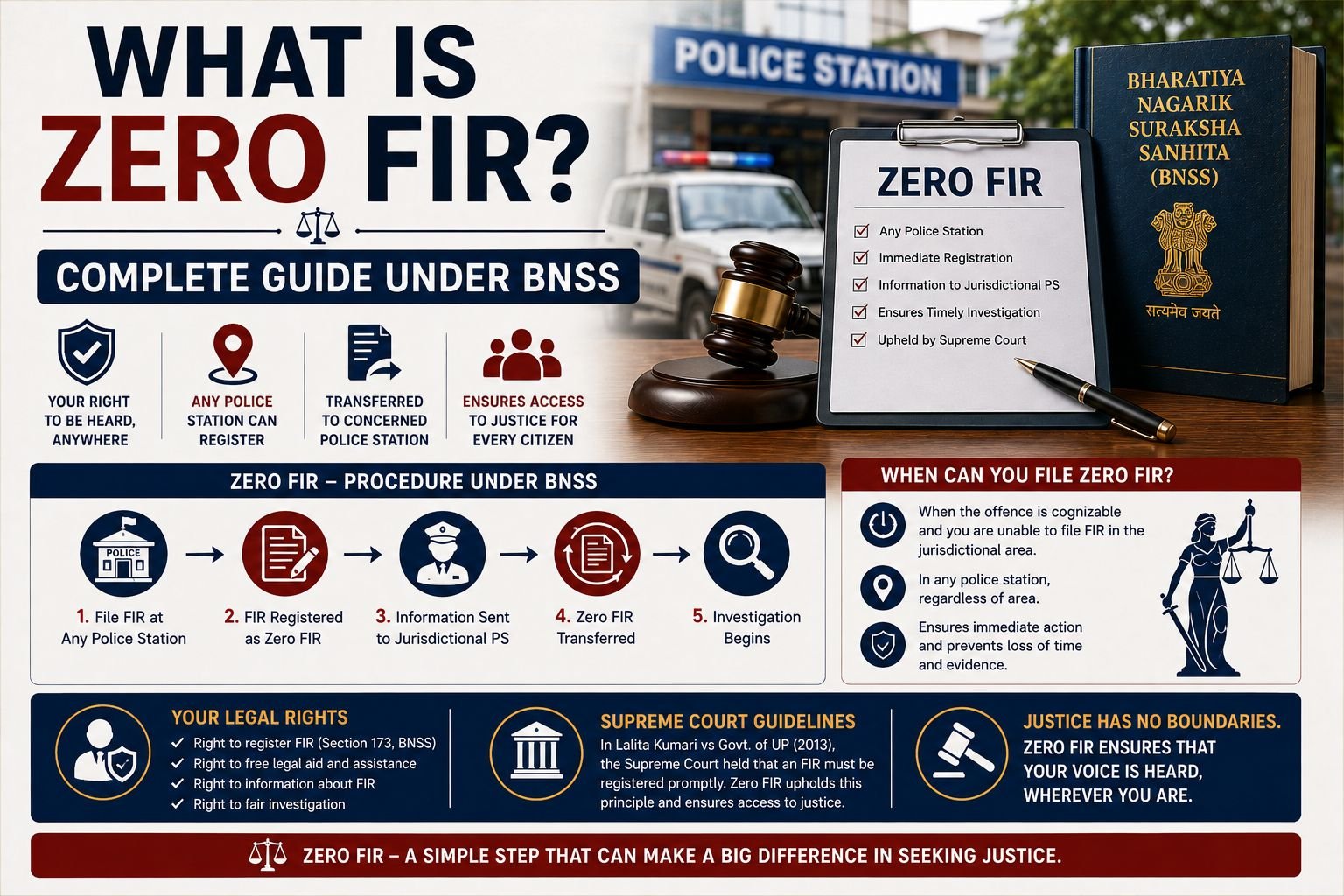
Example 3 – Zero FIR
A traveller files a Zero FIR at a nearby police station.
The complainant later checks whether:
- The FIR has been transferred.
- The jurisdictional police station has begun the investigation.
Common Mistakes While Checking FIR Status
Avoid the following mistakes:
- Entering an incorrect FIR number.
- Using unofficial websites.
- Confusing FIR status with court case status.
- Expecting confidential investigation details online.
- Ignoring updates from the Investigating Officer.
- Sharing FIR details publicly on social media.
Protect sensitive information related to your case.
Important Precautions
While checking your FIR status online:
- Use only official government websites.
- Verify the website address before entering details.
- Do not share OTPs or personal credentials.
- Keep a copy of your FIR safely.
- Preserve login details, if any.
- Beware of fraudulent websites claiming to provide police records.
Cybersecurity is equally important when accessing digital public services.
Tips for Faster FIR Tracking
To make the process easier:
- Save the FIR number immediately after registration.
- Keep the registration year noted.
- Verify the correct police station name.
- Use the official State Police portal.
- Follow up periodically rather than checking excessively.
- Contact the Investigating Officer if updates are unavailable for an extended period.
What Happens After an FIR Is Registered?
Once an FIR is registered, the police begin the criminal investigation in accordance with the Bharatiya Nagarik Suraksha Sanhita, 2023 (BNSS).
The purpose of the investigation is to:
- Verify the allegations.
- Collect evidence.
- Identify the accused.
- Record witness statements.
- Determine whether sufficient evidence exists for prosecution.
The registration of an FIR does not mean that the accused is guilty. It only marks the beginning of the investigation.
Stages of Police Investigation
Every criminal case may differ, but most investigations follow these stages.
1. Assignment of the Investigating Officer (IO)
After the FIR is registered, a police officer is assigned to investigate the case.
The Investigating Officer is responsible for:
- Examining the facts.
- Collecting evidence.
- Questioning witnesses.
- Preparing reports.
- Filing the final report before the court.
2. Crime Scene Inspection
If required, the Investigating Officer visits the place where the offence occurred.
The officer may:
- Examine the crime scene.
- Take photographs.
- Prepare a site plan.
- Collect physical evidence.
- Identify potential witnesses.
Prompt inspection helps preserve crucial evidence.
3. Collection of Evidence
The police gather all relevant evidence, including:
- Documents.
- CCTV footage.
- Mobile phone records.
- Emails.
- WhatsApp messages.
- Bank transaction details.
- DNA samples.
- Fingerprints.
- Weapons.
- Digital devices.
Scientific and electronic evidence has become increasingly important in modern investigations.
4. Recording Witness Statements
The Investigating Officer records statements of:
- Victims.
- Eye-witnesses.
- Experts.
- Family members.
- Other persons having knowledge of the incident.
These statements help establish the sequence of events.
5. Examination of Suspects
If necessary, the police may question the accused or other suspects.
The questioning must comply with the BNSS and constitutional safeguards.
The accused has important legal rights, including:
- Right to legal representation.
- Protection against unlawful detention.
- Right to be informed of the grounds of arrest.
Common FIR Status Updates Explained
While checking your FIR status online, you may come across different status messages.
Understanding these terms helps you know what stage your case has reached.
FIR Registered
This means:
- The police have officially recorded your FIR.
- The investigation process has begun.
- The FIR has been assigned a unique number.
This is the first stage of every criminal investigation.
Under Investigation
This is one of the most common FIR statuses.
It means the police are actively:
- Collecting evidence.
- Recording statements.
- Conducting searches.
- Examining suspects.
- Preparing investigation reports.
The duration of this stage depends on the complexity of the case.
Evidence Being Collected
Some online systems may indicate that evidence collection is ongoing.
This may include:
- Forensic examination.
- CCTV analysis.
- Mobile phone data analysis.
- Financial investigation.
- Medical reports.
Arrest Made
If the police arrest an accused person in accordance with the law, some systems may indicate that an arrest has been made.
However, many investigation details remain confidential and may not appear online.
Charge Sheet Filed
A charge sheet is filed when the police conclude that sufficient evidence exists against the accused.
The charge sheet generally contains:
- Details of the accused.
- List of witnesses.
- Documentary evidence.
- Forensic reports.
- Applicable legal provisions.
After filing the charge sheet, the matter proceeds before the competent court.
Closure Report Submitted
If the police conclude that sufficient evidence is unavailable, they may submit a closure report before the court.
The Magistrate may:
- Accept the report.
- Reject the report.
- Direct further investigation.
- Take other action permitted by law.
Case Transferred
Sometimes the investigation is transferred due to:
- Jurisdictional issues.
- Special investigation requirements.
- Orders of higher authorities.
- Transfer to specialised agencies.
The online status may indicate such transfers.
Search and Seizure During Investigation
During the investigation, police may conduct lawful searches and seize relevant evidence.
Examples include:
- Computers.
- Mobile phones.
- Documents.
- Vehicles.
- Financial records.
- Electronic storage devices.
All searches must comply with the procedure prescribed under the BNSS.
Arrest Status
Many complainants expect immediate arrest after an FIR is registered.
However, this is a misconception.
The police consider several factors before making an arrest, such as:
- Nature of the offence.
- Availability of evidence.
- Possibility of the accused absconding.
- Risk of tampering with evidence.
- Legal requirements under the BNSS.
Registration of an FIR alone does not automatically justify arrest.
Charge Sheet and Its Importance
The charge sheet is one of the most important stages in a criminal case.
It informs the court that the investigating agency believes sufficient evidence exists to proceed against the accused.
The court then considers whether charges should be framed and the trial should proceed.
Closure Report
A closure report does not necessarily mean the complaint was false.
It simply indicates that the investigating agency could not find sufficient evidence for prosecution.
The complainant has legal remedies if dissatisfied with the closure report.
How to Track Court Proceedings
After the charge sheet is filed, the matter enters the judicial stage.
Court proceedings may be tracked through the eCourts portal.
Information commonly available includes:
- Case number.
- Court name.
- Hearing dates.
- Orders passed.
- Stage of the case.
- Final judgment (when delivered).
Remember that court case status is separate from FIR investigation status.
Rights of Victims During Investigation
Victims are entitled to several legal protections.
These generally include:
- Right to fair treatment.
- Right to provide evidence.
- Right to receive a copy of the FIR.
- Right to legal representation.
- Right to seek updates in accordance with applicable procedures.
- Right to apply for compensation where provided by law.
Duties of the Police
The investigating agency has important legal responsibilities, including:
- Conducting a fair investigation.
- Preserving evidence.
- Recording witness statements.
- Following due process.
- Respecting constitutional rights.
- Filing the final report before the court.
Failure to follow proper procedures may affect the investigation and subsequent trial.
Common Reasons for Delay in Investigation
Investigations may sometimes take longer due to:
- Multiple accused persons.
- Forensic examinations.
- Collection of electronic evidence.
- Large number of witnesses.
- Financial transaction analysis.
- Cybercrime investigations.
- Pending expert reports.
- Inter-state coordination.
Complex cases naturally require more time.
What If the Investigation Is Delayed?
If there is an unreasonable delay, the complainant may:
- Contact the Investigating Officer.
- Visit the concerned police station.
- Submit a written representation.
- Approach senior police authorities.
- Seek appropriate legal remedies before the competent court where necessary.
Legal advice may be useful in prolonged investigations.
Practical Examples
Example 1 – Theft Case
A person’s motorcycle is stolen.
Online status may progress as follows:
- FIR Registered
- Under Investigation
- CCTV Footage Collected
- Suspect Identified
- Charge Sheet Filed
Example 2 – Cyber Fraud
A victim reports an online investment scam.
Possible investigation stages include:
- FIR Registered.
- Bank accounts traced.
- Digital evidence collected.
- Accused identified.
- Charge Sheet Submitted.
Example 3 – Road Accident
After a serious road accident:
- FIR Registered.
- Medical reports collected.
- Witness statements recorded.
- Vehicle inspection completed.
- Investigation completed.
What If Your FIR Status Is Not Updated?
Sometimes, complainants find that their FIR status remains unchanged on the official police portal for several days or even weeks.
This does not necessarily mean that the police have stopped investigating the case. Online portals may not display real-time updates, and administrative or technical delays can occur.
If you do not see any update for a prolonged period, you should follow the appropriate legal and administrative steps instead of relying solely on the online portal.
Reasons Why FIR Status May Not Be Updated
There are several reasons why an FIR status may not change immediately.
Common reasons include:
- Investigation is still in progress.
- Technical delay in updating the online portal.
- Forensic reports are pending.
- Statements of witnesses are yet to be recorded.
- Electronic evidence is under examination.
- The case has been transferred to another investigating agency.
- Confidential information cannot be displayed publicly.
- State Police portal is updated periodically rather than in real time.
Therefore, a delayed update does not always indicate inaction by the police.
Contact the Investigating Officer
If you need information regarding your FIR, the first step is to contact the Investigating Officer (IO).
The IO may provide updates regarding:
- Current stage of investigation.
- Evidence collection.
- Recording of witness statements.
- Recovery of stolen property.
- Filing of the charge sheet.
- Further documents required from you.
Maintain polite communication and keep a record of your interactions.
Visit the Concerned Police Station
If online updates are unavailable, you may personally visit the police station where the FIR was registered.
Carry:
- Copy of the FIR.
- Identity proof.
- Any correspondence with the police.
- Additional evidence, if available.
The police may provide information that cannot be displayed online due to technical limitations.
Submit a Written Representation
If there has been an unreasonable delay, you may submit a written application requesting an update.
Your representation should include:
- FIR Number.
- Police Station Name.
- Date of FIR.
- Your contact details.
- Reason for requesting the status.
Always keep a copy of the representation for future reference.
Approach Senior Police Officers
If satisfactory information is not provided, you may approach senior police authorities such as:
- Superintendent of Police (SP).
- Deputy Commissioner of Police (DCP).
- Commissioner of Police.
- Inspector General of Police (IG), where applicable.
Senior officers have supervisory powers and may review the progress of the investigation.
Legal Remedy Before the Magistrate
If there is an unreasonable delay or serious irregularity in the investigation, you may approach the jurisdictional Magistrate in accordance with the BNSS.
Depending on the facts of the case, the Magistrate may pass appropriate orders permitted under law.
Legal assistance from a criminal lawyer is often beneficial at this stage.
Important Supreme Court Judgments
Several landmark judgments have strengthened the rights of complainants and clarified the duties of the police.
1. Lalita Kumari v. Government of Uttar Pradesh (2014)
The Supreme Court held that registration of an FIR is generally mandatory where information discloses a cognizable offence.
Significance
- Prevents arbitrary refusal to register FIRs.
- Promotes transparency.
- Protects victims’ rights.
- Ensures prompt investigation.
2. Sakiri Vasu v. State of Uttar Pradesh (2008)
The Court recognised that if police fail to perform their duties properly, complainants may seek appropriate remedies before the Magistrate.
Importance
- Strengthens judicial oversight.
- Provides legal remedies against police inaction.
- Ensures accountability.
3. D.K. Basu v. State of West Bengal (1997)
This landmark judgment established safeguards regarding arrest and detention.
It protects:
- Constitutional rights.
- Transparency in police action.
- Fair treatment during criminal investigations.
4. Arnesh Kumar v. State of Bihar (2014)
The Supreme Court clarified that:
- Registration of an FIR does not automatically justify arrest.
- Police must exercise their powers responsibly.
- Personal liberty should be respected.
BNSS vs CrPC – Changes Relevant to FIR Tracking
The Bharatiya Nagarik Suraksha Sanhita, 2023 (BNSS) replaced the Code of Criminal Procedure, 1973 (CrPC).
The BNSS places greater emphasis on:
- Digital criminal justice processes.
- Electronic communication.
- Technology-assisted investigation.
- Improved documentation.
- Better integration of police records.
These developments support more efficient tracking and management of criminal cases.
Can You Obtain Investigation Details Through RTI?
Many people ask whether they can use the Right to Information Act, 2005 (RTI) to obtain investigation records.
Generally:
- Basic public information may be available.
- Sensitive investigation material may be exempt from disclosure.
- Information that could affect an ongoing investigation may not be disclosed under applicable legal provisions.
The availability of information depends on the stage of the case and the applicable exemptions under the RTI Act.
False Information About FIR Status
Complainants should rely only on:
- Official State Police portals.
- Police communications.
- Investigating Officer.
- Court records.
- Government websites.
Avoid trusting:
- Social media rumours.
- Unverified websites.
- Fake case-tracking portals.
- Messages claiming to alter FIR records.
Always verify information through official sources.
Common Myths About FIR Status
Myth 1: FIR Status Updates Instantly
Reality: Online systems may take time to update depending on the investigating agency and technical processes.
Myth 2: No Online Update Means No Investigation
Reality: The investigation may still be actively continuing even if the portal has not been updated.
Myth 3: Anyone Can View Every FIR
Reality: Access to FIR information depends on the State Police policy, privacy considerations, and the nature of the offence.
Myth 4: FIR Status Shows All Evidence Collected
Reality: Confidential evidence and investigation records are generally not displayed publicly.
Myth 5: Filing an FIR Guarantees Conviction
Reality: An FIR only initiates the investigation. Conviction depends on the evidence presented before the court.
Role of a Criminal Lawyer
A criminal lawyer can assist complainants by:
- Explaining FIR status updates.
- Communicating with investigating authorities.
- Advising on legal remedies.
- Preparing representations.
- Filing applications before the Magistrate.
- Protecting victims’ legal rights.
- Assisting during court proceedings.
Legal guidance becomes especially important in complex or high-value criminal cases.
Practical Do’s and Don’ts
Do’s
- Use only official police websites.
- Preserve your FIR copy.
- Keep the FIR number secure.
- Follow up with the Investigating Officer when necessary.
- Preserve all evidence.
- Seek legal advice if the investigation is unreasonably delayed.
Don’ts
- Do not rely on unofficial portals.
- Do not circulate confidential case details publicly.
- Do not interfere with witnesses.
- Do not submit false information.
- Do not assume that a delayed update means the case has been closed.
Practical Examples
Example 1 – Delayed Portal Update
An FIR is registered for vehicle theft.
The online portal still shows “Registered” after two weeks.
The complainant contacts the Investigating Officer and learns that CCTV footage is being analysed, although the portal has not yet been updated.
Example 2 – Cybercrime Investigation
A victim reports an online investment fraud.
Digital forensic examination takes several weeks.
The online portal continues to display “Under Investigation” until forensic reports are received.
Example 3 – Charge Sheet Filed
After completing the investigation, the police file a charge sheet.
The complainant can later track the judicial proceedings separately through the eCourts portal.
Frequently Asked Questions (FAQs)
1. What is FIR status?
FIR status shows the current stage of a First Information Report after it has been registered by the police, such as whether the case is under investigation, transferred, or has reached the charge sheet stage.
2. Can I check FIR status online?
Yes. Many State Police departments provide online FIR status services through their official websites or citizen portals. The availability of this service varies by State.
3. What information is required to check FIR status?
Generally, you may need:
- FIR Number
- Police Station Name
- Registration Year
- District
- State or Union Territory
Some portals may also require a captcha or registered mobile number.
4. Is checking FIR status online free?
Yes. Official government websites provide this facility free of charge.
5. Can anyone check FIR status?
Access depends on the State Police portal and the nature of the case. Certain information may be publicly available, while sensitive cases may have restricted access.
6. What is the difference between FIR status and case status?
FIR status relates to the police investigation, whereas case status refers to judicial proceedings after the matter reaches the court.
7. Can I check FIR status without the FIR number?
Some portals may allow searches using other details, but having the FIR number makes the search easier and more accurate.
8. What does “Under Investigation” mean?
It means the police are collecting evidence, recording witness statements, examining suspects, and completing other investigative procedures.
9. What does “Charge Sheet Filed” mean?
It means the investigating agency has completed the investigation and filed a charge sheet before the competent court based on the available evidence.
10. What does “Closure Report” mean?
A closure report indicates that the investigating agency believes there is insufficient evidence to proceed. The Magistrate decides whether to accept or reject the report.
11. Can I check FIR status using CCTNS?
Several State Police departments use the Crime and Criminal Tracking Network & Systems (CCTNS), but the availability of citizen-facing FIR tracking depends on the respective State.
12. Can I check FIR status on my mobile phone?
Yes. Most official State Police websites are mobile-friendly, and some States also offer dedicated mobile applications.
13. Why is my FIR status not updated?
Possible reasons include:
- Investigation is continuing.
- Technical delays.
- Forensic reports are pending.
- Portal updates are delayed.
- Confidential investigation details are restricted.
14. Does FIR status show whether someone has been arrested?
Not always. Many online portals do not disclose detailed information about arrests or investigation progress.
15. Can I track a Zero FIR online?
If the concerned State Police portal provides online tracking, you may be able to check the status after the Zero FIR has been registered and transferred.
16. How long does it take for FIR status to appear online?
The timeline varies depending on the State Police system. Some FIRs appear quickly, while others may take time to be updated.
17. Can I download a copy of my FIR online?
Some State Police portals allow downloading copies of FIRs for certain categories of cases, subject to applicable rules and restrictions.
18. Can I check the status of an old FIR?
Yes. If the information is available on the State Police portal or police records, you may be able to access the status of older FIRs.
19. What should I do if my FIR is not visible online?
You should:
- Verify the FIR number.
- Check the correct State Police website.
- Contact the concerned police station.
- Speak with the Investigating Officer.
20. Can online FIR status be considered official proof?
The information available on official government portals is useful for tracking purposes. However, certified records issued by the police or court remain the primary official documents where required.
21. Can I obtain investigation records through RTI?
Certain information may be available under the Right to Information Act, 2005. However, records relating to ongoing investigations may be exempt from disclosure under the applicable provisions of the RTI Act.
22. Can I check court proceedings using the FIR number?
Once a charge sheet is filed and a case number is assigned, court proceedings are generally tracked through the eCourts portal rather than the FIR status portal.
23. Is FIR status updated in real time?
No. Most portals are updated periodically and may not reflect every investigative step immediately.
24. Can an advocate check FIR status on behalf of a client?
Yes. An advocate representing the concerned party may assist in obtaining updates through lawful means.
25. Can I check FIR status for cybercrime cases?
Yes. Subject to the facilities provided by the concerned police department or cybercrime portal, you may be able to monitor the status of cybercrime complaints.
26. What if the police do not provide updates?
You may:
- Contact the Investigating Officer.
- Approach the Superintendent of Police.
- Submit a written representation.
- Seek appropriate legal remedies before the Magistrate.
27. Is FIR status available for every offence?
No. Certain offences involving national security, juveniles, sexual offences, or other sensitive matters may have restricted public access.
28. Which law governs FIR registration and investigation?
The Bharatiya Nagarik Suraksha Sanhita, 2023 (BNSS) governs the procedure for FIR registration and criminal investigations in India.
29. Is there a time limit for completing an investigation?
The time required depends on the nature and complexity of the offence, the evidence involved, and other legal requirements. There is no single fixed timeline applicable to every investigation.
30. Where can I seek legal assistance regarding an FIR?
You may consult an experienced criminal lawyer or seek free legal aid through the National Legal Services Authority (NALSA) or the appropriate State Legal Services Authority if you are eligible.
Conclusion
Knowing how to check FIR status online helps complainants, victims, and their families stay informed about the progress of a criminal investigation. With the increasing adoption of digital platforms by State Police departments and the Crime and Criminal Tracking Network & Systems (CCTNS), accessing basic FIR information has become more convenient than ever. However, the availability of online services varies across States, and certain sensitive details remain confidential to protect the integrity of ongoing investigations.
To check your FIR status efficiently, always use the official State Police portal, keep your FIR number and police station details readily available, and understand that online updates may not always be immediate. If there are significant delays or you require additional information, you can contact the Investigating Officer, approach senior police officials, or seek legal remedies where appropriate.
Being aware of your rights under the Bharatiya Nagarik Suraksha Sanhita, 2023 (BNSS) ensures that you can actively monitor your case while respecting the legal process. If your matter involves complex legal issues or prolonged investigation, consulting an experienced criminal lawyer can help you understand your options and protect your interests.