An arrest is often the beginning of the criminal justice process in India. Whether a person is arrested for a bailable or non-bailable offence, it is important to understand what happens next. Many people believe that an arrest automatically means imprisonment or conviction, but that is not true. An arrest only means that the police have taken a person into custody in connection with a criminal investigation. The accused continues to enjoy several constitutional and legal rights, including the presumption of innocence until proven guilty.
The Bharatiya Nagarik Suraksha Sanhita, 2023 (BNSS), which replaced the Code of Criminal Procedure (CrPC), lays down the procedure that the police, Magistrates, and courts must follow after an arrest. The law ensures that investigations are conducted fairly while protecting the rights of the accused against arbitrary detention or unlawful treatment.
In this guide, you will learn what happens after arrest in India, including the arrest procedure, production before a Magistrate, police custody, judicial custody, bail, investigation, filing of the charge sheet, trial, and the legal rights available to every arrested person.
What Is an Arrest?
An arrest is the lawful detention of a person by the police or another competent authority based on allegations or reasonable suspicion of involvement in a criminal offence. The purpose of an arrest is to facilitate investigation, prevent the accused from absconding, preserve evidence, or ensure the person’s presence before the court.
An arrest does not amount to a declaration of guilt. The guilt or innocence of an accused is determined only after a fair trial before a competent court.
The police must follow the procedure prescribed under the BNSS and the Constitution of India while making an arrest. Any arrest made in violation of the law can be challenged before the appropriate court.
Step 1: Informing the Accused About the Grounds of Arrest
The first legal requirement after an arrest is that the police must inform the arrested person of the grounds of arrest. This enables the accused to understand the allegations and prepare a legal defence.
If the offence is bailable, the arrested person should also be informed about the right to seek bail.
The police are expected to act transparently and ensure that the accused understands the reason for being taken into custody.
Step 2: Preparation of the Arrest Memo
After the arrest, the police prepare an arrest memo, which is an important legal document.
It generally contains:
- Name of the accused.
- Date and time of arrest.
- Place of arrest.
- Name and designation of the arresting officer.
- Details of witnesses to the arrest.
- Signature of the arrested person, where applicable.
The arrest memo serves as an official record and helps prevent illegal or secret detention.
Step 3: Informing a Family Member or Friend
An arrested person has the right to have a relative, friend, or another nominated person informed about the arrest.
The police should record the details of the person who has been informed. This safeguard promotes transparency and allows family members to arrange legal assistance for the accused.
In many cases, timely communication with family members plays an important role in securing bail and preparing a defence.
Step 4: Search and Seizure
After the arrest, the police may conduct a lawful search of the accused and seize articles relevant to the investigation.
These may include:
- Mobile phones.
- Laptops.
- Identity documents.
- Cash.
- Electronic devices.
- Weapons.
- Other material connected with the alleged offence.
The police should maintain a proper inventory of seized articles, and the accused is generally entitled to receive an acknowledgment of the seized property in accordance with the law.
Step 5: Medical Examination
A medical examination may be conducted where required by law or the circumstances of the case.
Medical examinations help:
- Record the physical condition of the accused.
- Detect any injuries.
- Protect against allegations of custodial violence.
- Preserve medical evidence where relevant.
If the accused requires medical treatment while in custody, the authorities are responsible for providing necessary medical care in accordance with the law.
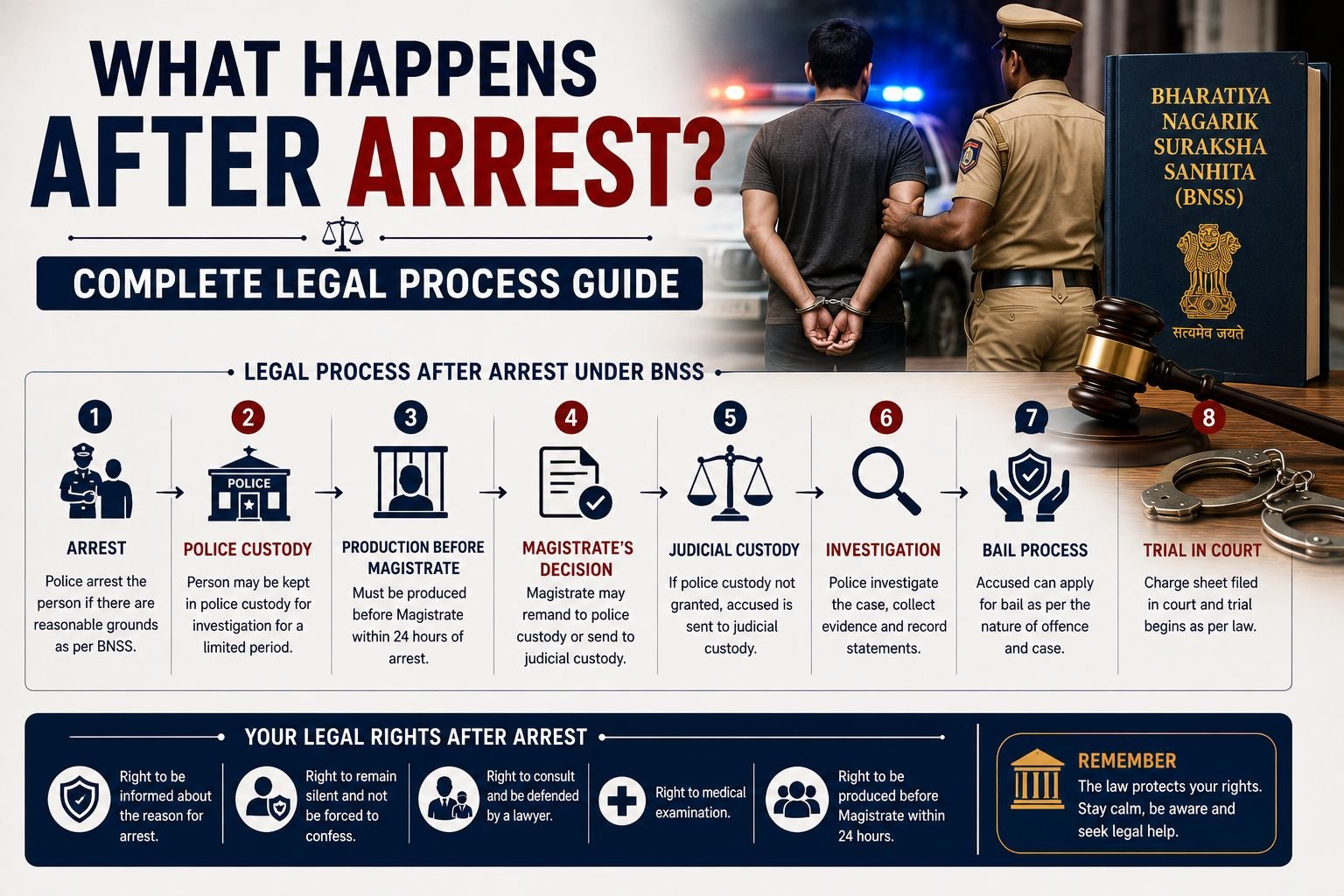
Step 6: Production Before the Magistrate
One of the most important safeguards under the BNSS is that every arrested person must generally be produced before the nearest Magistrate within 24 hours of the arrest, excluding the time required for travel.
The Magistrate examines:
- Whether the arrest was lawful.
- Whether further detention is necessary.
- Whether the accused’s legal rights have been respected.
- Whether police custody is required.
- Whether the accused should be released on bail, where applicable.
Without judicial authorization, the police cannot continue to detain a person beyond the legally permissible period.
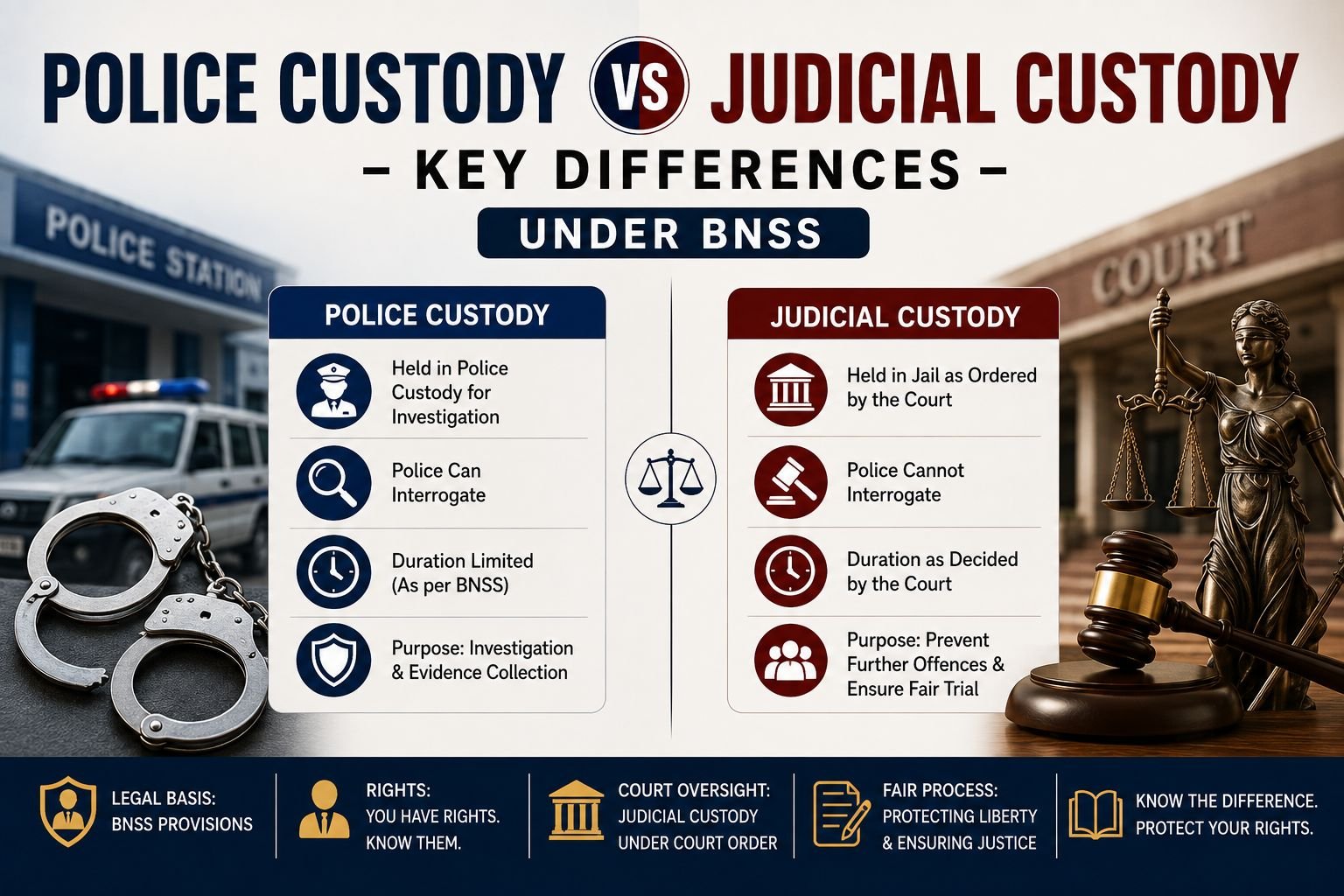
Step 7: Police Custody or Judicial Custody
After hearing the investigating agency and the accused, the Magistrate decides the nature of custody required.
Police Custody
Police custody means the accused remains under the control of the police for investigation. During this period, the police may question the accused, recover evidence, identify co-accused, or verify facts related to the offence.
Police custody is granted only when the Magistrate is satisfied that custodial interrogation is necessary for the investigation.
Judicial Custody
Judicial custody means the accused is sent to jail under the supervision of prison authorities. The police do not have unrestricted access to the accused during this period.
If the police require further interrogation while the accused is in judicial custody, they must obtain permission from the court.
Step 8: Investigation Continues
Even after the accused is remanded to custody or released on bail, the investigation generally continues.
The investigating officer may:
- Record witness statements.
- Visit the crime scene.
- Collect documentary evidence.
- Obtain forensic reports.
- Examine digital evidence.
- Recover stolen property.
- Identify additional suspects.
- Conduct searches and seizures as permitted by law.
The duration of the investigation depends on the nature and complexity of the case.
Step 9: Bail Proceedings
The accused may apply for bail if the law permits.
Depending on the circumstances, the accused may seek:
- Regular Bail.
- Interim Bail.
- Default Bail.
- Anticipatory Bail (before arrest).
While deciding a bail application, the court considers factors such as:
- Nature and seriousness of the offence.
- Criminal antecedents of the accused.
- Risk of absconding.
- Possibility of influencing witnesses.
- Likelihood of tampering with evidence.
- Stage of the investigation.
The grant of bail depends on the facts of each case and the applicable legal provisions.
Step 10: Filing of Charge Sheet or Closure Report
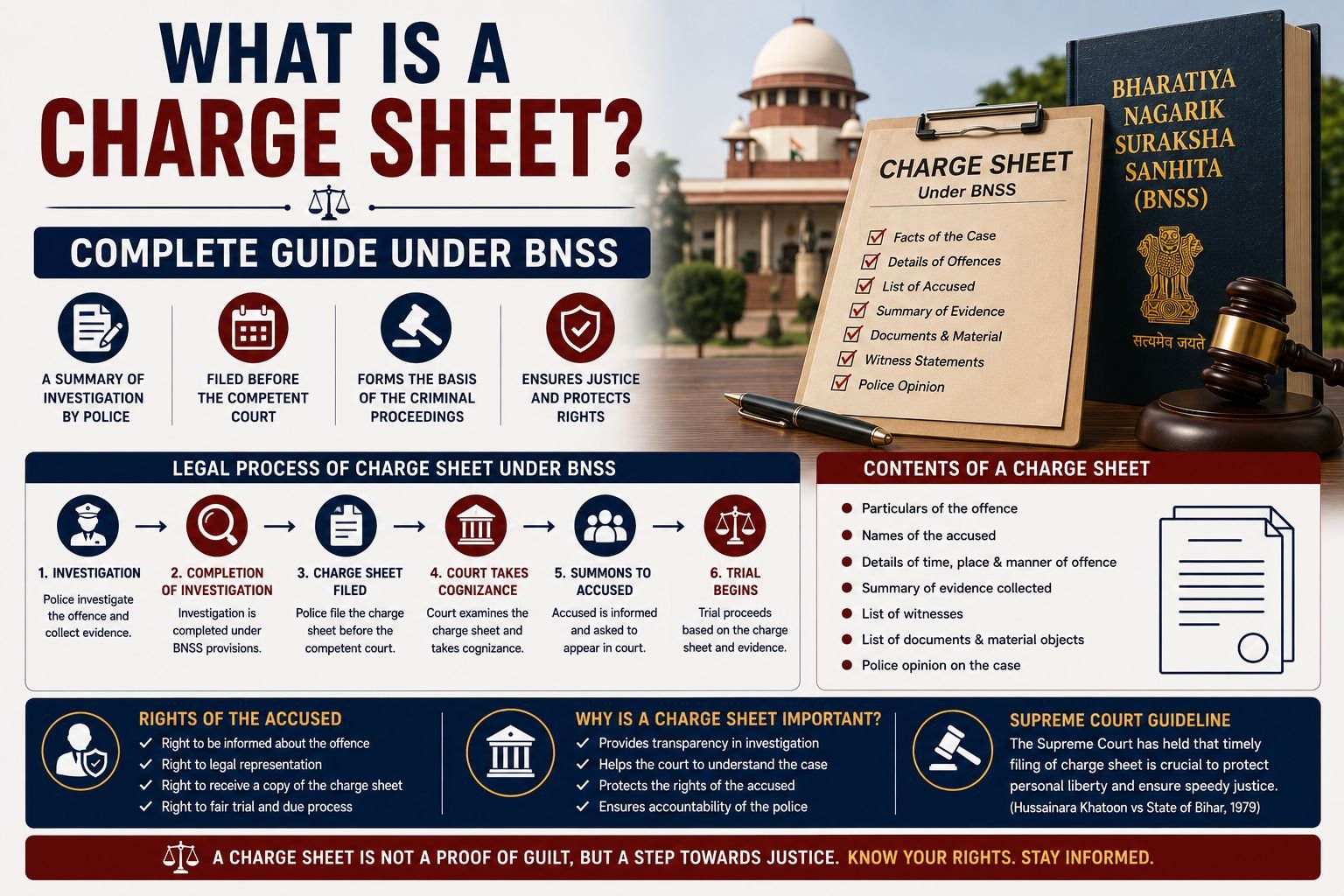
After completing the investigation, the police submit a final report before the competent court.
Charge Sheet
If sufficient evidence is available, the investigating agency files a charge sheet, which contains:
- Details of the accused.
- List of witnesses.
- Documentary evidence.
- Forensic reports.
- Applicable legal provisions.
The court then decides whether to take cognizance of the offence and proceed with the trial.
Closure Report
If the police conclude that there is insufficient evidence, they may file a closure report before the Magistrate.
The court may:
- Accept the closure report.
- Reject the report.
- Direct further investigation.
- Pass any other appropriate order according to law.
Trial Before the Court
If the court takes cognizance of the charge sheet, the criminal trial begins.
The trial generally includes:
- Framing of charges.
- Examination of prosecution witnesses.
- Cross-examination.
- Statement of the accused.
- Defence evidence, where applicable.
- Final arguments.
- Judgment.
The prosecution must establish the guilt of the accused beyond reasonable doubt.
Rights of an Arrested Person
The Constitution of India and the BNSS provide several safeguards to protect arrested persons.
These include:
- Right to know the grounds of arrest.
- Right to legal representation.
- Right to remain silent where protected by law.
- Right to medical examination.
- Right to inform a family member or friend.
- Right to be produced before a Magistrate within the prescribed time.
- Right to apply for bail where legally permissible.
- Right to a fair and impartial trial.
- Protection against unlawful detention and custodial torture.
These safeguards help maintain fairness and accountability within the criminal justice system.
Important Supreme Court Judgments
D.K. Basu v. State of West Bengal (1997)
The Supreme Court laid down comprehensive guidelines regarding arrest and detention, including the preparation of arrest memos, informing family members, and conducting medical examinations to prevent custodial abuse.
Joginder Kumar v. State of Uttar Pradesh (1994)
The Court held that the power to arrest should not be exercised routinely. Arrest must be justified by the facts and circumstances of each case.
Arnesh Kumar v. State of Bihar (2014)
The Supreme Court clarified that registration of an FIR does not automatically require arrest. The police must assess whether arrest is necessary under the law.
Common Mistakes to Avoid After Arrest
If a person is arrested, they should avoid:
- Resisting lawful arrest.
- Providing false information.
- Destroying or concealing evidence.
- Influencing witnesses.
- Signing documents without understanding their contents.
- Delaying consultation with a lawyer.
Prompt legal advice can help protect the rights of the accused and ensure compliance with legal procedures.
Frequently Asked Questions
Can the police arrest someone without a warrant?
Yes. In cases involving cognizable offences and other situations permitted by law, the police may arrest without a warrant.
How long can the police keep an arrested person?
An arrested person must generally be produced before the nearest Magistrate within 24 hours, excluding travel time. Any further detention requires judicial authorization.
Can family members meet the arrested person?
Yes, subject to applicable legal procedures, prison rules, and court directions.
Does arrest mean conviction?
No. Every accused person is presumed innocent until proven guilty in a court of law.
Can an arrested person obtain bail immediately?
It depends on the nature of the offence, applicable legal provisions, and the court’s decision.
Conclusion
Understanding what happens after arrest is essential for protecting legal rights and ensuring that the criminal justice process is followed fairly. From informing the accused of the grounds of arrest to production before a Magistrate, decisions regarding police or judicial custody, bail proceedings, investigation, and trial, every stage is governed by the Bharatiya Nagarik Suraksha Sanhita, 2023 (BNSS) and constitutional safeguards.
An arrest should never be viewed as proof of guilt. The legal system provides several protections to ensure that investigations are conducted lawfully and that every accused person receives a fair opportunity to defend themselves. If you or someone close to you has been arrested, consulting an experienced criminal lawyer at the earliest opportunity can help safeguard your rights and guide you through the legal process.