A Zero FIR is one of the most important legal safeguards available to victims of crime in India. It allows a person to report a cognizable offence at any police station, regardless of where the offence occurred or which police station has territorial jurisdiction. This provision ensures that victims receive immediate legal assistance without being turned away due to jurisdictional issues.
The concept of Zero FIR was introduced to make the criminal justice system more accessible and victim-friendly. It is especially useful in emergencies, such as road accidents, sexual offences, kidnapping, domestic violence, and other serious crimes, where every minute is crucial. Instead of asking the victim to visit the police station having territorial jurisdiction, the police must register the complaint as a Zero FIR and later transfer it to the appropriate police station for investigation.
The Bharatiya Nagarik Suraksha Sanhita, 2023 (BNSS) continues to emphasize prompt registration of information relating to cognizable offences, ensuring that victims are not denied access to justice merely because they approach the wrong police station.
In this guide, you’ll learn what Zero FIR is, when it can be filed, how it works, the procedure for registration and transfer, the rights of complainants, important Supreme Court judgments, and answers to frequently asked questions.
What Is Zero FIR?
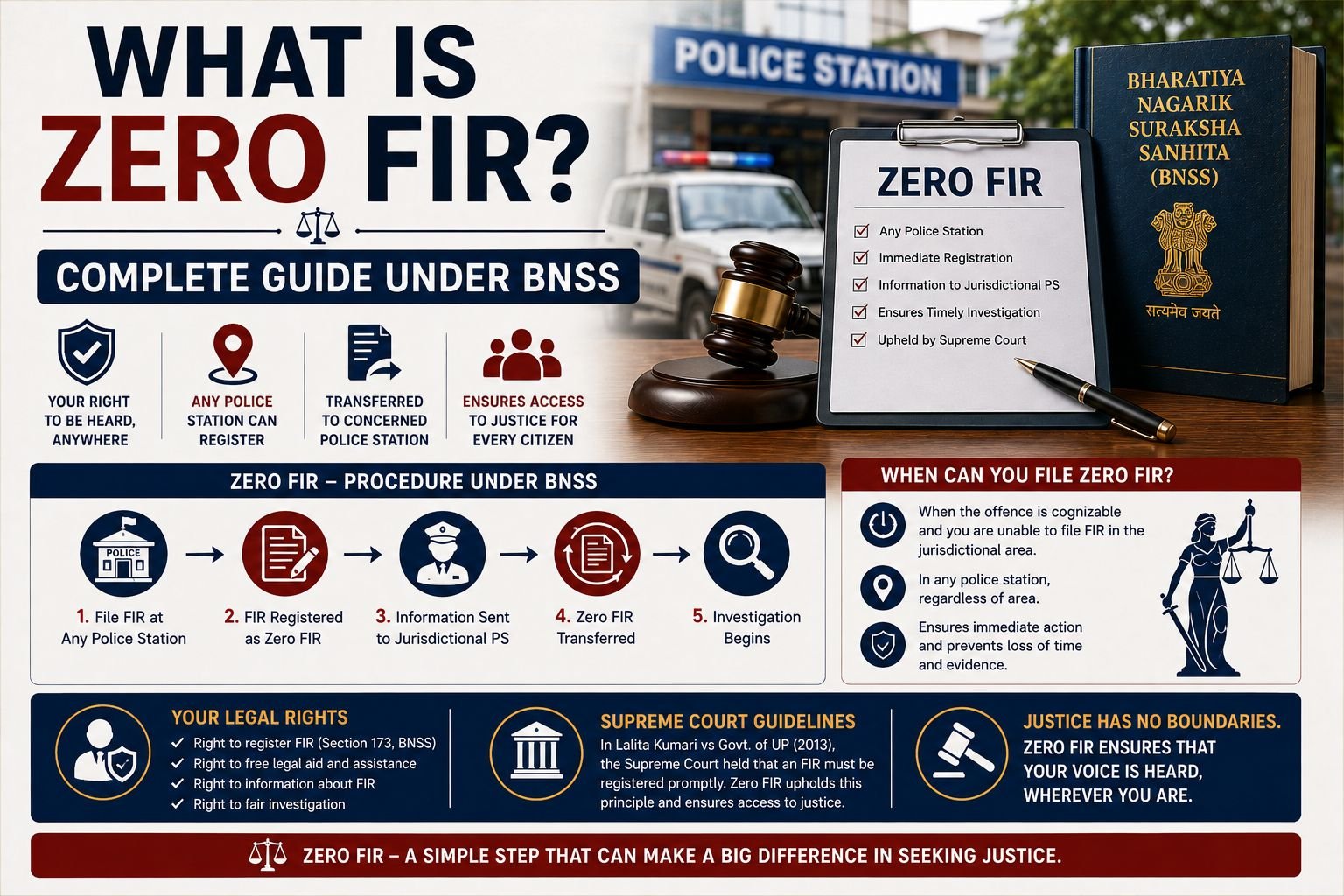
A Zero FIR is an FIR that is registered at any police station without considering territorial jurisdiction. It is assigned the number “Zero” (or registered without the usual jurisdictional serial number, depending on local practice) because the police station recording the complaint is not the station that will investigate the case.
After registration, the FIR is forwarded to the police station that has jurisdiction over the place where the offence was committed. That police station then assigns a regular FIR number and continues the investigation in accordance with the BNSS.
The primary objective of Zero FIR is to ensure that victims can report crimes immediately without procedural delays.
Why Was Zero FIR Introduced?
Before the concept of Zero FIR became widely recognized, victims were often asked to approach another police station if the offence had occurred outside the territorial limits of the station they visited. This caused delays in registering complaints and, in many cases, resulted in the loss of valuable evidence.
Zero FIR was introduced to:
- Ensure immediate registration of cognizable offences.
- Prevent delay in police action.
- Protect victims’ rights.
- Preserve evidence.
- Enable quicker investigation.
- Improve access to justice.
- Reduce procedural hurdles.
It reflects the principle that prompt reporting is more important than determining jurisdiction at the initial stage.
Legal Basis of Zero FIR Under BNSS
The Bharatiya Nagarik Suraksha Sanhita, 2023 (BNSS) requires the police to record information relating to cognizable offences and initiate the legal process in accordance with the law.
Although territorial jurisdiction remains relevant for investigation, it should not become a reason to refuse registration of a cognizable offence. The police station receiving the information can register a Zero FIR and transfer it to the appropriate police station for further investigation.
The objective is to ensure that victims receive timely assistance while jurisdictional issues are resolved administratively.
When Can a Zero FIR Be Filed?
A Zero FIR may be appropriate when a cognizable offence has been committed and the complainant approaches a police station that does not have territorial jurisdiction.
Common situations include:
- Road accidents.
- Sexual offences.
- Kidnapping.
- Murder.
- Robbery.
- Domestic violence.
- Human trafficking.
- Cybercrime (depending on the circumstances).
- Assault causing serious injuries.
- Property offences requiring immediate police action.
For example, if a person from Delhi is travelling in Jaipur and becomes the victim of a robbery, they can report the offence at the nearest police station instead of searching for the police station with territorial jurisdiction.
Difference Between Zero FIR and Regular FIR
| Basis | Zero FIR | Regular FIR |
|---|---|---|
| Jurisdiction | Can be filed at any police station | Filed at the police station having territorial jurisdiction |
| FIR Number | Initially registered as a Zero FIR | Assigned a regular FIR number |
| Investigation | Transferred to the appropriate police station | Conducted by the same police station |
| Purpose | Immediate registration without delay | Registration by the jurisdictional police station |
| Delay | Prevents delay due to jurisdiction | Jurisdiction already exists |
The key difference is that Zero FIR removes jurisdictional barriers at the stage of registration.
Step-by-Step Procedure to File a Zero FIR
Step 1: Visit the Nearest Police Station
Go to the nearest police station, even if the offence occurred elsewhere.
Step 2: Provide Complete Information
Clearly explain:
- Date and time of the incident.
- Place where the offence occurred.
- Details of the accused, if known.
- Description of the incident.
- Names of witnesses, if available.
Step 3: Request Registration of a Zero FIR
If the police mention lack of jurisdiction, inform them that you wish to register a Zero FIR.
The police should register the complaint if it relates to a cognizable offence.
Step 4: Verify the Complaint
Carefully read the complaint before signing it and ensure that all important facts have been recorded accurately.
Step 5: Obtain a Copy of the FIR
Request a free copy of the registered FIR for your records.
Step 6: Transfer to the Jurisdictional Police Station
After registration, the police transfer the Zero FIR to the police station having territorial jurisdiction, where further investigation is conducted.
Advantages of Zero FIR
Zero FIR offers several important benefits:
- Immediate access to the criminal justice system.
- Prevents loss of valuable evidence.
- Saves time during emergencies.
- Ensures prompt police action.
- Protects victims from unnecessary procedural hurdles.
- Improves access to justice.
- Helps preserve witness testimony.
- Reduces delays caused by jurisdictional disputes.
Can Police Refuse to Register a Zero FIR?
If information discloses a cognizable offence, the police should not refuse registration solely because the offence occurred outside their territorial jurisdiction.
If registration is refused, the complainant may consider appropriate legal remedies, such as approaching senior police officers or seeking relief before the competent court in accordance with applicable law.
Important Supreme Court Judgment
Lalita Kumari v. Government of Uttar Pradesh (2014)
This landmark judgment held that registration of an FIR is generally mandatory where information discloses the commission of a cognizable offence.
The judgment strengthened the rights of victims by emphasizing prompt registration of criminal cases and reducing arbitrary refusals by police authorities.
Although the judgment addressed FIR registration generally, its principles support the objective of ensuring that procedural issues do not prevent timely reporting of cognizable offences.
Common Misconceptions
Myth 1: Zero FIR Can Only Be Filed by Women
Reality: Any person reporting a cognizable offence may seek registration of a Zero FIR where jurisdictional issues exist.
Myth 2: Zero FIR Is a Different Type of Criminal Case
Reality: It is an ordinary FIR registered without regard to territorial jurisdiction and later transferred for investigation.
Myth 3: Only Serious Crimes Qualify
Reality: The key consideration is whether the information relates to a cognizable offence, not merely whether it is a “serious” crime.
Myth 4: The Police Station Registering the Zero FIR Conducts the Entire Investigation
Reality: After registration, the FIR is ordinarily transferred to the police station having territorial jurisdiction for further investigation.
Frequently Asked Questions
1. What is a Zero FIR?
A Zero FIR is an FIR registered at any police station irrespective of territorial jurisdiction and later transferred to the competent police station.
2. Can I file a Zero FIR online?
This depends on the online facilities provided by the concerned State Police. Availability varies across States.
3. Is there any fee for filing a Zero FIR?
No. Registration of an FIR is free of charge.
4. Can the police refuse a Zero FIR?
The police should not refuse registration of a cognizable offence merely because the offence occurred outside their territorial jurisdiction.
5. Who transfers the Zero FIR?
The police station that registers the Zero FIR transfers it to the police station having jurisdiction over the place of occurrence.
6. Can a Zero FIR be filed for cybercrime?
Depending on the facts and the applicable procedures, a Zero FIR may be appropriate for certain cybercrime cases involving cognizable offences.
7. Will I receive a copy of the Zero FIR?
Yes, you may request a copy of the FIR after registration.
8. Can the investigation begin before transfer?
In urgent situations, the police may take lawful preliminary steps to preserve evidence or protect victims before the case is transferred, subject to applicable law.
9. Does a Zero FIR have the same legal value as a regular FIR?
Yes. A Zero FIR is a valid FIR and forms the basis for investigation after transfer to the competent police station.
10. Can an advocate assist in filing a Zero FIR?
Yes. A lawyer can guide the complainant regarding the legal process and available remedies if difficulties arise.
Conclusion
A Zero FIR is an important legal mechanism that ensures victims of cognizable offences can report crimes without being delayed by jurisdictional issues. By allowing any police station to register the complaint first and transfer it later, the law prioritizes immediate police action, preservation of evidence, and access to justice.
Understanding what a Zero FIR is and how it works can help victims act quickly during emergencies and protect their legal rights. If you encounter difficulties in registering a Zero FIR or believe that your complaint has been wrongly refused, seeking advice from an experienced criminal lawyer can help you understand the legal remedies available under the BNSS.