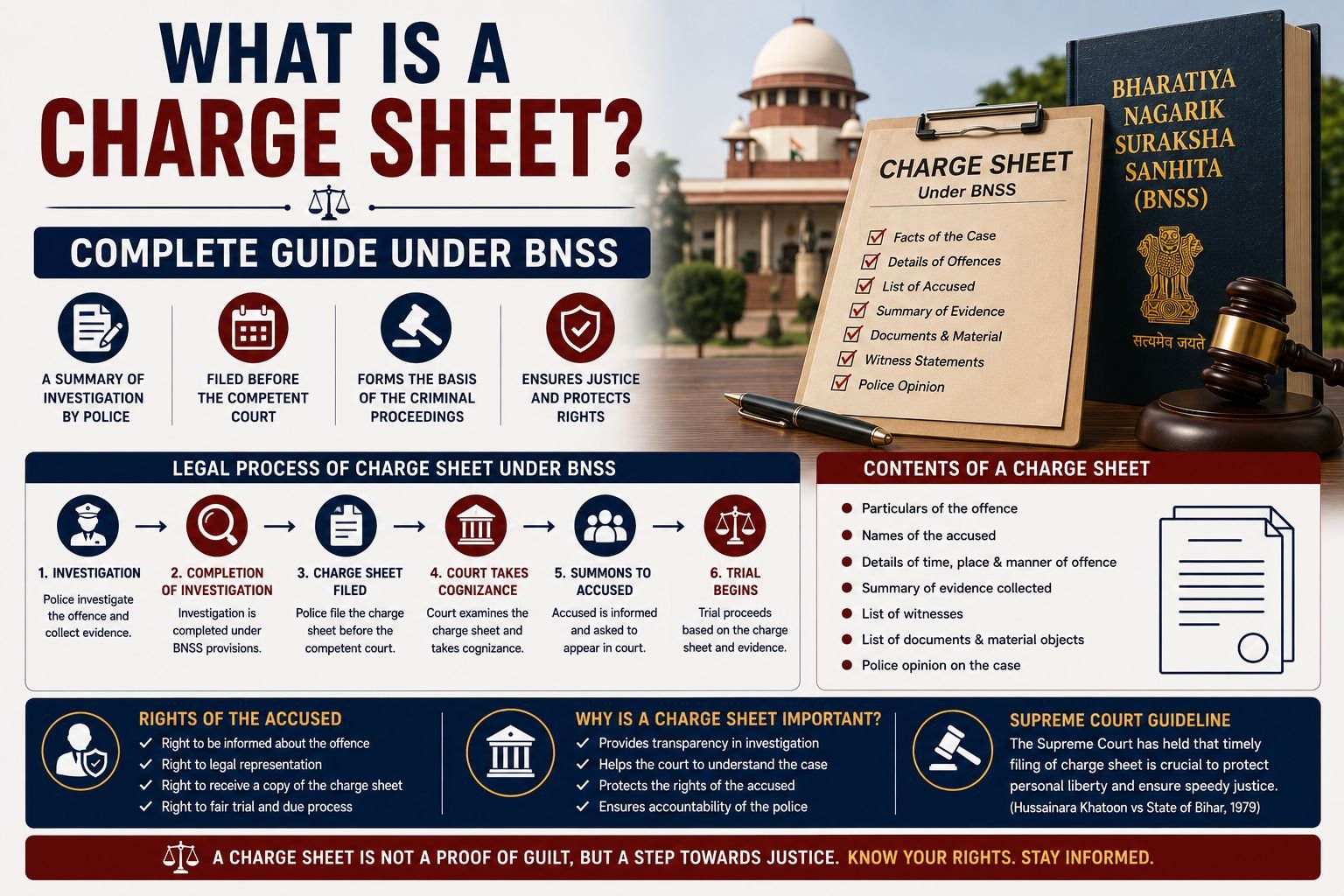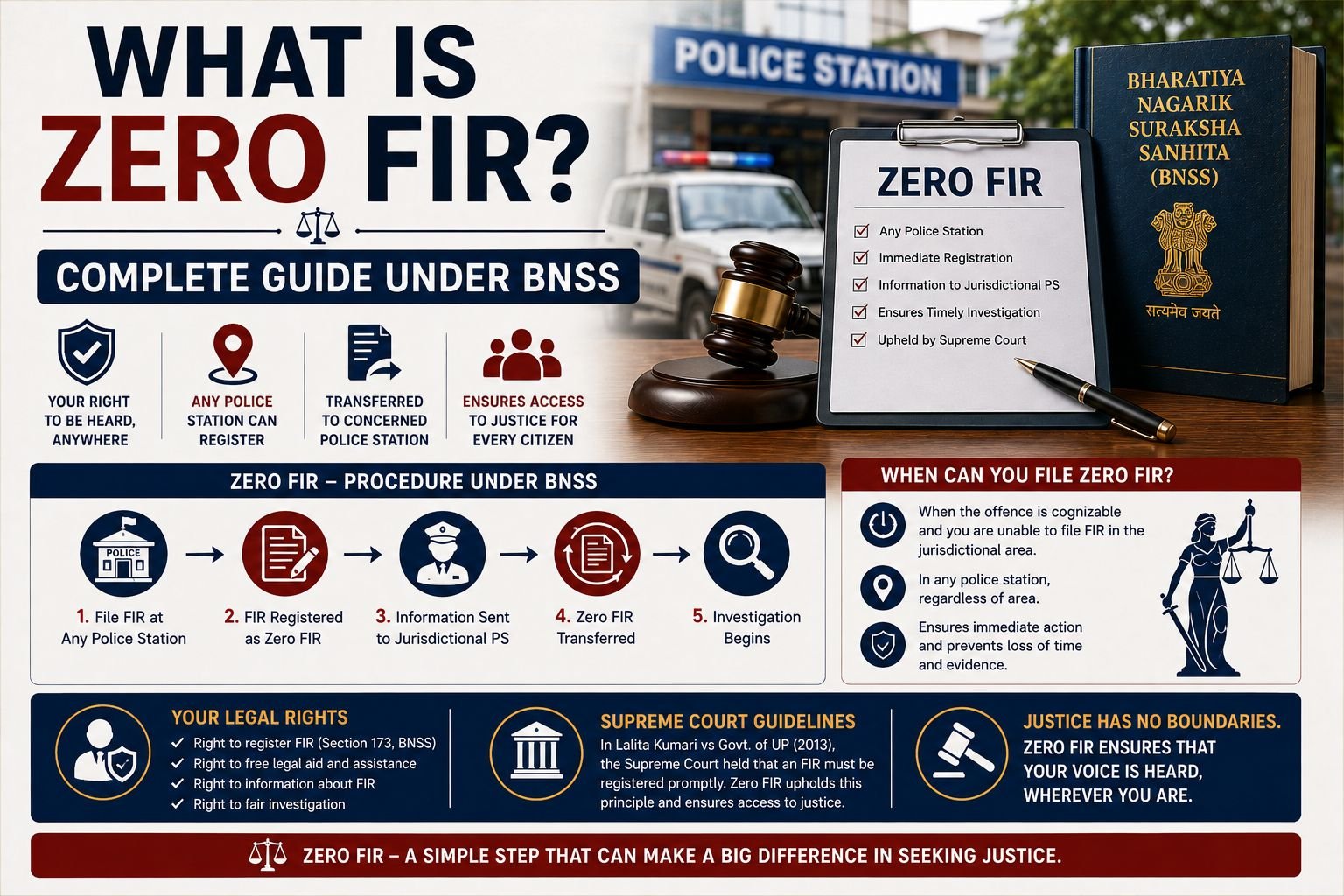
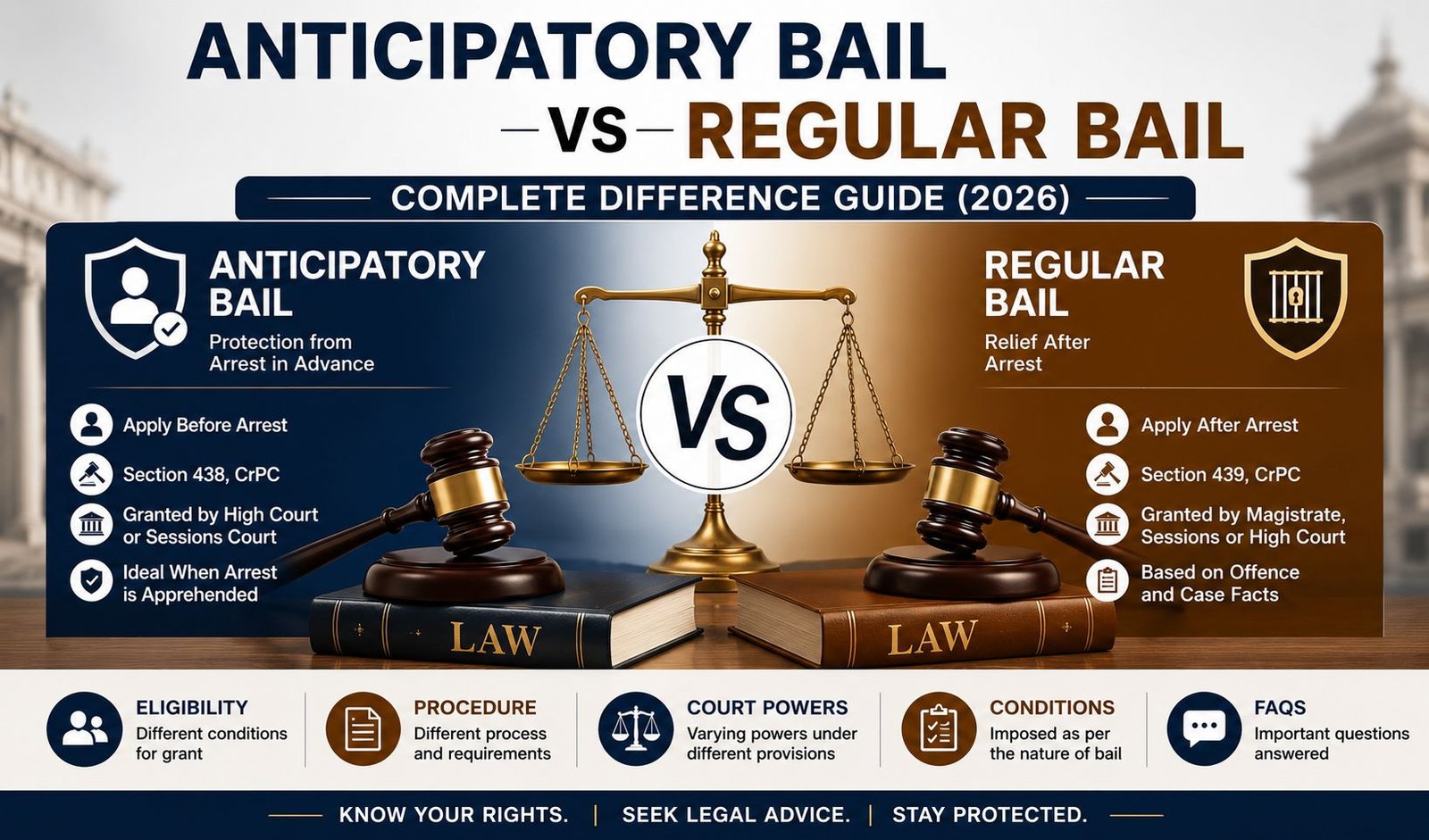
Bail is one of the most important safeguards available under India’s criminal justice system. It protects the personal liberty of an accused person while ensuring that criminal investigations and court proceedings continue without unnecessary detention. However, many people are confused about the difference between anticipatory bail and regular bail, especially after the implementation of the Bharatiya Nagarik Suraksha Sanhita (BNSS), 2023, which replaced the Code of Criminal Procedure (CrPC).
Although both remedies allow an accused person to avoid or end custody, they are available at different stages of a criminal case and serve different legal purposes. Anticipatory bail is a preventive remedy that can be sought before arrest, whereas regular bail is granted after a person has been arrested. Choosing the correct remedy at the right time is crucial because filing the wrong type of bail application may delay relief.
Understanding anticipatory bail vs regular bail is essential for accused persons, family members, advocates, law students, and anyone seeking information about India’s criminal procedure. Knowing when each type of bail is available, the eligibility requirements, the courts that can grant bail, and the conditions imposed by the court can help individuals respond appropriately to criminal proceedings.
Under the current legal framework:
- Bharatiya Nyaya Sanhita (BNS), 2023 defines criminal offences and punishments.
- Bharatiya Nagarik Suraksha Sanhita (BNSS), 2023 governs criminal procedure, including arrest and bail.
- Bharatiya Sakshya Adhiniyam (BSA), 2023 governs the law relating to evidence.
This comprehensive guide explains every important aspect of anticipatory bail and regular bail, including:
- Meaning of bail
- What is anticipatory bail?
- What is regular bail?
- Major differences between both remedies
- Eligibility conditions
- Step-by-step application process
- Documents required
- Court procedure
- Grounds for rejection
- Bail conditions
- Landmark Supreme Court judgments
- Frequently asked questions
By the end of this guide, you will clearly understand which type of bail is appropriate in different situations and how Indian courts approach bail applications under the BNSS.
Quick Comparison
| Particular | Anticipatory Bail | Regular Bail |
|---|---|---|
| Purpose | Protection from arrest | Release after arrest |
| Stage | Before arrest | After arrest |
| Who Can Apply | Person apprehending arrest | Person already arrested |
| Custody | Not yet arrested | Already in custody |
| Granted By | Sessions Court or High Court | Magistrate, Sessions Court, High Court (or police in certain bailable offences) |
| Nature | Preventive | Curative |
| Governing Law | BNSS | BNSS |
Table of Contents
- What is Bail?
- Constitutional Basis of Bail
- What is Anticipatory Bail?
- What is Regular Bail?
- Anticipatory Bail vs Regular Bail
- Eligibility
- Step-by-Step Procedure
- Documents Required
- Court Process
- Conditions of Bail
- Rejection and Cancellation
- Supreme Court Judgments
- FAQs
What is Bail?
Bail is the legal process through which an accused person is released from police or judicial custody while criminal proceedings continue. Instead of remaining in custody throughout the investigation or trial, the accused is allowed to remain at liberty after complying with the conditions imposed by the court or the competent authority.
The objective of bail is to strike a balance between:
- Protecting personal liberty.
- Ensuring a fair investigation.
- Securing the presence of the accused during trial.
- Preventing misuse of the criminal justice process.
Grant of bail does not amount to acquittal. The criminal case continues until it is finally decided by the court.
Objectives of Bail
The concept of bail serves several important purposes in criminal law.
1. Protection of Personal Liberty
Bail protects the constitutional right to personal liberty and prevents unnecessary detention before conviction.
2. Presumption of Innocence
Every accused is presumed innocent until proven guilty. Bail reflects this principle by avoiding punitive detention before the conclusion of the trial.
3. Ensuring Attendance Before Court
The accused remains legally bound to appear before the court whenever directed.
4. Fair Opportunity to Defend the Case
A person released on bail can consult legal counsel, collect evidence, and prepare an effective defence.
5. Reducing Unnecessary Custody
Where further detention is not required for investigation, bail helps reduce the number of undertrial prisoners.
Constitutional Basis of Bail
Although the Constitution of India does not expressly mention bail, the concept is closely linked with Article 21, which guarantees that no person shall be deprived of life or personal liberty except according to the procedure established by law.
Indian courts have consistently held that personal liberty is a fundamental constitutional value. Accordingly, courts strive to ensure that an accused is not unnecessarily detained before conviction unless the circumstances justify continued custody.
The well-known judicial principle that “bail is the rule and jail is the exception” continues to guide courts while deciding bail applications, though each case is considered on its own facts.
What is Anticipatory Bail?
Anticipatory bail is a legal remedy that protects a person who reasonably apprehends arrest for a non-bailable offence. Instead of waiting to be arrested, the person may approach the competent court seeking an order that, in the event of arrest, they shall be released on bail.
In simple terms, anticipatory bail is pre-arrest protection.
It is intended to safeguard individuals from unnecessary or unjustified arrest while ensuring that they cooperate with the investigation.
Purpose of Anticipatory Bail
The primary objectives of anticipatory bail include:
- Preventing unnecessary arrest.
- Protecting personal liberty.
- Safeguarding individuals from false or motivated complaints.
- Preventing misuse of arrest powers.
- Allowing the accused to cooperate with the investigation without being taken into custody.
Who Can Apply for Anticipatory Bail?
A person may apply for anticipatory bail if they have a reasonable apprehension that they may be arrested for a non-bailable offence.
Applications are commonly filed in situations involving:
- Matrimonial disputes.
- Property disputes.
- Business disagreements.
- Political rivalry.
- Family disputes.
- Allegations of cheating or breach of trust.
- Cases where false implication is alleged.
Which Court Grants Anticipatory Bail?
Applications for anticipatory bail are generally filed before:
- Sessions Court.
- High Court.
The court considers the facts, hears the prosecution, and decides whether pre-arrest protection should be granted.
Conditions That May Be Imposed
While granting anticipatory bail, the court may require the applicant to:
- Cooperate with the investigation.
- Appear before the investigating officer whenever required.
- Avoid threatening or influencing witnesses.
- Not tamper with evidence.
- Not leave India without prior permission, where directed.
- Comply with any additional conditions imposed by the court.
What is Regular Bail?
Regular bail is granted to a person who has already been arrested and is in police or judicial custody. The accused applies to the competent authority or court seeking release while the investigation or trial continues.
Unlike anticipatory bail, regular bail is available only after arrest.
Purpose of Regular Bail
Regular bail seeks to:
- End unnecessary custody.
- Protect personal liberty after arrest.
- Allow the accused to prepare a defence.
- Ensure participation in court proceedings.
- Balance the rights of the accused with the interests of justice.
Who Can Apply for Regular Bail?
A regular bail application may be filed by:
- A person already arrested.
- An accused in police custody.
- An accused in judicial custody.
- An advocate acting on behalf of the accused.
Which Authorities Can Grant Regular Bail?
Depending on the nature of the offence, regular bail may be granted by:
- Police (in certain bailable offences).
- Judicial Magistrate.
- Sessions Court.
- High Court.
Conditions of Regular Bail
The court may impose conditions such as:
- Execution of a bail bond.
- Furnishing sureties.
- Attendance before the court.
- Cooperation with the investigation.
- Restriction on contacting witnesses.
- Compliance with any additional directions.
Key Difference Between Anticipatory Bail and Regular Bail
Although both remedies protect the liberty of the accused, they operate at different stages of criminal proceedings.
Anticipatory bail protects a person before arrest, whereas regular bail secures the release of a person after arrest. Anticipatory bail is preventive in nature because it aims to avoid unnecessary custody. Regular bail, on the other hand, is curative because it ends an existing detention.
The choice between the two depends entirely on whether the accused has already been arrested and the circumstances of the case.
Why Understanding the Difference Is Important
Knowing the distinction between anticipatory bail and regular bail helps individuals:
- Choose the correct legal remedy.
- Avoid procedural delays.
- Protect constitutional rights.
- Respond effectively to criminal proceedings.
- Ensure timely legal representation.
- Comply with court procedures under the BNSS.
Understanding these differences is particularly important for accused persons facing non-bailable offences where the timing of the bail application can significantly affect the outcome.
Anticipatory Bail vs Regular Bail: Detailed Comparison
Although both anticipatory bail and regular bail protect the liberty of an accused person, they differ significantly in terms of purpose, timing, eligibility, procedure, and the authorities empowered to grant them. Understanding these distinctions helps individuals choose the appropriate legal remedy based on the facts of their case.
The following table provides a comprehensive comparison.
Anticipatory Bail vs Regular Bail (Comparison Table)
| Basis | Anticipatory Bail | Regular Bail |
|---|---|---|
| Meaning | Protection from arrest before it takes place | Release after a person has been arrested |
| Stage | Before arrest | After arrest |
| Nature | Preventive remedy | Curative remedy |
| Custody | Applicant is not in custody | Applicant is already in police or judicial custody |
| Objective | Prevent unnecessary arrest | Secure release from custody |
| Who Can Apply | Person apprehending arrest | Person already arrested |
| Applicable Generally In | Non-bailable offences | Bailable and non-bailable offences |
| Competent Authority | Sessions Court or High Court | Police (in certain bailable offences), Magistrate, Sessions Court, High Court |
| Timing | Before arrest | After arrest |
| Bail Bond | Usually executed after arrest if required by the order | Executed after the court grants bail |
| Surety | May be required depending on the court’s order | Frequently required by the court |
| Police Custody | Seeks protection from being taken into custody | Ends existing custody |
| Court’s Discretion | Based on the facts and apprehension of arrest | Based on the facts after arrest |
| Investigation | Applicant must cooperate with the investigation | Accused must cooperate after release |
| Conditions | Often includes cooperation and appearance before investigators | Includes court attendance and compliance with conditions |
| Violation of Conditions | May result in cancellation of anticipatory bail | May result in cancellation of regular bail |
| Constitutional Basis | Protection of personal liberty under Article 21 | Protection of personal liberty under Article 21 |
| Duration | Operates according to the terms of the court’s order | Continues unless cancelled or modified |
| Cancellation | Possible on valid legal grounds | Possible on valid legal grounds |
| Purpose | Avoid unnecessary detention | Prevent prolonged custody after arrest |
When Should You Apply for Anticipatory Bail?
Anticipatory bail is appropriate when a person reasonably believes that they may be arrested for a non-bailable offence. The apprehension of arrest should be genuine and supported by circumstances.
Common situations include:
Matrimonial Disputes
Disputes arising between spouses or their families may sometimes lead to criminal complaints. Where a person apprehends arrest, anticipatory bail may be considered.
Property Disputes
Disagreements relating to ownership, possession, inheritance, or partition may occasionally result in criminal allegations. In appropriate cases, anticipatory bail may be sought.
Business and Commercial Disputes
Business partners, company directors, or professionals facing allegations of cheating, breach of trust, or financial irregularities may apply for anticipatory bail where they reasonably fear arrest.
Family Disputes
Criminal complaints arising from family disagreements may also lead to applications for anticipatory bail depending on the facts.
Political Rivalry
In certain situations, allegations may arise in politically sensitive matters. Courts examine such cases carefully while considering anticipatory bail.
False or Motivated Complaints
Where an individual believes that false allegations have been made solely to facilitate arrest, anticipatory bail may provide protection while the investigation proceeds.
When Should You Apply for Regular Bail?
Regular bail becomes relevant after a person has been arrested.
Applications may be filed in the following situations:
After Police Arrest
Immediately after arrest, the accused may apply for regular bail before the competent authority or court.
During Police Custody
If the accused remains in police custody, a regular bail application may be filed where legally permissible.
During Judicial Custody
Many regular bail applications are filed after the accused has been remanded to judicial custody.
During Investigation
Even while the investigation is ongoing, the accused may seek release if continued custody is unnecessary.
During Trial
Regular bail may also be granted during the trial if the circumstances justify release.
Eligibility for Anticipatory Bail
Although every case is decided on its own facts, courts generally consider whether the applicant satisfies certain requirements.
Reasonable Apprehension of Arrest
The applicant should demonstrate a genuine apprehension that arrest may occur.
Non-Bailable Offence
Anticipatory bail is generally sought in relation to non-bailable offences where arrest is apprehended.
Cooperation with Investigation
Applicants should express willingness to cooperate fully with the investigating agency.
No Intention to Abscond
Courts consider whether the applicant is likely to remain available for investigation and trial.
No Risk of Witness Intimidation
The court examines whether granting anticipatory bail could adversely affect witnesses or the investigation.
Eligibility for Regular Bail
Regular bail is available only after arrest.
The court generally considers:
- Nature of the offence.
- Seriousness of allegations.
- Stage of investigation.
- Criminal antecedents.
- Conduct of the accused.
- Possibility of absconding.
- Risk of witness intimidation.
- Need for continued custody.
Step-by-Step Procedure for Obtaining Anticipatory Bail
The process generally involves the following steps.
Step 1: Consult an Advocate
The applicant should seek legal advice immediately after apprehending arrest.
Step 2: Prepare the Bail Application
The application generally includes:
- Personal details.
- Facts of the case.
- Grounds for apprehending arrest.
- Legal submissions.
- Prayer for anticipatory bail.
Step 3: File Before the Appropriate Court
Applications are generally filed before:
- Sessions Court, or
- High Court.
Step 4: Notice to the Prosecution
The court may hear the prosecution before deciding the application, depending on the circumstances.
Step 5: Hearing
Both parties present their submissions before the court.
The court considers:
- Nature of allegations.
- Available material.
- Conduct of the applicant.
- Need for custodial interrogation.
Step 6: Court Order
The court may:
- Grant anticipatory bail.
- Reject the application.
- Grant interim protection pending final hearing.
- Impose conditions.
Step 7: Compliance with Conditions
If anticipatory bail is granted, the applicant must strictly comply with every condition imposed by the court.
Step-by-Step Procedure for Obtaining Regular Bail
The procedure differs because the accused has already been arrested.
Step 1: Arrest
The accused is arrested by the police in connection with an alleged offence.
Step 2: Determine Bail Status
The accused or advocate determines whether the offence is bailable or non-bailable.
Step 3: Prepare the Bail Application
A detailed application is prepared containing:
- FIR details.
- Relevant legal provisions.
- Grounds for release.
- Supporting documents.
Step 4: File Before the Competent Authority
Depending on the offence, the application may be filed before:
- Police (where applicable).
- Magistrate.
- Sessions Court.
- High Court.
Step 5: Court Hearing
The court hears submissions from both sides before passing an order.
Step 6: Bail Order
The court may:
- Grant bail.
- Reject bail.
- Grant interim relief.
- Impose conditions.
Step 7: Execute Bail Bond
After bail is granted, the accused executes the required bail bond and furnishes sureties where directed.
Step 8: Release from Custody
Once all formalities are completed, the accused is released.
Documents Required
Although documentation may vary depending on the facts of the case, the following are commonly required.
| Document | Anticipatory Bail | Regular Bail |
|---|---|---|
| Bail Application | ✔ | ✔ |
| FIR Copy | ✔ | ✔ |
| Identity Proof | ✔ | ✔ |
| Address Proof | ✔ | ✔ |
| Arrest Memo | Usually Not Available | ✔ |
| Affidavit | Where Required | Where Required |
| Medical Records | If Relied Upon | If Relied Upon |
| Surety Documents | If Directed | Usually Required |
| Previous Bail Orders | If Applicable | If Applicable |
Which Bail Should You Choose?
The answer depends entirely on the stage of the criminal proceedings.
Choose anticipatory bail if:
- Arrest has not yet taken place.
- There is a reasonable apprehension of arrest.
- The offence is generally non-bailable.
- Immediate pre-arrest protection is required.
Choose regular bail if:
- You have already been arrested.
- You are in police or judicial custody.
- You seek release while the investigation or trial continues.
Important Practical Difference
The biggest distinction is simple:
- Anticipatory Bail = Before Arrest
- Regular Bail = After Arrest
Everything else—including the procedure, court’s approach, and applicable conditions—flows from this fundamental difference.
Factors Courts Consider While Granting Bail
Whether the application is for anticipatory bail or regular bail, courts do not grant bail automatically. Every application is examined on its own facts, the nature of the allegations, and the applicable legal provisions. The objective is to balance the accused’s right to personal liberty with the need for a fair investigation and the administration of justice.
The following are some of the most important factors considered by courts while deciding bail applications.
1. Nature and Gravity of the Offence
The seriousness of the alleged offence is one of the primary considerations.
Courts generally scrutinize bail applications more carefully where the allegations involve:
- Murder
- Rape
- Terror-related offences
- Organized crime
- Kidnapping
- Large-scale financial fraud
- Offences affecting national security
Less serious offences are generally viewed differently depending on the facts and applicable law.
2. Prima Facie Evidence
At the bail stage, the court does not conduct a full trial or determine guilt. However, it examines whether there is sufficient prima facie material suggesting the involvement of the accused.
The court may consider:
- FIR
- Witness statements
- Documentary evidence
- Electronic evidence
- Case diary (where relevant)
3. Criminal Antecedents
The court may examine whether the accused has:
- Previous criminal convictions.
- Pending criminal cases.
- A history of similar offences.
- Earlier violations of bail conditions.
A clean criminal record may weigh in favour of granting bail, though each case is decided on its own facts.
4. Possibility of Absconding
Courts consider whether the accused is likely to evade the investigation or trial.
Factors that may be relevant include:
- Permanent residence.
- Employment or business.
- Family ties.
- Financial capacity.
- Previous conduct.
5. Possibility of Influencing Witnesses
Protecting witnesses is an important concern.
If there is a reasonable possibility that the accused may:
- Threaten witnesses.
- Influence witnesses.
- Induce witnesses to change their statements.
- Intimidate the complainant,
the court may refuse bail or impose strict conditions.
6. Tampering with Evidence
The court considers whether release on bail could enable the accused to:
- Destroy documents.
- Alter electronic records.
- Remove physical evidence.
- Interfere with the investigation.
7. Requirement of Custodial Interrogation
Particularly in anticipatory bail cases, the investigating agency may argue that custodial interrogation is necessary.
The court evaluates whether custody is genuinely required for effective investigation.
8. Conduct of the Accused
The court also considers:
- Cooperation with the investigation.
- Respect for previous court orders.
- Overall conduct before and after registration of the case.
9. Public Interest
In exceptional cases involving serious public consequences, courts may also consider broader public interest while deciding bail applications.
Conditions Commonly Imposed While Granting Bail
When a court grants anticipatory or regular bail, it may impose conditions to ensure that the accused does not misuse the liberty granted.
Common conditions include:
- Executing a personal bond.
- Furnishing one or more sureties.
- Appearing before the court whenever required.
- Cooperating with the investigating officer.
- Not threatening or influencing witnesses.
- Not tampering with evidence.
- Informing the court before changing address.
- Not leaving India without prior permission, where directed.
- Complying with any additional conditions considered necessary by the court.
Failure to comply with these conditions may result in cancellation of bail.
Can Anticipatory Bail Be Rejected?
Yes.
Anticipatory bail is a discretionary remedy. The court may reject the application if it is not satisfied that pre-arrest protection is justified.
Common Grounds for Rejection
- Serious nature of the offence.
- Strong prima facie evidence.
- Need for custodial interrogation.
- Risk of absconding.
- Possibility of influencing witnesses.
- Tampering with evidence.
- Criminal antecedents.
- Lack of cooperation with the investigation.
Even if anticipatory bail is refused, the applicant may seek other legal remedies available under law.
Can Regular Bail Be Rejected?
Yes.
In non-bailable offences, the court examines all relevant circumstances before deciding whether to release the accused.
Reasons for Rejection
- Serious allegations.
- Strong evidence.
- Criminal history.
- Possibility of absconding.
- Threat to witnesses.
- Ongoing investigation requiring custody.
- Public interest considerations.
A rejection of regular bail does not amount to a finding of guilt. The accused may file a fresh application if circumstances change or approach a higher court where legally permissible.
Can Bail Be Cancelled?
Yes.
Grant of bail does not permanently protect an accused from being taken back into custody. If the accused violates the conditions imposed by the court or misuses the liberty granted, the prosecution or complainant may seek cancellation of bail.
Grounds for Cancellation of Bail
The court may cancel anticipatory or regular bail if the accused:
- Violates any bail condition.
- Commits another offence while on bail.
- Threatens the complainant.
- Influences witnesses.
- Tampers with evidence.
- Absconds.
- Fails to appear before the court.
- Interferes with the investigation.
Procedure for Cancellation of Bail
The process generally includes:
Step 1
An application for cancellation is filed before the competent court.
Step 2
Notice is issued to the accused.
Step 3
Both parties are heard.
Step 4
The court examines the evidence and surrounding circumstances.
Step 5
If sufficient grounds exist, the court may cancel the bail and direct that the accused be taken into custody.
Practical Examples
The following examples illustrate the difference between anticipatory bail and regular bail.
Example 1: Matrimonial Dispute
A husband receives information that a criminal complaint alleging cruelty has been filed against him. Apprehending arrest, he approaches the Sessions Court seeking anticipatory bail.
The court considers the allegations, hears both parties, and grants anticipatory bail subject to conditions requiring cooperation with the investigation.
Example 2: Business Fraud Allegation
A company director is arrested in connection with allegations of cheating and criminal breach of trust.
Since the arrest has already taken place, the director files an application for regular bail before the competent court. After considering the available material, the court grants bail subject to furnishing a bond and sureties.
Example 3: Property Dispute
Two brothers are involved in a property dispute that results in criminal allegations.
One brother, fearing arrest, applies for anticipatory bail before the Sessions Court. The court grants interim protection while the matter is heard.
Example 4: Arrest in a Theft Case
A person is arrested for an alleged theft. After being produced before the Magistrate, the accused files a regular bail application.
The court considers the seriousness of the offence, the investigation, and the accused’s conduct before granting bail with conditions.
Which Court Should You Approach?
The appropriate court depends on the type of bail sought.
For Anticipatory Bail
Applications are generally filed before:
- Sessions Court.
- High Court.
For Regular Bail
Depending on the offence and circumstances, applications may be made before:
- Police (where applicable in certain bailable offences).
- Judicial Magistrate.
- Sessions Court.
- High Court.
Common Misconceptions
Many people misunderstand the law relating to bail. The following clarifications may help.
Myth 1: Anticipatory Bail Means the Case Ends
Reality: Anticipatory bail only protects against arrest. The investigation and trial continue.
Myth 2: Regular Bail Means the Person Is Innocent
Reality: Bail does not decide guilt or innocence. It only permits temporary release from custody.
Myth 3: Bail Can Never Be Cancelled
Reality: Both anticipatory bail and regular bail may be cancelled if the accused violates the conditions imposed by the court.
Myth 4: Anticipatory Bail Is Available in Every Case
Reality: No. The court considers the facts, the applicable law, and the nature of the allegations before granting pre-arrest protection.
Myth 5: Bail Is Guaranteed in Non-Bailable Offences
Reality: In non-bailable offences, bail is granted at the discretion of the court after considering all relevant circumstances.
Tips Before Applying for Bail
Whether applying for anticipatory or regular bail, consider the following practical tips:
- Consult an experienced criminal lawyer promptly.
- Provide complete and accurate information in the bail application.
- Attach all relevant supporting documents.
- Cooperate with the investigating agency.
- Avoid contacting witnesses or the complainant.
- Strictly comply with every court direction.
- Attend all hearings unless exempted by the court.
Advantages of Anticipatory Bail
Anticipatory bail is an important legal safeguard that protects individuals from unnecessary arrest while ensuring that the investigation continues in accordance with law. It balances the rights of the accused with the interests of justice.
1. Protection from Arrest
The primary benefit of anticipatory bail is that it protects a person from being taken into police custody, provided they comply with the conditions imposed by the court.
2. Safeguards Personal Liberty
Anticipatory bail upholds the constitutional guarantee of personal liberty under Article 21 by preventing unnecessary detention before trial.
3. Prevents Misuse of Criminal Law
In cases involving false allegations or malicious complaints, anticipatory bail acts as a safeguard against misuse of the criminal justice system.
4. Protects Reputation
An arrest can significantly affect an individual’s professional and personal reputation. Anticipatory bail helps avoid unnecessary arrest where the court finds it appropriate.
5. Enables Better Legal Preparation
A person protected by anticipatory bail can:
- Consult advocates.
- Collect evidence.
- Prepare legal documents.
- Cooperate with the investigation without being in custody.
6. Reduces Mental Stress
Protection from immediate arrest allows the accused and their family to focus on preparing their legal defence instead of dealing with custodial detention.
7. Facilitates Cooperation with Investigation
Courts often direct applicants to cooperate with investigating agencies, enabling the investigation to proceed without unnecessary incarceration.
Advantages of Regular Bail
Regular bail provides relief to a person who has already been arrested by securing release from custody during the investigation or trial.
1. Release from Custody
The most significant benefit is that the accused can leave police or judicial custody while the case continues.
2. Opportunity to Prepare Defence
A person on regular bail can:
- Meet legal counsel.
- Gather documents.
- Contact defence witnesses.
- Prepare for court proceedings.
3. Continue Employment or Business
Being released on bail enables the accused to continue earning a livelihood and fulfilling professional obligations.
4. Family Responsibilities
Regular bail allows the accused to continue supporting family members emotionally and financially.
5. Avoid Prolonged Pre-Trial Detention
Where continued custody is unnecessary, regular bail helps prevent long periods of incarceration before guilt is established.
6. Easier Access to Legal Representation
Meeting advocates and participating in the preparation of the defence becomes significantly easier after release.
7. Better Participation in Court Proceedings
The accused can actively attend hearings, comply with court directions, and participate in the legal process.
Limitations of Anticipatory Bail
Despite its advantages, anticipatory bail is subject to important legal limitations.
1. Judicial Discretion
Grant of anticipatory bail is not automatic. The court examines the facts and exercises its discretion.
2. Not Available in Every Situation
A mere fear of arrest is insufficient. The applicant must demonstrate a reasonable apprehension of arrest based on the circumstances.
3. Strict Conditions
Courts frequently impose conditions requiring cooperation with the investigation, attendance before investigating officers, and compliance with other directions.
4. Possibility of Rejection
Applications may be rejected where:
- Custodial interrogation is necessary.
- Serious allegations exist.
- Strong prima facie evidence is available.
5. Can Be Cancelled
If the applicant violates bail conditions or misuses the protection granted, the court may cancel anticipatory bail.
Limitations of Regular Bail
Regular bail also has certain limitations.
1. Available Only After Arrest
Unlike anticipatory bail, regular bail cannot be sought before arrest.
2. Custody Before Bail
The accused generally remains in custody until the court hears and decides the bail application.
3. Court’s Discretion in Non-Bailable Offences
In non-bailable offences, the accused has no automatic right to bail. The court decides whether release is appropriate.
4. Bail Conditions
The court may impose conditions such as:
- Bail bond.
- Sureties.
- Regular appearance before the court.
- Restrictions on travel.
- Cooperation with the investigation.
5. Risk of Cancellation
Failure to comply with bail conditions may result in cancellation of regular bail.
Important Supreme Court Judgments
Indian courts have developed the law relating to bail through several landmark judgments that continue to guide bail jurisprudence.
1. Gurbaksh Singh Sibbia v. State of Punjab (1980)
Principle
The Supreme Court held that anticipatory bail is an important protection of personal liberty and should be decided based on the facts of each case rather than rigid rules.
Importance
This remains the leading judgment on anticipatory bail.
2. Siddharam Satlingappa Mhetre v. State of Maharashtra (2010)
Principle
The Court emphasized that personal liberty deserves strong protection and that unnecessary arrests should be avoided.
Importance
The judgment highlighted that anticipatory bail should be interpreted in a manner consistent with constitutional values.
3. Sushila Aggarwal v. State (NCT of Delhi) (2020)
Principle
The Supreme Court clarified that anticipatory bail does not ordinarily have to be limited by time unless the court specifically directs otherwise.
Importance
The decision removed uncertainty regarding the duration of anticipatory bail.
4. Arnesh Kumar v. State of Bihar (2014)
Principle
The Court issued safeguards against unnecessary arrests and directed investigating agencies to exercise arrest powers responsibly.
Importance
This judgment significantly reduced arbitrary arrests in appropriate cases.
5. Satender Kumar Antil v. CBI (2022)
Principle
The Supreme Court issued comprehensive guidelines relating to arrests, bail, and the treatment of undertrial prisoners.
Importance
The decision promotes consistency and reinforces the principle of protecting personal liberty while ensuring effective criminal proceedings.
Special Situations
Courts may consider additional humanitarian or legal factors while deciding bail applications in certain circumstances.
Bail for Women
The court may consider factors such as:
- Nature of the allegations.
- Family responsibilities.
- Health condition.
- Applicable statutory provisions.
Each case is decided on its own facts.
Bail for Senior Citizens
Advanced age, medical condition, and humanitarian considerations may be relevant while deciding whether continued custody is necessary.
Bail on Medical Grounds
Where an accused suffers from a serious illness requiring specialized treatment, the court may consider medical records while deciding the bail application.
Bail for Persons with Disabilities
The court may take into account the applicant’s physical condition and the availability of appropriate medical care while considering bail.
Bail After Prolonged Custody
Where an accused has remained in custody for a long period and the trial is unlikely to conclude soon, prolonged incarceration may be considered as one of the relevant factors while deciding bail.
Common Mistakes to Avoid
Applicants should avoid the following mistakes while seeking anticipatory or regular bail:
- Delaying the filing of the bail application.
- Providing false or incomplete information.
- Failing to attach relevant documents.
- Ignoring court notices or hearing dates.
- Violating conditions imposed by the court.
- Contacting or influencing witnesses.
- Failing to cooperate with the investigating agency.
- Not seeking timely legal advice in serious cases.
Frequently Asked Questions (FAQs)
1. What is anticipatory bail?
Anticipatory bail is a legal remedy that protects a person from arrest in a non-bailable offence when they have a reasonable apprehension of being arrested. It is generally granted by the Sessions Court or the High Court under the BNSS.
2. What is regular bail?
Regular bail is the release of an accused person who has already been arrested and is in police or judicial custody, subject to the conditions imposed by the court.
3. What is the main difference between anticipatory bail and regular bail?
The main difference is the stage at which they are sought. Anticipatory bail is obtained before arrest, while regular bail is sought after arrest.
4. Can anticipatory bail be granted after arrest?
No. Once a person has been arrested, anticipatory bail is generally no longer available. The appropriate remedy is to apply for regular bail.
5. Who can apply for anticipatory bail?
Any person who has a reasonable apprehension of arrest in a non-bailable offence may apply for anticipatory bail before the competent court.
6. Who can apply for regular bail?
A person who has already been arrested and is in police or judicial custody can apply for regular bail.
7. Which court grants anticipatory bail?
Anticipatory bail applications are generally filed before the Sessions Court or the High Court.
8. Which court grants regular bail?
Depending on the nature of the offence, regular bail may be granted by the police (in certain bailable offences), the Judicial Magistrate, the Sessions Court, or the High Court.
9. Is anticipatory bail available in every criminal case?
No. Anticipatory bail is not granted automatically. The court considers the facts, seriousness of the allegations, and the need for custodial interrogation before deciding the application.
10. Can regular bail be granted in non-bailable offences?
Yes. Even in non-bailable offences, courts have the discretion to grant regular bail after considering the facts and circumstances of the case.
11. What documents are required for anticipatory bail?
Commonly required documents include the bail application, FIR copy (if available), identity proof, address proof, supporting documents, and an affidavit where applicable.
12. What documents are required for regular bail?
A regular bail application generally includes the FIR copy, arrest memo, identity proof, address proof, bail bond, and surety documents where required.
13. Is an FIR necessary to apply for anticipatory bail?
Not always. If there is a genuine apprehension of arrest, the court may consider the application based on the available facts and circumstances.
14. What is a bail bond?
A bail bond is a written undertaking by the accused promising to appear before the court and comply with all conditions imposed while granting bail.
15. Who can act as a surety?
A surety is a person accepted by the court who undertakes responsibility for ensuring that the accused complies with the bail conditions and appears before the court as directed.
16. Can anticipatory bail be cancelled?
Yes. The court may cancel anticipatory bail if the accused violates the conditions of bail, tampers with evidence, threatens witnesses, or misuses the protection granted.
17. Can regular bail be cancelled?
Yes. Regular bail can also be cancelled if the accused breaches bail conditions, commits another offence, or interferes with the investigation or trial.
18. What factors do courts consider while granting bail?
Courts generally consider the nature of the offence, seriousness of allegations, criminal history, risk of absconding, possibility of witness intimidation, need for custodial interrogation, and overall interests of justice.
19. How long does it take to obtain anticipatory bail?
The time depends on the urgency of the matter, the court’s schedule, and the complexity of the case. Urgent applications may be heard quickly.
20. How long does it take to obtain regular bail?
The timeline varies depending on whether the offence is bailable or non-bailable, the court’s workload, and the facts of the case.
21. Does bail mean the accused has been acquitted?
No. Bail is only a temporary release from custody. The criminal case continues until it is decided by the court.
22. Can a fresh bail application be filed after rejection?
Yes. A fresh application may be filed if there is a significant change in circumstances or before a higher court, where legally permissible.
23. Is anticipatory bail permanent?
The duration of anticipatory bail depends on the court’s order and the facts of the case. Courts may impose conditions or modify the relief when necessary.
24. Which is better: anticipatory bail or regular bail?
Neither is inherently better. The appropriate remedy depends on the stage of the criminal proceedings. Anticipatory bail is suitable before arrest, while regular bail is sought after arrest.
25. Can women apply for anticipatory bail?
Yes. Women may apply for anticipatory bail if they satisfy the legal requirements. Courts consider each application based on its individual facts.
26. Can senior citizens obtain bail more easily?
Age and medical condition may be relevant considerations, but bail is not granted solely because of advanced age. Each case is decided on its own merits.
27. What happens if bail conditions are violated?
Violation of bail conditions may result in cancellation of bail and the accused may be taken back into custody.
28. Does Article 21 of the Constitution support bail?
Article 21 protects the right to life and personal liberty. Courts have consistently held that bail jurisprudence should be interpreted in a manner that respects these constitutional protections.
29. Can the prosecution challenge the grant of bail?
Yes. The prosecution may challenge the grant of bail before a higher court or seek cancellation of bail if valid legal grounds exist.
30. Where can I read the legal provisions relating to bail?
The legal provisions can be accessed through:
- India Code (https://www.indiacode.nic.in/)
- Official Gazette notifications
- Supreme Court and High Court judgments
- The Bharatiya Nagarik Suraksha Sanhita (BNSS), 2023
Conclusion
Understanding the distinction between anticipatory bail and regular bail is essential for anyone involved in criminal proceedings. Although both remedies protect the personal liberty of an accused person, they operate at different stages of a criminal case and serve different legal purposes. Anticipatory bail offers protection before arrest, while regular bail provides release after a person has been taken into custody.
Courts evaluate several factors before granting either form of bail, including the seriousness of the allegations, available evidence, criminal antecedents, the possibility of absconding, and the need for a fair investigation. Compliance with court-imposed conditions is equally important, as violation of those conditions may lead to cancellation of bail.
Whether you are an accused person, a family member, a law student, or a legal professional, understanding the legal framework governing bail under the Bharatiya Nagarik Suraksha Sanhita (BNSS), 2023 can help you make informed decisions and protect your legal rights. Since every criminal case is unique, obtaining advice from a qualified legal practitioner is advisable whenever bail-related issues arise.