You can have a valid contract, a solid title, and a genuinely wronged buyer — but none of that reaches a courtroom without following a very specific set of rules first. Where do you file? What must the plaint contain? How is the other side notified? What happens if they don’t show up?
That’s the job of the Code of Civil Procedure, 1908 (CPC) — not a law about property rights themselves, but the procedural machinery that makes every property lawsuit actually function.
What Is the Civil Procedure Code?
While laws like the Transfer of Property Act and the Indian Contract Act define your substantive rights, the CPC governs how those rights are enforced through civil courts. It’s the procedural backbone underneath virtually every civil suit in India — including the majority of serious property disputes that don’t get resolved through RERA or consumer commissions alone.
Think of it this way: if the Contract Act tells you what was promised, and the Transfer of Property Act tells you what was transferred, the CPC tells you how to actually sue when either goes wrong.
Why Property Disputes Still Rely on the CPC
RERA and consumer commissions have given buyers faster, more accessible options for many disputes — but they don’t cover everything. Complex title disputes, possession suits, partition matters, and cases requiring detailed civil court remedies still run through the CPC framework, often because:
- The dispute involves title or ownership questions beyond a builder-buyer relationship
- Multiple parties or inherited/family property are involved, requiring partition
- The relief sought — like a permanent injunction or declaration of title — needs civil court jurisdiction
- The matter involves third parties not bound by an arbitration or RERA-specific agreement
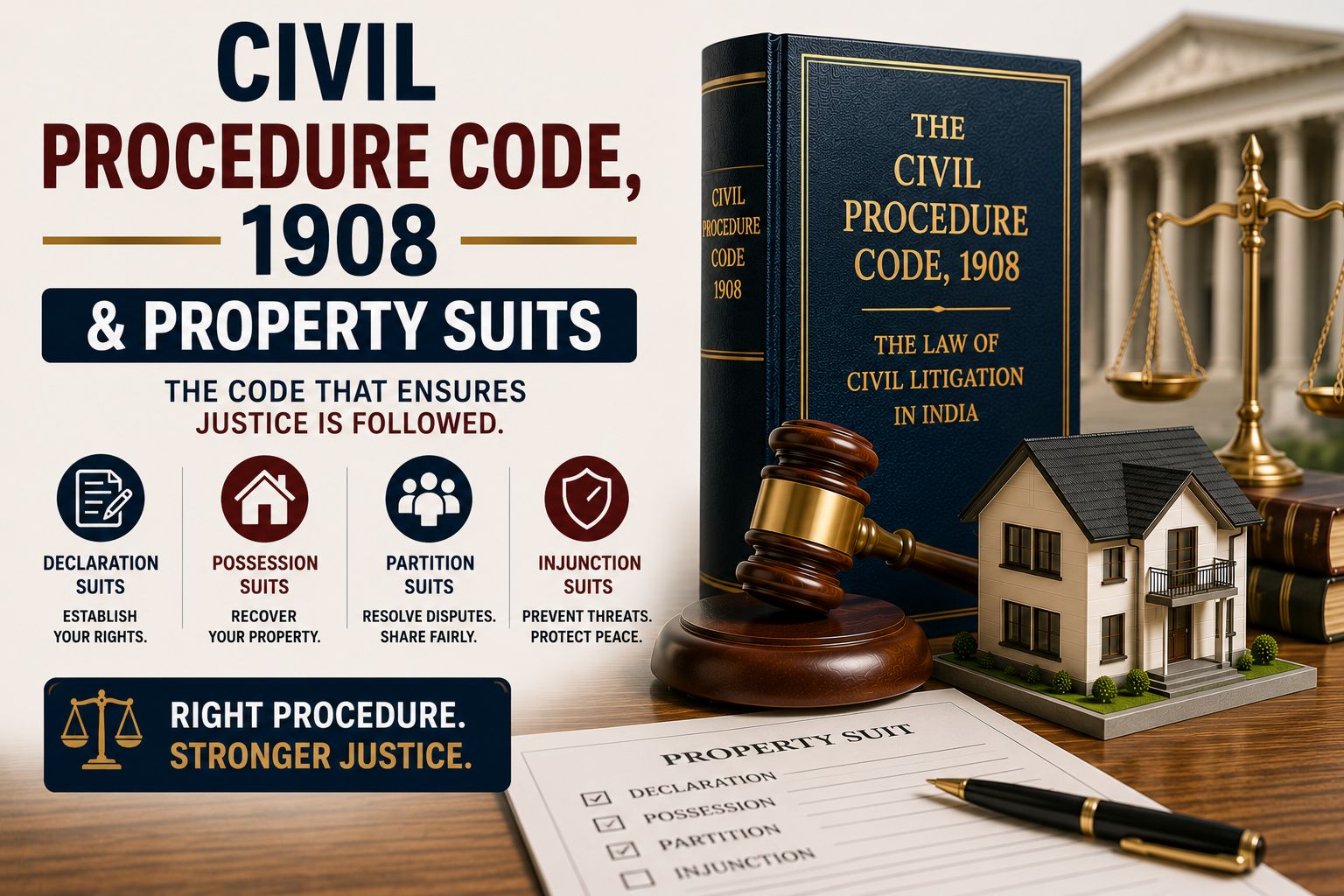
The Core Types of Property Suits Under CPC
1. Suits for Declaration
A declaratory suit asks the court to formally declare a party’s legal right or status — for instance, declaring someone the rightful owner of a property where ownership itself is disputed. This doesn’t necessarily order any action, but it establishes a legal fact the court can then enforce.
2. Suits for Possession
When someone is wrongfully occupying property, or a rightful owner has been dispossessed, a suit for possession asks the court to order that the property be handed back to its legitimate owner.
3. Suits for Partition
When property is jointly owned — often inherited family property — and co-owners can’t agree on how to divide it, a partition suit asks the court to formally divide the property, or order its sale with proceeds distributed proportionally.
4. Suits for Injunction
An injunction suit seeks a court order preventing a party from doing something that would harm the plaintiff’s rights — such as stopping construction, preventing a sale, or halting interference with peaceful possession.
Injunctions: Temporary vs. Permanent
This distinction matters enormously in fast-moving property disputes:
| Type | Purpose | When Granted |
|---|---|---|
| Temporary (Interim) Injunction | Preserves the status quo while the suit is pending | Early in the case, often urgently, to prevent immediate harm |
| Permanent Injunction | A final order after the full trial | Granted only after the court decides the merits of the case |
A temporary injunction can be the difference between stopping a builder from selling your booked unit to someone else today, versus discovering it’s already sold by the time your case is finally heard.
How a Typical Civil Property Suit Proceeds
Step 1: Filing the plaint — the formal document laying out facts, the cause of action, and the relief sought, filed in a court with appropriate jurisdiction.
Step 2: Issuance of summons — the defendant is formally notified and given an opportunity to respond.
Step 3: Written statement — the defendant files their response, admitting or denying the claims.
Step 4: Framing of issues — the court identifies the specific questions of fact and law that need to be decided.
Step 5: Evidence and trial — both sides present documents, witnesses, and arguments.
Step 6: Judgment and decree — the court delivers its decision, and a formal decree is issued, which becomes enforceable.
Step 7: Execution — if the losing party doesn’t comply voluntarily, the winning party can seek execution of the decree, including police assistance for possession matters where necessary.
This process, while thorough, is also why civil suits are often criticized for taking years — a stark contrast to RERA’s intended 60-day disposal timeline for many disputes.
Where the CPC Intersects With the Rest of This Series
The CPC doesn’t replace the other laws — it’s the vehicle that carries them into court:
- A Specific Relief Act claim for specific performance is filed and processed as a civil suit under CPC procedure
- A Transfer of Property Act dispute over ownership often becomes a declaratory or possession suit under CPC
- Documents proved admissible under the Bharatiya Sakshya Adhiniyam are formally presented as evidence within a CPC trial
- Limitation Act deadlines determine whether a CPC suit can even be filed in the first place
Why This Matters for Buyers Who Assume RERA Covers Everything
Here’s a common and costly misconception: assuming that because RERA exists, civil courts and the CPC are no longer relevant to real estate disputes. In reality:
- Title disputes, boundary disputes, and inheritance-linked property conflicts typically still require civil suits
- Disputes involving parties outside the builder-buyer relationship (neighbors, co-owners, third-party claimants) generally fall outside RERA’s scope
- Complex cases sometimes require civil court powers — like permanent injunctions or partition — that RERA authorities aren’t designed to grant
This is exactly why an experienced property lawyer evaluates each dispute individually, deciding whether RERA, a consumer commission, or a full civil suit under the CPC is the right — or sometimes necessary — forum.
The Bottom Line
Rights on paper mean little without a functioning process to enforce them. The Civil Procedure Code, 1908 is that process — the structured pathway through which declarations, possession, partition, and injunctions actually get decided and enforced in Indian courts. For property disputes too complex or too far outside RERA’s scope, it remains the ultimate mechanism buyers rely on.
Facing a title dispute, possession issue, or property matter beyond a builder relationship? Consult a lawyer to determine whether a civil suit under the CPC is the right path for your case.
FAQs
Q1: Can I file a property case in civil court if I’ve already approached RERA? It depends on the nature of your claim. Some matters fall outside RERA’s scope entirely and require civil court remedies, while pursuing overlapping claims for the same relief across forums needs careful legal strategy.
Q2: What’s the difference between a temporary and permanent injunction? A temporary injunction is an urgent, interim measure to preserve the status quo while a case is pending. A permanent injunction is a final order granted only after the full trial concludes.
Q3: How long does a typical civil property suit take? Civil suits can take considerably longer than RERA or consumer forums, often extending over several years depending on complexity, evidence, and court workload.
Q4: Is a partition suit necessary for all jointly owned property disputes? Not always — co-owners can sometimes reach a private, registered partition agreement. A partition suit becomes necessary when co-owners cannot agree and require court intervention.
Q5: What happens if the losing party doesn’t comply with a court decree? The winning party can seek execution of the decree through the court, which can include measures like attaching property or, in possession matters, enforcing the order through official assistance.