Here’s something that surprises many buyers: you can have a registered sale deed, paid stamp duty, and a clean title — and still run into trouble because your name was never updated in the local revenue records, or your building has an unapproved extra floor sitting on top of it.
That’s because ownership on paper and ownership on the ground are governed by two different systems. The Acts covered so far in this series handle the legal transfer. Municipal and revenue rules are what local authorities actually use, day to day, to recognize, tax, and regulate your property.
Why “State & Local” Rules Matter So Much
Unlike RERA, the Transfer of Property Act, or the Contract Act — which apply broadly across India with largely uniform principles — municipal and revenue regulation is inherently local. Each state, and often each municipal corporation within that state, sets its own building bye-laws, land-use classifications, mutation procedures, and property tax structures.
This is exactly why two buyers in different cities, holding functionally identical sale deeds, can face very different real-world compliance requirements.
Building Bye-Laws: What You’re Actually Allowed to Build
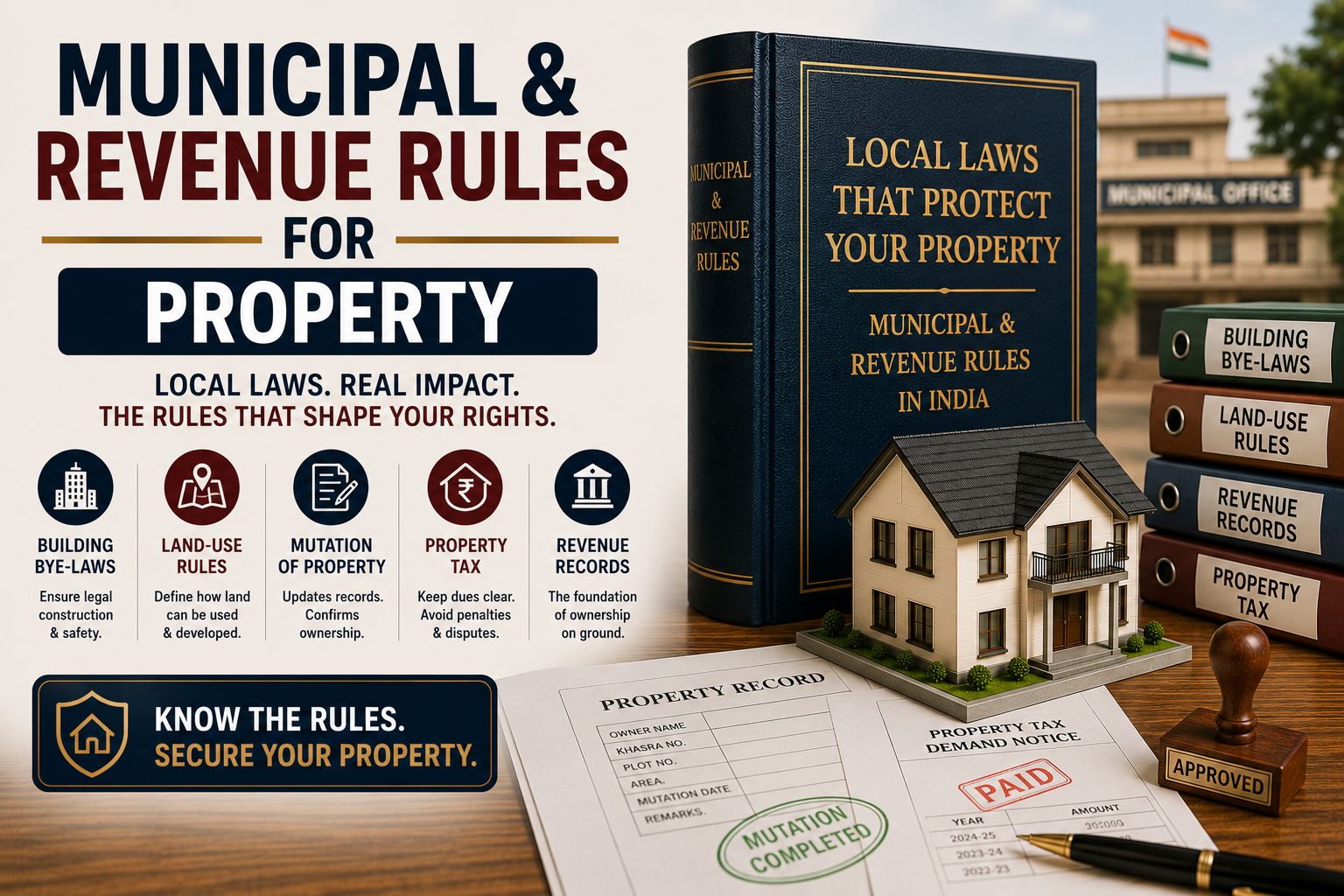
Municipal building bye-laws govern the physical construction of any structure — height limits, floor space index (FSI/FAR), setback requirements, parking norms, and structural safety standards.
Why this matters for buyers:
- Unauthorized construction — an extra floor, an extended balcony, or a converted terrace built without approval — can render part of a building illegal, regardless of how legitimate the underlying sale deed looks
- Deviation from sanctioned plans creates real risk, including potential demolition orders or regularization costs down the line
- Occupancy certificates, issued only after bye-law compliance is verified, are often essential for utility connections, resale, and loan approvals
A property with a technically valid sale deed but bye-law violations can still become a legal and financial headache — which is why checking sanctioned building plans against actual construction is a standard part of serious due diligence.
Land-Use Rules: Is This Property Even Meant for What You Think?
Every parcel of land typically falls under a specific land-use classification — residential, commercial, agricultural, industrial, or mixed-use — as defined by the local development authority’s master plan or zoning regulations.
This becomes critical because:
- Agricultural land generally cannot be used for residential or commercial construction without proper conversion approval
- Buying land with mismatched land-use classification can leave a buyer with a technically unusable or unregularizable property
- Land-use conversion, where permitted, typically requires a formal application and approval process before construction can lawfully begin
Buyers eyeing plots on the outskirts of expanding cities should pay particularly close attention here — some of the most common real estate disputes in India trace back to land sold for residential use that was never actually converted from agricultural classification.
Mutation: The Step Buyers Most Often Forget
Mutation is the process of updating the local revenue records to reflect a change in property ownership — essentially telling the municipal or revenue authority, “this property now belongs to someone new.”
Here’s the critical distinction many buyers miss: registration under the Registration Act makes your sale deed legally recorded, but mutation is what updates the actual revenue/municipal ownership records used for tax and administrative purposes.
| Registration | Mutation | |
|---|---|---|
| Governed by | Registration Act, 1908 | State-specific municipal/revenue rules |
| Purpose | Legal recording of the transaction document | Updating local ownership records for tax and administrative purposes |
| Effect on Ownership | Establishes the transfer legally | Doesn’t itself transfer ownership, but is essential for practical recognition |
| Commonly Needed For | Court evidence, legal enforceability | Property tax billing, utility transfers, future sale documentation |
Skipping mutation after a purchase is one of the most common — and most avoidable — mistakes buyers make. Years later, it can complicate resale, loan applications, or even inheritance matters, simply because the local records never caught up with the actual ownership.
Property Tax: The Recurring Obligation Tied to Local Records
Property tax is levied by municipal authorities based on factors like built-up area, location, usage type, and applicable local rates. A few practical points buyers should know:
- Property tax obligations are typically tied to whoever is recorded in municipal records — reinforcing why mutation matters
- Unpaid property tax dues from a previous owner can sometimes become a complication for a new buyer, making tax clearance checks an important part of due diligence before purchase
- Tax rates and calculation methods vary considerably by municipal corporation, and many now offer online portals for payment, dues verification, and mutation-linked updates
How This Connects to the Rest of the Legal Series
Municipal and revenue rules aren’t a replacement for the other laws covered so far — they’re the ground-level layer that makes legal ownership practically functional:
- The Transfer of Property Act and Registration Act establish legal ownership
- Municipal bye-laws determine whether what’s actually built is lawful
- Mutation ensures local authorities recognize the new owner for tax and administrative purposes
- RERA regulates the developer’s conduct during the project, but doesn’t replace the buyer’s individual responsibility to complete mutation and verify local compliance after possession
A buyer who’s diligent about RERA compliance, registration, and stamp duty — but skips mutation or ignores unauthorized construction — hasn’t actually completed the ownership journey.
Practical Checklist for Buyers
- Verify sanctioned building plans against actual construction before purchase
- Confirm land-use classification matches your intended use, especially for plots or peripheral areas
- Complete mutation promptly after registration — don’t assume it happens automatically
- Check property tax dues are cleared up to date before finalizing a resale purchase
- Retain occupancy certificates and approval documents, as these are frequently required for loans, resale, and future compliance checks
The Bottom Line
The grand legal framework — RERA, the Contract Act, the Transfer of Property Act, and everything else in this series — ultimately has to land somewhere real: a specific plot, a specific building, recognized by a specific municipal authority. Municipal and revenue rules are where that landing actually happens, and they’re often the most overlooked part of a buyer’s due diligence.
Buying a property, or unsure if your mutation and compliance records are up to date? A property lawyer can verify the ground-level details that paperwork alone doesn’t always reveal.
FAQs
Q1: Is mutation legally required after buying a property? While mutation itself doesn’t transfer ownership, it’s essential for updating local revenue records, and skipping it can create practical complications for tax, utilities, and future transactions.
Q2: Can I build extra floors or extend my property without approval? No. Unauthorized construction beyond sanctioned building plans can lead to legal complications, including regularization costs or demolition orders, regardless of your ownership status.
Q3: What happens if I buy agricultural land planning to build a house on it? You generally need formal land-use conversion approval before residential construction is legally permitted; building without conversion can create serious regularization risks.
Q4: Am I responsible for a previous owner’s unpaid property tax? This can become complicated depending on local rules, which is why verifying tax clearance is an important part of due diligence before purchasing a resale property.
Q5: Does RERA cover municipal compliance issues like unauthorized construction? Not directly. RERA primarily regulates developer conduct, registration, and buyer protections during the sale process, while municipal bye-law compliance is governed separately by local authorities.