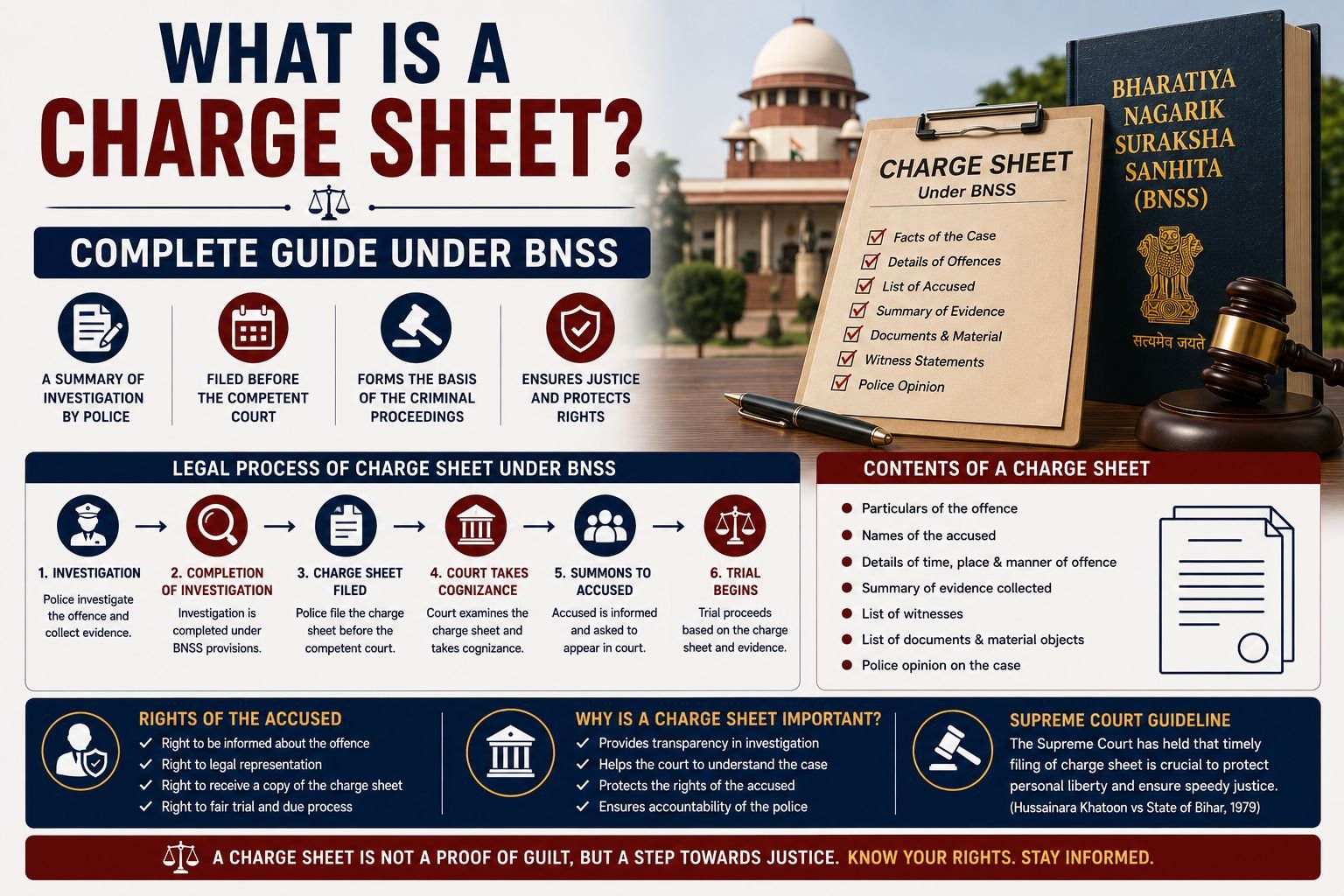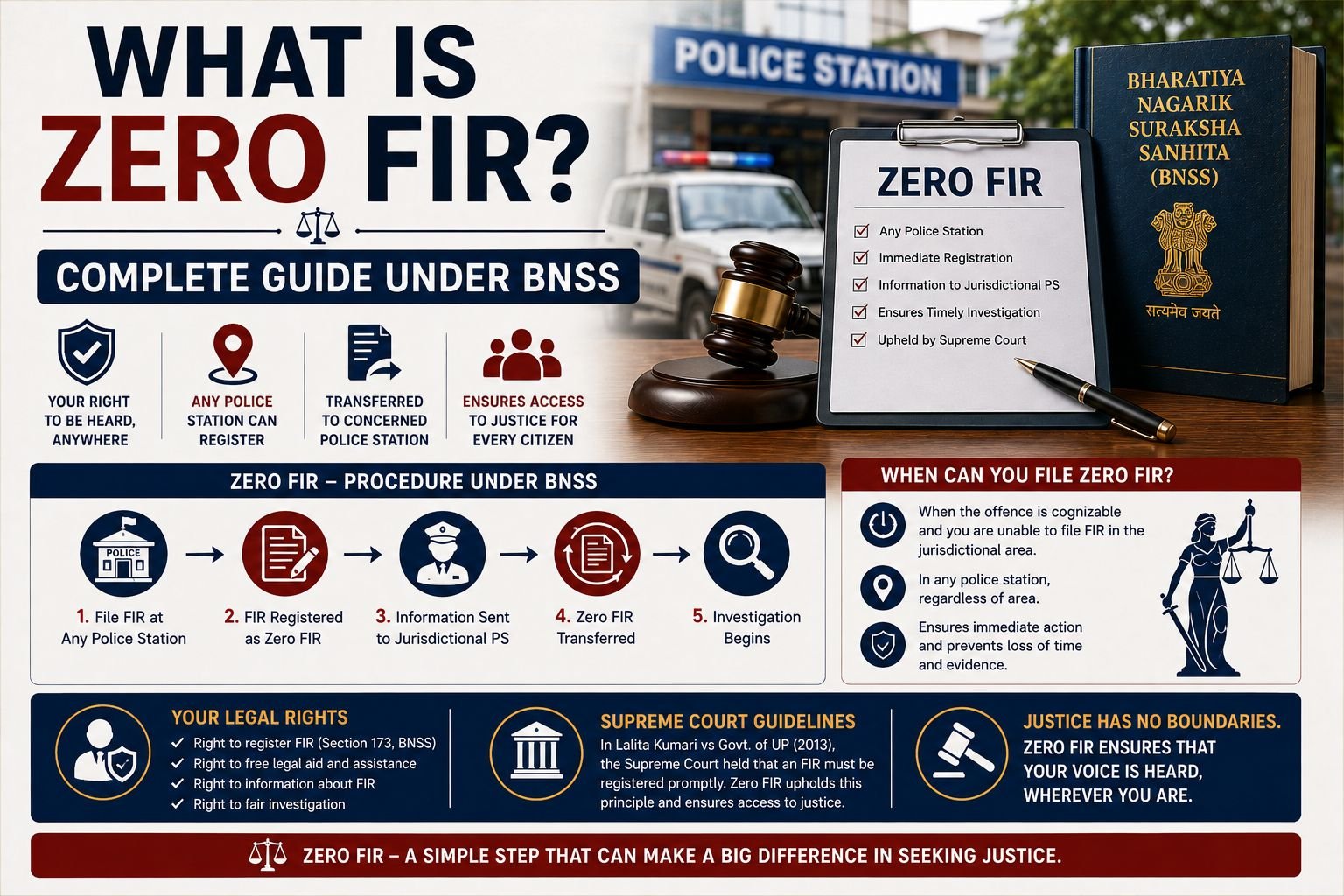
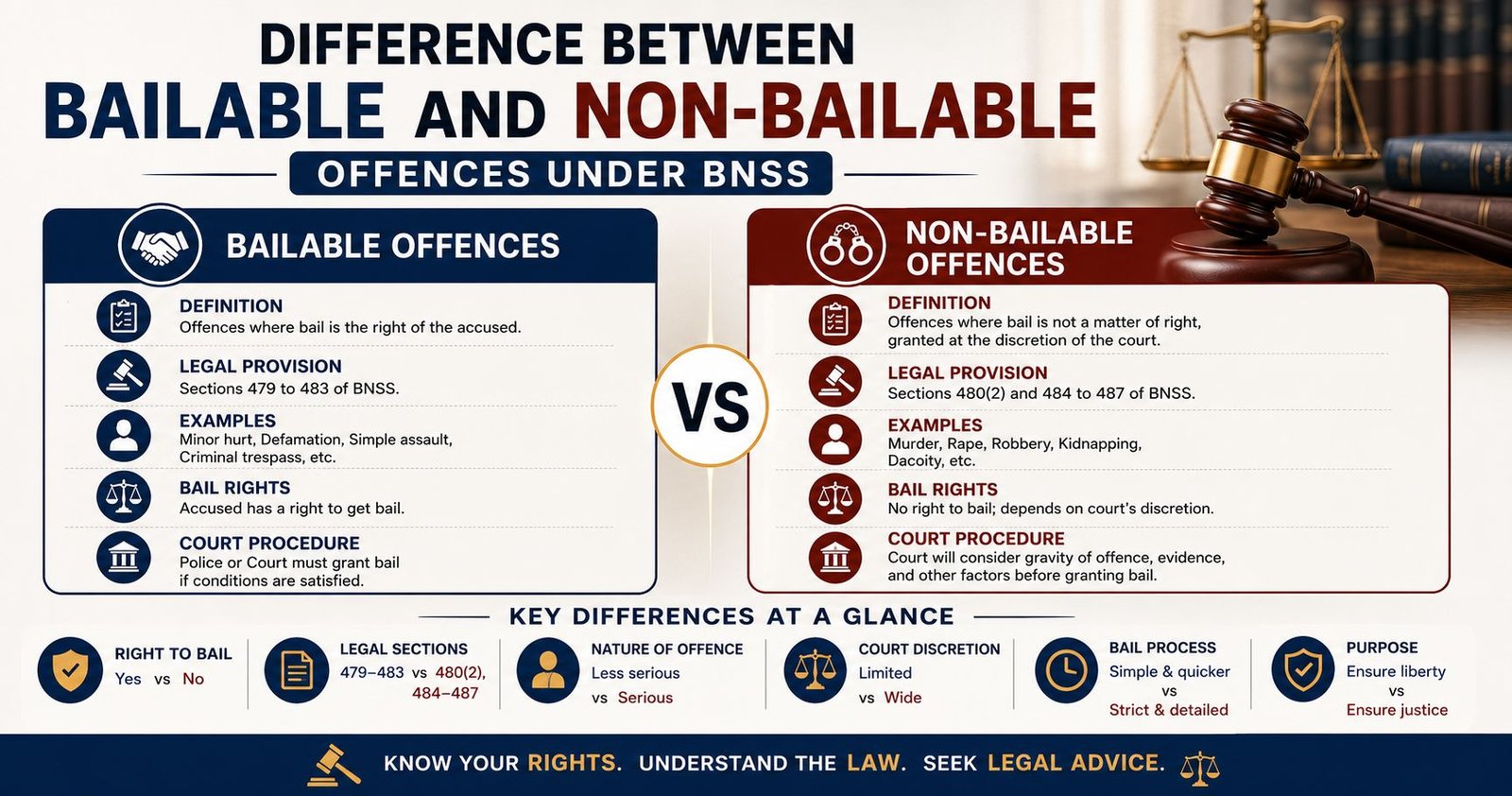
Understanding the difference between bailable and non-bailable offences is one of the most important aspects of criminal law in India. Whether a person is accused of a crime, a family member is facing arrest, or someone simply wants to understand the legal process, knowing the distinction between these two categories of offences helps in understanding bail rights, arrest procedures, and the role of courts.
The Bharatiya Nagarik Suraksha Sanhita, 2023 (BNSS) governs the criminal procedure relating to arrest, investigation, custody, and bail in India. While every accused person has important legal rights, the procedure for obtaining bail differs significantly depending on whether the alleged offence is classified as bailable or non-bailable.
In this comprehensive guide, we explain the meaning of both categories, their legal implications, constitutional principles, and why this distinction plays a crucial role in the criminal justice system.
In this article, you will learn:
- Meaning of bailable offences.
- Meaning of non-bailable offences.
- Key differences between the two.
- Rights of an accused person.
- Powers of the police and courts.
- Bail procedure under the BNSS.
- Practical examples.
- Frequently asked questions.
What Are Criminal Offences?
A criminal offence is an act or omission that is prohibited by law and is punishable by the State. Criminal offences are investigated by law enforcement agencies and tried before criminal courts.
Offences vary in seriousness. Some involve relatively minor violations of law, while others involve grave crimes affecting individuals or society.
The classification of offences helps determine:
- The procedure for arrest.
- Investigation powers.
- Availability of bail.
- Trial process.
- Punishment prescribed by law.
One of the most important classifications is between bailable and non-bailable offences.
What is a Bailable Offence?
A bailable offence is an offence in which the accused generally has a legal right to be released on bail, subject to compliance with the applicable legal provisions.
In such cases:
- Bail is ordinarily available as a matter of right.
- The police or the court may release the accused after completion of the required formalities.
- The accused must comply with the conditions of bail.
Bailable offences are generally considered less serious compared to non-bailable offences, although the classification depends on the applicable law rather than public perception.
Key Features of Bailable Offences
Some important characteristics include:
- Bail is generally available as a legal right.
- The police may grant bail in appropriate cases where authorised by law.
- The court may also grant bail.
- The accused executes a bail bond and, where required, provides sureties.
- The criminal proceedings continue even after the accused is released.
Being granted bail does not mean that the accused has been acquitted or declared innocent.
What is a Non-Bailable Offence?
A non-bailable offence is an offence in which bail is not available as a matter of right.
In these cases, the accused must apply to the competent court, which decides whether bail should be granted after considering the facts and circumstances of the case.
The court exercises judicial discretion while deciding such applications.
Key Features of Non-Bailable Offences
Important features include:
- Bail is not automatic.
- Judicial discretion plays an important role.
- The court examines the seriousness of the allegations.
- The prosecution is generally given an opportunity to oppose bail.
- Conditions may be imposed if bail is granted.
- Every case is decided on its own merits.
Grant of bail depends upon the applicable legal provisions and the facts presented before the court.
Why Does the Difference Matter?
The distinction between bailable and non-bailable offences has practical consequences for an accused person.
It affects:
- The right to obtain bail.
- The authority competent to grant bail.
- The role of the police.
- The powers of the court.
- Duration of custody.
- Bail procedure.
- Investigation process.
Understanding this difference enables accused persons and their families to take timely legal steps.
Constitutional Right to Personal Liberty
The concept of bail is closely linked with Article 21 of the Constitution of India, which guarantees that no person shall be deprived of life or personal liberty except according to the procedure established by law.
Indian courts have repeatedly emphasised that personal liberty is a valuable constitutional right.
At the same time, courts must balance:
- Individual liberty.
- Public safety.
- Fair investigation.
- Administration of justice.
The classification of offences helps courts strike this balance.
Bail Under the BNSS
The Bharatiya Nagarik Suraksha Sanhita, 2023 (BNSS) provides the procedural framework governing criminal cases, including provisions relating to arrest and bail.
While deciding bail applications, courts generally consider factors such as:
- Nature of the offence.
- Gravity of allegations.
- Stage of investigation.
- Criminal antecedents.
- Possibility of absconding.
- Risk of witness intimidation.
- Possibility of evidence tampering.
- Interests of justice.
The legal approach differs depending on whether the offence is bailable or non-bailable.
Objectives of Classifying Offences
The law classifies offences into different categories to ensure that criminal procedure remains fair, proportionate, and effective.
Some important objectives include:
Protecting Individual Liberty
Less serious offences generally allow easier access to bail, reducing unnecessary detention.
Protecting Society
Serious offences may require stricter judicial scrutiny before granting bail to ensure public safety.
Ensuring Proper Investigation
The classification helps investigating agencies conduct effective investigations while protecting the rights of accused persons.
Preventing Misuse of Liberty
Courts may impose appropriate conditions to ensure that the accused does not misuse the liberty granted through bail.
Maintaining Public Confidence
A balanced bail system strengthens public confidence in the criminal justice system by protecting both individual rights and societal interests.
Key Legal Terms You Should Know
Before understanding the difference between bailable and non-bailable offences, it is useful to know some commonly used legal terms.
Accused
A person against whom criminal allegations have been made.
FIR (First Information Report)
The document registered by the police upon receiving information regarding the commission of a cognisable offence.
Arrest
The legal act of taking a person into custody according to law.
Bail
The temporary release of an accused person from custody, subject to conditions imposed by the competent authority or court.
Bail Bond
A written undertaking executed by the accused, promising to appear before the court and comply with the conditions of bail.
Surety
A person who undertakes responsibility for ensuring that the accused complies with the bail conditions.
Judicial Custody
Custody authorised by a court, where the accused remains under judicial supervision.
Police Custody
Custody granted to the investigating agency for the purpose of investigation, subject to judicial oversight.
Remand
A judicial order authorising continued custody of the accused for a legally permissible period.
Overview Table: Bailable vs Non-Bailable Offences
| Basis | Bailable Offence | Non-Bailable Offence |
|---|---|---|
| Right to Bail | Generally available as a matter of right | Not available as a matter of right |
| Authority Granting Bail | Police or Court, depending on the law | Competent Court |
| Judicial Discretion | Limited in granting bail where bail is a right | Significant judicial discretion |
| Seriousness | Generally less serious | Generally more serious |
| Bail Procedure | Comparatively simpler | More detailed judicial scrutiny |
| Investigation | Continues after release | Continues whether or not bail is granted |
| Conditions | May be imposed | Often subject to stricter conditions |
Common Misconceptions
Many people misunderstand the meaning of a non-bailable offence.
Some common misconceptions include:
- Myth: Non-bailable means bail can never be granted.
Fact: Bail may still be granted by the competent court depending on the facts and applicable law. - Myth: Every serious offence automatically results in denial of bail.
Fact: Courts decide each bail application individually after considering the relevant legal factors. - Myth: Grant of bail means the accused has been declared innocent.
Fact: Bail is only temporary release from custody and does not determine guilt or innocence.
Importance of Legal Assistance
Whether an offence is bailable or non-bailable, obtaining legal advice at the earliest opportunity can help an accused person understand:
- The correct bail procedure.
- The appropriate court.
- Documents required.
- Legal rights.
- Bail conditions.
- Available legal remedies.
Proper legal guidance helps ensure that applications are prepared in accordance with the BNSS and applicable judicial principles.
Difference Between Bailable and Non-Bailable Offences
Although both categories involve criminal offences, the procedure for arrest, bail, and judicial intervention differs significantly.
The following table provides a quick comparison.
| Basis | Bailable Offence | Non-Bailable Offence |
|---|---|---|
| Right to Bail | Generally available as a matter of right | Granted at the discretion of the court |
| Who Grants Bail | Police or Court | Competent Court |
| Judicial Discretion | Limited | Significant |
| Nature of Offence | Generally less serious | Generally more serious |
| Bail Procedure | Comparatively simple | More detailed judicial scrutiny |
| Police Powers | May release on bail where authorised | Cannot grant bail as a matter of right |
| Court Hearing | Usually straightforward | Detailed hearing may be required |
| Bail Conditions | Usually less stringent | Often stricter conditions |
| Custody | May be shorter | May continue until court considers bail |
| Investigation | Continues after release | Continues whether bail is granted or not |
Nature of the Offence
The seriousness of an offence plays an important role in determining whether it is classified as bailable or non-bailable.
Bailable Offences
These offences generally involve comparatively less serious criminal conduct. The law provides easier access to bail because the risk to society is usually considered lower.
Examples may include certain offences involving:
- Minor hurt.
- Simple assault.
- Public nuisance.
- Defamation.
- Wrongful restraint.
- Minor property-related offences, depending on the applicable law.
Non-Bailable Offences
These offences generally involve allegations of a more serious nature.
Examples may include:
- Murder.
- Rape.
- Kidnapping.
- Terror-related offences.
- Large-scale financial fraud.
- Attempt to murder.
- Dacoity.
The classification depends upon the relevant penal law and not merely the severity perceived by the public.
Right to Bail
This is the most significant distinction.
In Bailable Offences
The accused generally has a legal right to be released on bail after complying with the applicable legal requirements.
The police or court ordinarily grants bail upon execution of the required bond.
In Non-Bailable Offences
The accused has the right to apply for bail, but not an automatic right to obtain it.
The court considers various legal factors before deciding whether bail should be granted.
Who Can Grant Bail?
The competent authority differs depending on the nature of the offence.
Bailable Offences
Bail may be granted by:
- The police officer authorised by law.
- The Judicial Magistrate.
- Other competent courts where necessary.
Non-Bailable Offences
Bail is generally considered by:
- Judicial Magistrate (where empowered).
- Sessions Court.
- High Court.
- Supreme Court, where legally permissible.
The investigating officer cannot grant bail as a matter of right in non-bailable offences.
Police Powers
The role of the police differs significantly.
In Bailable Offences
The police may release the accused on bail after completion of the necessary legal formalities, where authorised by law.
The accused usually executes a bail bond and may provide sureties if required.
In Non-Bailable Offences
The police investigate the offence and produce the accused before the competent court.
The decision regarding bail is generally taken by the court.
Court’s Discretion
Judicial discretion is one of the defining features of non-bailable offences.
Bailable Offences
Where bail is available as a matter of right, the court generally does not undertake extensive scrutiny before granting bail, provided legal requirements are fulfilled.
Non-Bailable Offences
The court carefully evaluates factors such as:
- Nature of allegations.
- Gravity of the offence.
- Stage of investigation.
- Criminal antecedents.
- Risk of absconding.
- Possibility of witness intimidation.
- Likelihood of evidence tampering.
- Overall interests of justice.
Arrest Procedure
The arrest procedure also differs in practical terms.
Bailable Offences
After arrest:
- The accused is informed of the grounds of arrest.
- The accused is informed of the right to bail where applicable.
- Bail formalities may be completed promptly.
Non-Bailable Offences
After arrest:
- The accused is produced before the Magistrate within the prescribed legal period.
- Custody is governed by judicial orders.
- Bail requires an application before the competent court.
Bail Bond Requirements
The execution of a bail bond is common in both categories, but the process differs.
Bailable Offences
The accused usually executes:
- Personal bond.
- Surety bond, where required.
The process is generally quicker.
Non-Bailable Offences
The court determines:
- Amount of bond.
- Number of sureties.
- Additional conditions.
- Reporting requirements.
- Travel restrictions, if necessary.
Investigation Process
Grant of bail does not stop the criminal investigation.
Bailable Offences
Even after release:
- Police continue investigating.
- Evidence is collected.
- Witnesses are examined.
- Charge sheet may later be filed.
Non-Bailable Offences
Similarly:
- Investigation continues.
- Custodial interrogation may be considered where legally justified.
- The accused may later obtain bail depending on the progress of the investigation.
Role of the Accused
Regardless of the category of offence, the accused has important legal responsibilities.
These include:
- Cooperating with the investigation.
- Appearing before the court.
- Following bail conditions.
- Not threatening witnesses.
- Not tampering with evidence.
Failure to comply may have legal consequences.
Rights of the Victim
Modern criminal procedure also recognises the interests of victims.
Victims may:
- Be heard where the law provides.
- Participate in proceedings in accordance with applicable legal provisions.
- Raise objections where permitted.
- Seek protection from witness intimidation.
- Request compliance with court orders.
The court balances the rights of the accused with the interests of victims and society.
Practical Examples
Example 1 – Bailable Offence
A person is arrested for an offence classified as bailable.
The investigating officer informs the accused of the right to bail. After executing the required bail bond and completing the formalities, the accused is released while the investigation continues.
Example 2 – Non-Bailable Offence
A person is arrested for an offence classified as non-bailable.
The accused is produced before the Magistrate. A bail application is filed before the competent court, which hears both the defence and the prosecution before deciding whether bail should be granted.
Example 3 – Bail with Conditions
An accused in a non-bailable offence is granted bail subject to:
- Furnishing two sureties.
- Surrendering the passport.
- Appearing before the investigating officer once every week.
- Not contacting prosecution witnesses.
Failure to comply with these conditions may lead to cancellation of bail.
Rights Available in Both Types of Offences
Whether an offence is bailable or non-bailable, every accused person continues to enjoy certain constitutional and legal protections, including:
- Right to legal representation.
- Right to be informed of the grounds of arrest.
- Right to be produced before a Magistrate within the prescribed legal time.
- Right to a fair investigation.
- Right to a fair trial.
- Protection against unlawful detention.
- Right to apply for bail where permitted by law.
Common Misunderstandings
Many people misunderstand the distinction between these two categories.
Myth 1: Non-Bailable Means Bail Is Impossible
Reality: Bail may still be granted by the competent court after considering the facts and applicable legal principles.
Myth 2: Every Bailable Offence Is Minor
Reality: The classification depends on the law. The seriousness of an offence is only one factor considered by the legislature.
Myth 3: Bail Ends the Criminal Case
Reality: Bail only allows temporary release from custody. The investigation and trial continue until the case is decided by the court.
Procedure in Bailable Offences
The procedure for obtaining bail in a bailable offence is generally straightforward because the accused ordinarily has a legal right to be released on bail, subject to compliance with the applicable legal requirements.
The usual process is as follows:
Step 1 – Arrest or Appearance
The accused may be arrested by the police or may appear before the court if required.
Step 2 – Information About Bail
The accused is informed that the offence is bailable and that bail may be obtained upon fulfilling the prescribed conditions.
Step 3 – Execution of Bail Bond
The accused executes a bail bond and, where required, provides one or more sureties.
Step 4 – Verification
The police or court verifies the identity and documents of the accused and sureties.
Step 5 – Release
Once the required formalities are completed, the accused is released while the investigation or trial continues.
Procedure in Non-Bailable Offences
The process is more detailed because bail is not granted as a matter of right.
Step 1 – Arrest
The accused is arrested in accordance with law.
Step 2 – Production Before Magistrate
The accused is produced before the competent Magistrate within the legally prescribed time.
Step 3 – Filing a Bail Application
A bail application is filed before the competent court, usually through an advocate.
Step 4 – Notice to the Prosecution
The prosecution is generally given an opportunity to present its objections.
Step 5 – Hearing
The court hears both the defence and the prosecution.
Step 6 – Judicial Consideration
The court examines the facts, applicable law, and surrounding circumstances.
Step 7 – Court Order
The court may:
- Grant bail.
- Reject the application.
- Grant interim protection.
- Impose specific conditions while granting bail.
Documents Required for Bail
Although requirements differ from case to case, the following documents are commonly submitted.
Basic Documents
- Copy of the FIR.
- Bail application.
- Arrest memo.
- Remand order.
- Identity proof.
- Address proof.
- Passport-size photographs (where required).
- Vakalatnama.
Supporting Documents
Where applicable:
- Medical records.
- Employment documents.
- Educational records.
- Family-related documents.
- Previous bail orders.
- Character certificates.
- Affidavits.
- Other supporting evidence.
Documents Required from Sureties
Where sureties are required, they may need to produce:
- Identity proof.
- Address proof.
- Photographs.
- PAN Card or Aadhaar Card (where applicable).
- Proof of financial capacity if directed by the court.
Factors Courts Consider Before Granting Bail
Whether the offence is bailable or non-bailable, courts examine several important considerations.
1. Nature of the Allegations
The seriousness of the allegations is one of the primary considerations.
2. Gravity of the Offence
More serious offences generally receive closer judicial scrutiny.
3. Stage of Investigation
The court examines whether:
- Investigation is ongoing.
- Charge sheet has been filed.
- Further custodial interrogation is required.
4. Criminal Antecedents
Previous criminal history may influence the court’s decision.
5. Possibility of Absconding
The court considers whether the accused is likely to evade the legal process.
6. Possibility of Tampering with Evidence
Protection of evidence is an important consideration while deciding bail.
7. Possibility of Influencing Witnesses
The court evaluates whether the accused may threaten or influence witnesses.
8. Health and Humanitarian Grounds
Serious illness, disability, advanced age, pregnancy, or other humanitarian circumstances may also be relevant in appropriate cases.
9. Interests of Justice
Ultimately, the court balances the rights of the accused with the interests of society and the administration of justice.
Common Examples of Bailable Offences
The exact classification depends on the applicable penal law. Some offences that may be classified as bailable include:
- Simple hurt.
- Wrongful restraint.
- Public nuisance.
- Defamation.
- Minor assault.
- Criminal trespass in certain circumstances.
- Mischief involving relatively minor damage.
Always verify the classification under the applicable legal provisions, as it depends on the specific offence and statute.
Common Examples of Non-Bailable Offences
Examples generally include more serious allegations such as:
- Murder.
- Attempt to murder.
- Rape.
- Kidnapping.
- Dacoity.
- Terror-related offences.
- Serious economic offences.
- Large-scale cheating and fraud in appropriate circumstances.
The applicable law determines whether a particular offence is bailable or non-bailable.
Can a Non-Bailable Offence Become Bailable?
This is a common question.
A non-bailable offence does not automatically become a bailable offence. However, the accused may still obtain bail if the competent court, after considering the facts and applicable legal principles, decides to grant bail.
The classification of the offence generally remains the same unless changed by legislation or judicial interpretation in accordance with law.
Can Bail Be Cancelled?
Yes.
Even after bail has been granted, the competent court may cancel it in appropriate circumstances.
Common reasons include:
- Violation of bail conditions.
- Failure to appear before the court.
- Threatening or influencing witnesses.
- Tampering with evidence.
- Committing another offence while on bail.
- Misuse of the liberty granted by the court.
Cancellation is not automatic and follows due legal process.
What Happens After Bail Is Granted?
After the court grants bail:
- The accused executes the bail bond.
- Sureties furnish the required documents, if applicable.
- The court verifies compliance with the bail order.
- A release order is issued.
- The accused is released from custody.
- The accused must comply with every condition imposed by the court.
The criminal investigation or trial continues despite the grant of bail.
Rights of the Accused After Bail
An accused released on bail generally has the right to:
- Consult a lawyer.
- Prepare a defence.
- Attend court proceedings.
- Receive a fair trial.
- Seek modification of bail conditions where appropriate.
These rights remain subject to the conditions imposed by the court.
Responsibilities After Bail
The accused must:
- Attend every court hearing.
- Cooperate with the investigation.
- Follow all bail conditions.
- Inform the court of any required change of address.
- Avoid influencing witnesses.
- Avoid tampering with evidence.
Failure to comply may result in cancellation of bail.
Common Mistakes While Seeking Bail
Applicants should avoid the following:
- Filing before the wrong court.
- Choosing the incorrect type of bail.
- Submitting incomplete documents.
- Concealing material facts.
- Ignoring court notices.
- Failing to arrange sureties.
- Missing hearing dates.
- Violating interim orders or bail conditions.
Proper preparation helps avoid unnecessary delays.
Practical Case Scenarios
Example 1 – Bailable Offence
A person is arrested for a bailable offence involving minor allegations. After executing the required bail bond and completing the formalities, the police release the accused, and the investigation continues.
Example 2 – Non-Bailable Offence
An accused is arrested in connection with a serious offence. A bail application is filed before the Sessions Court. After hearing both parties and considering the facts, the court grants bail subject to conditions such as furnishing sureties and appearing before the investigating officer when required.
Example 3 – Bail Cancelled
An accused who was granted bail repeatedly contacts prosecution witnesses despite an express condition prohibiting such contact. Upon an application by the prosecution, the court cancels the bail after following the prescribed legal process.
Frequently Asked Practical Questions
Can police refuse bail in a bailable offence?
Where the offence is legally classified as bailable and the accused fulfils the required conditions, the applicable legal provisions govern the grant of bail. Any dispute may be addressed before the competent court.
Does grant of bail end the criminal case?
No. Bail only permits temporary release from custody. The investigation and trial continue until the court decides the case.
Can the prosecution oppose bail?
Yes. In non-bailable offences, the prosecution is generally given an opportunity to oppose the bail application before the court.
Important Supreme Court Judgments on Bail
The Supreme Court of India has delivered several landmark judgments that have shaped the law relating to bail and personal liberty.
1. Gurbaksh Singh Sibbia v. State of Punjab (1980)
This is one of the most important judgments on bail jurisprudence.
Key Principles
- Personal liberty is a valuable constitutional right.
- Bail decisions must depend on the facts of each case.
- Courts should exercise judicial discretion carefully.
- There cannot be rigid rules for granting or refusing bail.
This judgment continues to guide courts while deciding bail applications.
2. Gudikanti Narasimhulu v. Public Prosecutor (1978)
The Supreme Court emphasised that liberty should not be curtailed unnecessarily.
Key Principles
- Bail should balance individual liberty and public interest.
- Courts should consider the circumstances of every case.
- Bail decisions should not be mechanical.
3. Sanjay Chandra v. CBI (2012)
The Court observed that detention before conviction should not become punishment.
Key Principles
- The purpose of bail is to secure the accused’s presence during trial.
- Bail is not intended to punish an accused before conviction.
- Long periods of pre-trial detention should generally be avoided where not legally justified.
4. Arnesh Kumar v. State of Bihar (2014)
This judgment introduced safeguards against unnecessary arrests.
Key Principles
- Arrest should not be automatic.
- Police officers must follow statutory requirements before making arrests.
- Courts should ensure compliance with procedural safeguards.
5. Satender Kumar Antil v. CBI (2022)
This judgment laid down comprehensive guidelines regarding arrest and bail.
Key Principles
- Bail applications should be decided expeditiously.
- Unnecessary incarceration should be avoided.
- Courts should protect the constitutional right to personal liberty while ensuring a fair investigation.
CrPC vs BNSS: Changes Relating to Bail
The Bharatiya Nagarik Suraksha Sanhita, 2023 (BNSS) has replaced the Code of Criminal Procedure, 1973 (CrPC) as the primary procedural law governing criminal cases.
Although the legal framework has been updated, the basic distinction between bailable and non-bailable offences continues.
| Feature | CrPC | BNSS |
|---|---|---|
| Governing Law | Code of Criminal Procedure, 1973 | Bharatiya Nagarik Suraksha Sanhita, 2023 |
| Bail Provisions | CrPC | BNSS |
| Bailable Offences | Recognised | Recognised |
| Non-Bailable Offences | Recognised | Recognised |
| Judicial Discretion | Yes | Yes |
| Personal Liberty | Protected | Protected |
The BNSS continues to emphasise procedural fairness while protecting the rights of both the accused and victims.
Rights of the Accused
Every accused person enjoys certain constitutional and statutory protections regardless of whether the offence is bailable or non-bailable.
These include:
- Right to know the grounds of arrest.
- Right to consult and be represented by a lawyer.
- Right to be produced before the Magistrate within the prescribed legal time.
- Right to apply for bail where permitted by law.
- Right against unlawful detention.
- Right to a fair investigation.
- Right to a fair and impartial trial.
- Right to present evidence in defence.
- Right to challenge adverse judicial orders before higher courts.
These safeguards help ensure that criminal proceedings are conducted fairly.
Rights and Duties of the Police
The police play an important role in the criminal justice system.
Their responsibilities include:
- Registering offences in accordance with law.
- Conducting a fair and impartial investigation.
- Informing the accused of the grounds of arrest.
- Producing the accused before the competent court within the legally prescribed period.
- Collecting evidence lawfully.
- Protecting victims and witnesses.
- Following all statutory safeguards during arrest and investigation.
Police officers are expected to act within the limits prescribed by law.
Rights of Victims
The criminal justice system also recognises the rights of victims.
Victims may have the right to:
- Receive information regarding the progress of the case where applicable.
- Participate in proceedings as permitted by law.
- Seek protection against threats or intimidation.
- Be represented through legal counsel where the law permits.
- Present relevant submissions before the court where applicable.
- Seek compensation where provided under the law.
The court seeks to balance the rights of victims with those of the accused.
Advantages of Bailable Offences
The legal framework for bailable offences offers several practical benefits.
1. Faster Release
Since bail is generally available as a matter of right, the accused can often secure release more quickly after completing the required formalities.
2. Better Protection of Personal Liberty
The law minimises unnecessary detention in comparatively less serious cases.
3. Reduced Burden on Courts
Many bailable matters can be processed without lengthy bail hearings, reducing judicial workload.
4. Lower Risk of Unnecessary Custody
The accused can continue daily life, employment, or education while the case proceeds.
5. Easier Access to Legal Defence
Release on bail allows the accused to consult lawyers, collect evidence, and prepare an effective defence.
Limitations of Bailable Offences
Despite these advantages, certain limitations remain.
- Bail does not end the criminal case.
- The accused must attend all court hearings.
- Bail conditions must be strictly followed.
- Violation of conditions may result in legal consequences.
- The investigation continues after release.
Advantages of Non-Bailable Offences
The stricter procedure for non-bailable offences serves important public interests.
1. Protects Public Safety
Judicial scrutiny helps ensure that persons accused of serious offences are not released without careful consideration.
2. Protects Witnesses
Courts can impose conditions to reduce the risk of witness intimidation.
3. Preserves Evidence
Stricter bail decisions may reduce the possibility of evidence being destroyed or altered.
4. Supports Effective Investigation
Where legally justified, custody may assist the investigation without compromising procedural safeguards.
5. Judicial Oversight
The court independently examines each case before deciding whether bail should be granted.
Limitations of Non-Bailable Offences
The stricter framework may also create practical challenges.
- Bail is not automatic.
- Court hearings may take longer.
- Detailed legal arguments are often required.
- The accused may remain in custody until the application is decided.
- Bail conditions may be more stringent.
However, every application is considered on its individual merits.
Common Myths About Bail
Many misconceptions exist regarding bailable and non-bailable offences.
Myth 1: Non-Bailable Means Bail Can Never Be Granted
Reality: Bail may still be granted by the competent court after considering the facts and applicable law.
Myth 2: Bail Means the Accused Is Innocent
Reality: Bail is only temporary release from custody. Guilt or innocence is determined only after the trial.
Myth 3: Police Decide Every Bail Application
Reality: In non-bailable offences, the competent court generally decides whether bail should be granted.
Myth 4: Every Serious Offence Automatically Results in Denial of Bail
Reality: Courts consider multiple factors before deciding a bail application. Seriousness alone does not determine the outcome.
Myth 5: Bail Stops the Investigation
Reality: The investigation continues even after the accused is released on bail.
Role of a Criminal Lawyer
An experienced criminal lawyer can assist at every stage of the bail process.
A lawyer may help by:
- Explaining whether the offence is bailable or non-bailable.
- Determining the appropriate legal remedy.
- Preparing the bail application.
- Collecting supporting documents.
- Representing the accused before the court.
- Responding to objections raised by the prosecution.
- Advising on compliance with bail conditions.
- Filing appeals or fresh applications where legally permissible.
Professional legal guidance can help ensure that procedural requirements are properly followed.
Practical Tips Before Applying for Bail
If you or a family member is involved in a criminal case, consider the following practical steps:
- Determine whether the alleged offence is bailable or non-bailable.
- Obtain a copy of the FIR and other relevant documents.
- Consult a criminal lawyer promptly.
- Prepare all supporting documents before filing the application.
- Arrange reliable sureties if required.
- Cooperate fully with the investigation.
- Attend every court hearing.
- Strictly comply with all bail conditions.
- Avoid influencing witnesses or interfering with evidence.
- Keep copies of all court orders and legal documents.
Proper preparation can help avoid unnecessary delays during the bail process.
Key Differences at a Glance
| Feature | Bailable Offence | Non-Bailable Offence |
|---|---|---|
| Bail | Generally a legal right | Subject to court’s discretion |
| Authority | Police or Court | Court |
| Hearing | Usually simpler | Often more detailed |
| Judicial Scrutiny | Limited | Extensive |
| Conditions | Generally fewer | May be stricter |
| Custody | Usually shorter | May continue until bail is granted |
| Public Interest | Lower-risk offences | Higher judicial scrutiny due to seriousness |
Frequently Asked Questions (FAQs)
1. What is a bailable offence?
A bailable offence is one in which the accused generally has the legal right to be released on bail after complying with the applicable legal requirements under the BNSS.
2. What is a non-bailable offence?
A non-bailable offence is one in which bail is not available as a matter of right. The competent court decides whether bail should be granted after considering the facts of the case.
3. What is the main difference between bailable and non-bailable offences?
The primary difference is that bail is generally available as a matter of right in bailable offences, whereas in non-bailable offences, bail is granted at the discretion of the court.
4. Can police grant bail in a bailable offence?
Yes. Where the law permits, the police may grant bail in a bailable offence after the accused completes the required formalities.
5. Can police grant bail in a non-bailable offence?
Generally, no. In non-bailable offences, the accused must apply to the competent court for bail.
6. Which court grants bail in non-bailable offences?
Depending on the circumstances, bail may be granted by:
- Judicial Magistrate
- Sessions Court
- High Court
- Supreme Court
7. Does non-bailable mean bail cannot be granted?
No. It only means that bail is not automatic. The court may still grant bail after considering the facts and applicable legal principles.
8. Does bailable mean the accused is innocent?
No. Bail does not determine guilt or innocence. It only allows temporary release during the investigation or trial.
9. Can bail be cancelled?
Yes. Bail may be cancelled if the accused violates bail conditions, tampers with evidence, threatens witnesses, absconds, or otherwise misuses the liberty granted by the court.
10. What documents are generally required for bail?
Common documents include:
- FIR copy
- Bail application
- Arrest memo
- Identity proof
- Address proof
- Remand order
- Vakalatnama
- Supporting documents, where applicable
11. Is a lawyer required for obtaining bail?
Although a person may represent themselves in certain circumstances, legal assistance from a criminal lawyer is generally advisable, particularly in non-bailable offences.
12. What is a bail bond?
A bail bond is a written undertaking executed by the accused agreeing to appear before the court and comply with the conditions imposed while on bail.
13. What is a surety?
A surety is a person who undertakes responsibility for ensuring that the accused complies with the conditions of bail and appears before the court whenever required.
14. Can bail be granted without a surety?
Yes. In appropriate cases, the court may release an accused on a personal bond without requiring a surety.
15. What factors does the court consider before granting bail?
Courts generally consider:
- Nature of the offence
- Seriousness of allegations
- Stage of investigation
- Criminal antecedents
- Risk of absconding
- Possibility of witness intimidation
- Possibility of tampering with evidence
- Overall interests of justice
16. Does grant of bail stop the investigation?
No. The investigation continues even after the accused is released on bail.
17. Can the accused leave India after obtaining bail?
Only if permitted by the court. Some bail orders impose restrictions on foreign travel.
18. Can a fresh bail application be filed after rejection?
Yes. A fresh bail application may be filed if there is a material change in circumstances or before a higher court, where legally permissible.
19. Are all serious offences non-bailable?
Not necessarily. Whether an offence is bailable or non-bailable depends on the applicable law, not merely on how serious it appears.
20. Can an accused apply for anticipatory bail in a non-bailable offence?
Yes. If a person reasonably apprehends arrest in a non-bailable offence, they may apply for anticipatory bail where such relief is available under the law.
21. What happens if bail conditions are violated?
The prosecution may seek cancellation of bail, and the court may revoke the bail after following due legal process.
22. Can victims oppose bail?
Yes. In appropriate cases and as permitted by law, victims or the prosecution may oppose the grant of bail.
23. Is every bailable offence a minor offence?
No. Although many bailable offences are less serious, the classification depends on the relevant statute.
24. What is judicial discretion in bail matters?
Judicial discretion means that the court evaluates the facts, evidence, legal provisions, and circumstances of each case before deciding whether to grant bail.
25. Can a person be arrested for a bailable offence?
Yes. A person may be arrested for a bailable offence where the law permits, but they are generally entitled to seek bail in accordance with the applicable legal provisions.
26. Does obtaining bail end the criminal case?
No. Bail only concerns release from custody. The investigation and trial continue until the court delivers its judgment.
27. What rights does an accused have after being granted bail?
The accused generally has the right to prepare a defence, consult a lawyer, attend court proceedings, and receive a fair trial, subject to compliance with bail conditions.
28. What is the role of the BNSS in bail matters?
The Bharatiya Nagarik Suraksha Sanhita, 2023 (BNSS) lays down the procedural framework relating to arrest, investigation, custody, and bail in India.
29. Can bail conditions be modified?
Yes. An accused may apply to the competent court for modification or relaxation of bail conditions where justified.
30. Where can I obtain legal assistance regarding bail?
You can consult an experienced criminal lawyer or seek free legal aid from the Legal Services Authorities if you are eligible.
Conclusion
The distinction between bailable and non-bailable offences is one of the most fundamental concepts in Indian criminal law. It determines whether an accused person can obtain bail as a legal right or must seek the court’s discretion for release. While bailable offences generally involve a simpler bail process, non-bailable offences require the court to carefully evaluate the seriousness of the allegations, the stage of the investigation, the likelihood of absconding, and the overall interests of justice.
The Bharatiya Nagarik Suraksha Sanhita, 2023 (BNSS) provides the legal framework governing arrest and bail procedures, ensuring a balance between protecting personal liberty and safeguarding the criminal justice system. Understanding these distinctions enables accused persons, families, legal professionals, and the general public to make informed decisions and effectively exercise their legal rights.
Whether dealing with a bailable or non-bailable offence, obtaining timely legal advice and following the proper legal procedure is essential for protecting one’s rights throughout the criminal process.