Filing a First Information Report (FIR) is the first and one of the most important steps in initiating criminal proceedings for a cognizable offence in India. An FIR enables the police to begin an investigation, collect evidence, identify suspects, and take appropriate legal action under the Bharatiya Nagarik Suraksha Sanhita, 2023 (BNSS).
Many people are unaware of when an FIR should be filed, who can file it, what information should be included, and what rights they have during the process. As a result, victims often face delays, confusion, or even refusal by the police to register an FIR.
Understanding the correct procedure helps citizens protect their legal rights and ensures that criminal investigations begin promptly. Whether you are a victim of theft, assault, cheating, cybercrime, domestic violence, or another cognizable offence, knowing how to file an FIR can make a significant difference in the outcome of your case.
This comprehensive guide explains the complete FIR registration process, legal provisions under the BNSS, documents required, police duties, and remedies available if the police refuse to register an FIR.
In this article, you will learn:
- What is an FIR?
- When should an FIR be filed?
- Who can file an FIR?
- Step-by-step FIR registration process.
- Documents required.
- Zero FIR and online FIR.
- Rights of the informant.
- Police duties after FIR registration.
- Frequently asked questions.
What is an FIR?
An FIR (First Information Report) is the first official document prepared by the police after receiving information about the commission of a cognizable offence.
It records the basic facts of the alleged offence and forms the foundation of the criminal investigation.
Once an FIR is registered, the police are empowered to investigate the offence in accordance with the provisions of the Bharatiya Nagarik Suraksha Sanhita, 2023 (BNSS).
An FIR is not evidence of guilt. It merely records the information provided by the informant regarding the alleged commission of a crime.
Legal Framework Under BNSS
The Bharatiya Nagarik Suraksha Sanhita, 2023 (BNSS) replaced the Code of Criminal Procedure, 1973 (CrPC), and now governs criminal procedure in India.
The BNSS lays down the legal framework for:
- Registration of FIRs.
- Police investigations.
- Arrest procedures.
- Search and seizure.
- Filing of charge sheets.
- Criminal trials.
- Rights of victims and accused persons.
The objective is to ensure that criminal investigations are conducted fairly, efficiently, and transparently while protecting the constitutional rights of all parties.
Purpose of an FIR
An FIR serves several important functions in the criminal justice system.
1. Initiates Criminal Investigation
The primary purpose of an FIR is to enable the police to begin investigating a cognizable offence without unnecessary delay.
2. Creates an Official Record
The FIR becomes the first official record of the alleged crime and may be referred to throughout the investigation and trial.
3. Preserves Evidence
Prompt registration allows investigators to secure physical and electronic evidence before it is lost, altered, or destroyed.
4. Protects Victims
An FIR enables law enforcement agencies to take immediate action in serious criminal cases and protect victims from further harm.
5. Promotes Transparency
The FIR documents the initial version of events, helping ensure accountability throughout the criminal justice process.
Why Filing an FIR is Important
Many criminal investigations begin only after an FIR has been registered. Delaying the registration of an FIR may:
- Make evidence difficult to recover.
- Affect witness recollection.
- Delay police investigation.
- Increase the chances of the accused absconding.
- Complicate subsequent legal proceedings.
Prompt reporting often improves the effectiveness of the investigation.
When Should You File an FIR?
An FIR should generally be filed whenever information discloses the commission of a cognizable offence.
Examples include:
- Murder.
- Attempt to murder.
- Kidnapping.
- Robbery.
- Theft.
- Rape.
- Dowry death.
- Human trafficking.
- Serious cybercrime.
- Major financial fraud.
- Acid attack.
- Certain offences against children.
If you are unsure whether the offence is cognizable, you should consult a lawyer or approach the nearest police station for guidance.
What Types of Cases Require an FIR?
An FIR is generally required for offences where immediate police intervention is necessary.
Common examples include:
Offences Against the Human Body
- Murder.
- Attempt to murder.
- Assault causing serious injuries.
- Kidnapping.
- Wrongful confinement.
Offences Against Women
- Rape.
- Sexual assault.
- Acid attacks.
- Cruelty by husband or relatives where applicable.
- Stalking in certain circumstances.
Property Offences
- Theft.
- Robbery.
- Dacoity.
- Housebreaking.
- Criminal breach of trust.
- Cheating involving serious criminal allegations.
Cyber Offences
- Online financial fraud.
- Identity theft.
- Hacking.
- Cyber extortion.
- Digital payment fraud.
Economic Offences
- Large-scale cheating.
- Criminal misappropriation.
- Forgery.
- Counterfeiting.
- Certain banking frauds.
The exact classification depends on the applicable law.
Cognizable vs Non-Cognizable Offences
Understanding this distinction is essential before filing an FIR.
Cognizable Offence
In a cognizable offence:
- Police can register an FIR.
- Investigation may begin without prior permission from the Magistrate.
- Arrest without a warrant may be made where authorised by law.
Examples include:
- Murder.
- Kidnapping.
- Robbery.
- Rape.
- Serious fraud.
Non-Cognizable Offence
In a non-cognizable offence:
- Police generally cannot investigate without the Magistrate’s permission.
- An FIR is not ordinarily registered.
- The complainant may need to approach the Magistrate.
Examples may include:
- Defamation.
- Public nuisance.
- Certain instances of simple hurt.
- Minor disputes under applicable laws.
Who Can File an FIR?
One of the most common misconceptions is that only the victim can file an FIR.
In reality, any person who has knowledge of the commission of a cognizable offence may provide information to the police.
This may include:
- The victim.
- A family member.
- A neighbour.
- A witness.
- A friend.
- A passer-by.
- Any person who becomes aware of the incident.
The law focuses on the information regarding the offence rather than the identity of the informant.
Can a Stranger File an FIR?
Yes.
A person who is not directly connected with the incident may still lodge an FIR if they have credible information regarding the commission of a cognizable offence.
For example:
- A bystander witnessing a road robbery.
- A neighbour hearing cries for help.
- A citizen witnessing a kidnapping.
- A person reporting abandoned explosives.
Public participation is an important aspect of maintaining law and order.
Can a Minor File an FIR?
Yes.
A minor may report the commission of a cognizable offence.
Where necessary, the police may record the information with the assistance of:
- Parents.
- Guardians.
- Child Welfare authorities.
- Special Juvenile Police Units.
- Other authorities prescribed by law.
Special procedures are followed where children are victims of offences.
Can an FIR Be Filed Against an Unknown Person?
Yes.
Many criminal cases begin without knowing the identity of the accused.
Examples include:
- Theft by an unknown person.
- Hit-and-run accidents.
- Chain snatching.
- Robbery by masked individuals.
- Anonymous cyber fraud.
The police investigate the matter and attempt to identify the accused during the course of the investigation.
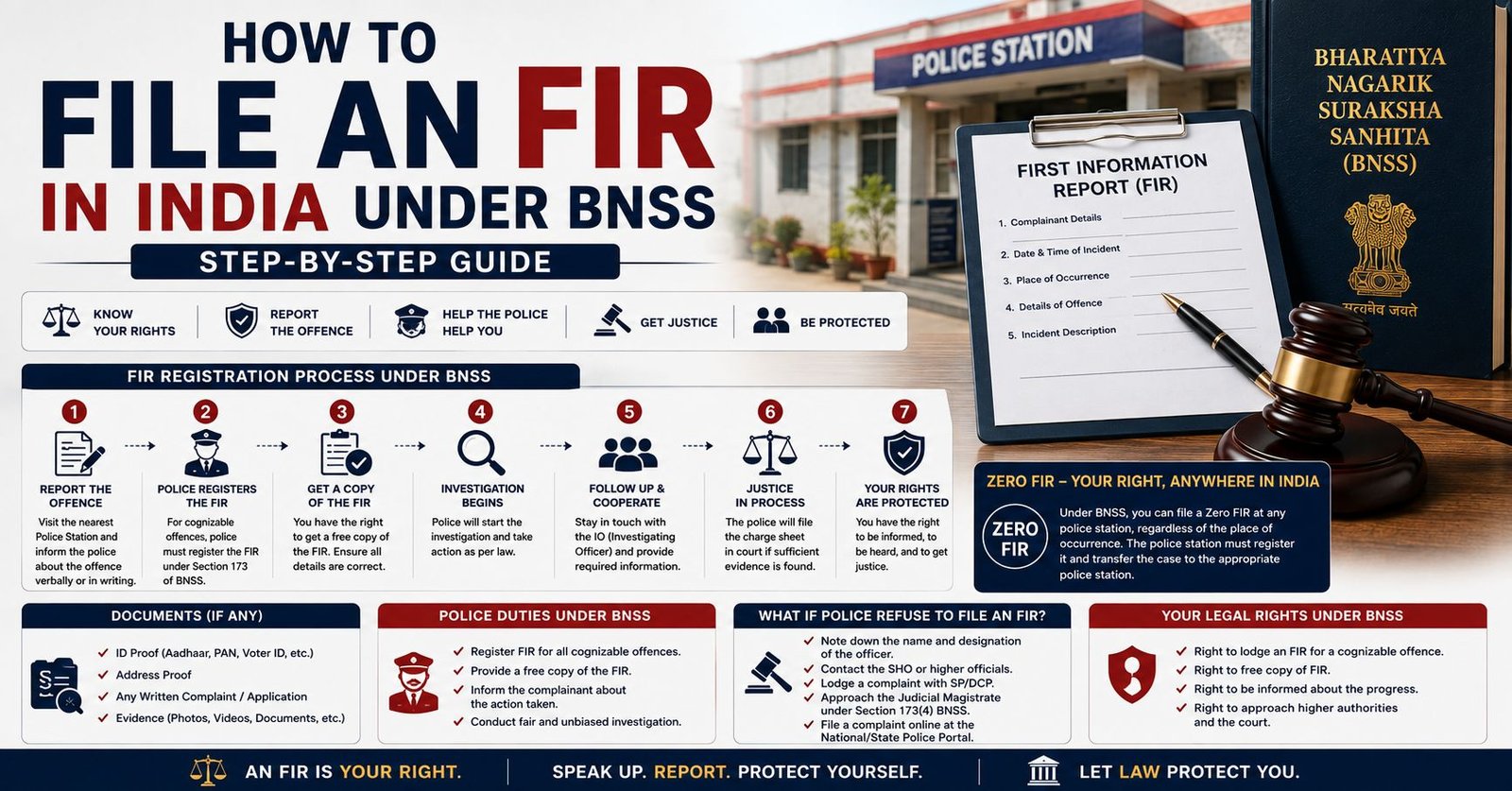
Rights of the Informant
The person providing information to the police enjoys important legal rights.
These generally include:
- Right to have information recorded where it discloses a cognizable offence.
- Right to receive a free copy of the FIR.
- Right to read the FIR before signing it.
- Right to request correction of factual errors.
- Right to approach higher authorities if the FIR is not registered.
- Right to legal representation.
- Right to fair treatment during the investigation.
Understanding these rights helps ensure that the criminal process is conducted fairly.
Important Legal Terms
FIR (First Information Report)
The first official report recorded by the police regarding a cognizable offence.
Informant
The person who provides information leading to the registration of the FIR.
Cognizable Offence
An offence in which the police may investigate without obtaining prior permission from the Magistrate.
Non-Cognizable Offence
An offence where the police generally require the Magistrate’s permission before commencing an investigation.
Investigation
The legal process of collecting evidence, examining witnesses, conducting searches, and identifying suspects.
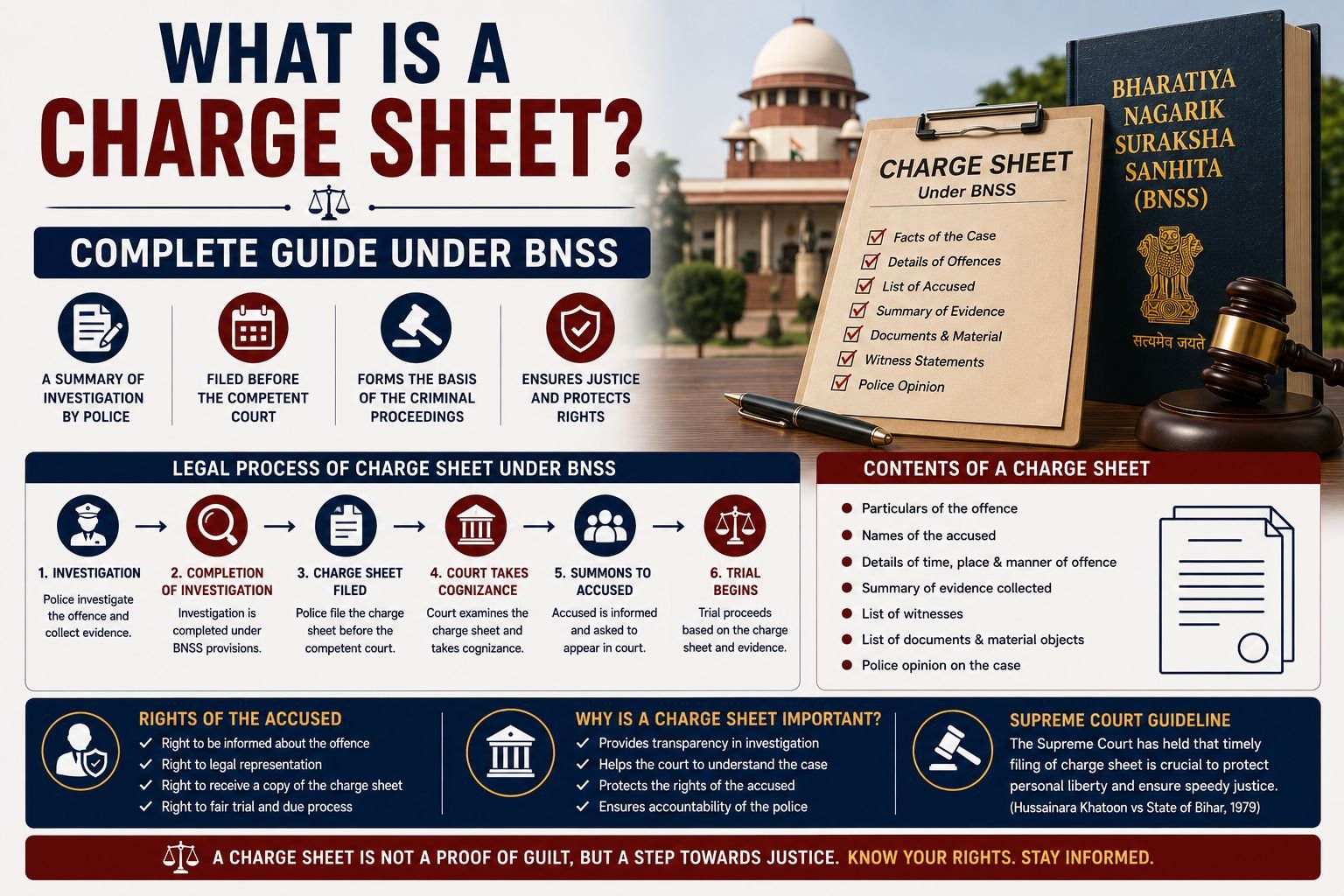
Charge Sheet
The report submitted by the investigating agency before the court after completing the investigation, where sufficient evidence exists.
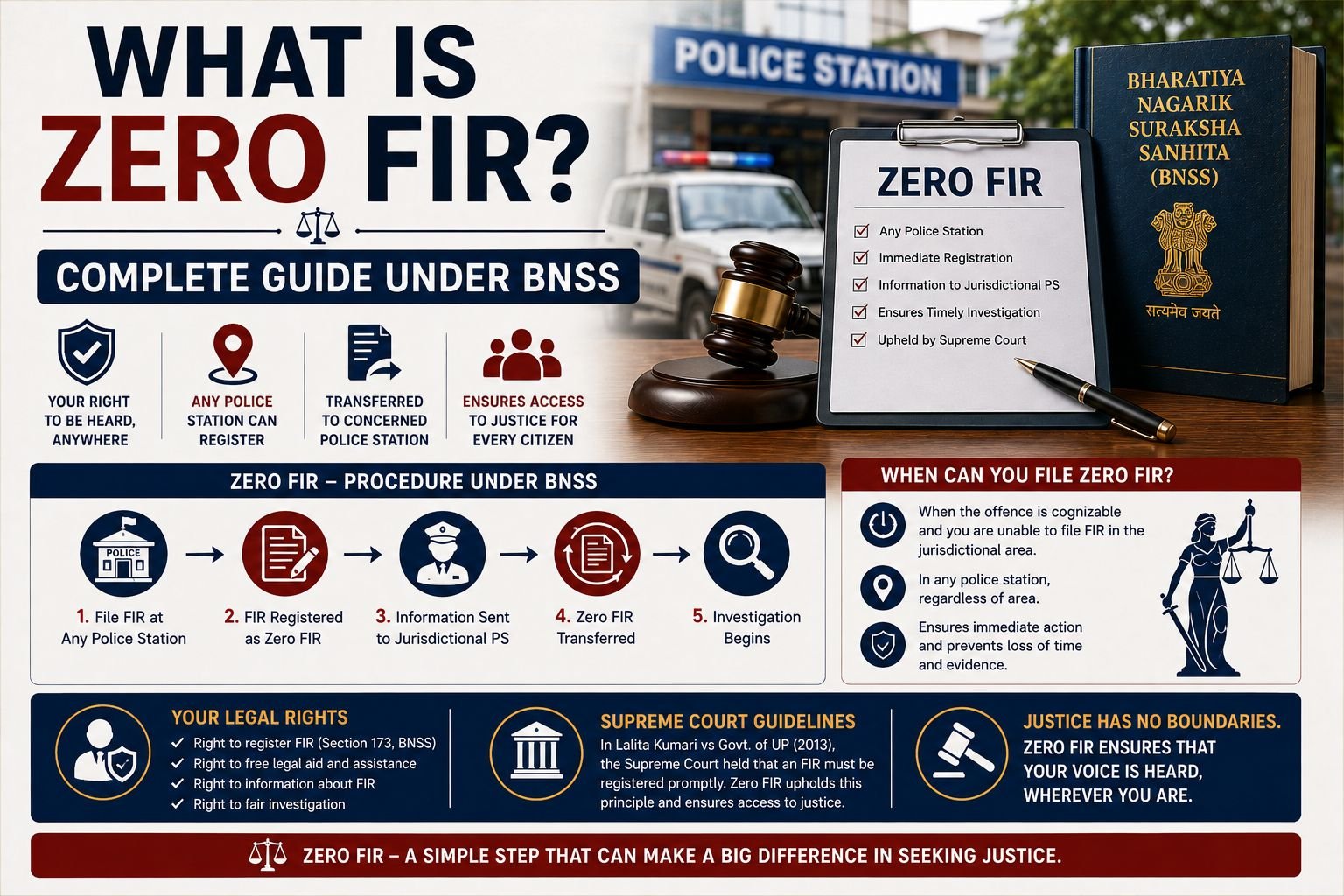
Zero FIR
An FIR that may be registered at any police station irrespective of territorial jurisdiction and later transferred to the appropriate police station.
Overview Table
| Particular | FIR |
|---|---|
| Full Form | First Information Report |
| Governed By | Bharatiya Nagarik Suraksha Sanhita, 2023 (BNSS) |
| Filed Before | Police |
| Applicable To | Cognizable offences |
| Purpose | Initiate police investigation |
| Who Can File | Any person having knowledge of the offence |
| Copy of FIR | Provided free of cost to the informant |
| Investigation | Begins after registration in accordance with law |
Common Misconceptions
Myth 1: Only the Victim Can File an FIR
Fact: Any person with knowledge of a cognizable offence may provide information to the police.
Myth 2: An FIR Means the Accused Is Guilty
Fact: An FIR only records allegations. Guilt is determined after investigation and trial.
Myth 3: Every Criminal Case Begins With an FIR
Fact: Certain criminal proceedings begin through a complaint before a Magistrate rather than an FIR.
Importance of Legal Advice
Although individuals can file an FIR without legal representation, consulting a criminal lawyer may be beneficial where:
- The offence is serious.
- Police refuse to register the FIR.
- Complex legal issues arise.
- The accused is influential.
- Multiple offences are involved.
Timely legal advice helps protect your rights and ensures that the correct legal procedure is followed.
Step-by-Step Process to File an FIR in India
Filing an FIR is a straightforward legal process when the information relates to a cognizable offence. Following the correct procedure helps ensure that your complaint is recorded properly and that the investigation begins without unnecessary delay.
Step 1 – Visit the Nearest Police Station
The first step is to approach the nearest police station and report the incident.
Generally, you should visit:
- The police station within whose jurisdiction the offence occurred.
- Any nearby police station if immediate assistance is required.
- The nearest police station for registration of a Zero FIR, if applicable.
If you are unable to visit personally because of injury, illness, or other exceptional circumstances, you may seek assistance through emergency services or other lawful means available in your State.
Territorial Jurisdiction
Ordinarily, an FIR is registered by the police station having territorial jurisdiction over the place where the offence occurred.
For example:
- A theft committed in Delhi is generally reported to the police station having jurisdiction over that area.
- A road accident in Mumbai is ordinarily reported to the concerned local police station.
However, jurisdiction should not become a barrier to urgent reporting in appropriate cases.
What is a Zero FIR?
A Zero FIR is an FIR that can be registered at any police station, regardless of where the offence occurred.
The FIR is assigned a temporary number and later transferred to the police station having territorial jurisdiction for investigation.
Zero FIR is particularly useful in urgent situations where immediate police action is necessary.
When Can a Zero FIR Be Filed?
A Zero FIR is commonly used in situations such as:
- Serious road accidents.
- Sexual offences.
- Kidnapping.
- Human trafficking.
- Terrorist incidents.
- Crimes committed while travelling.
- Cases where the victim cannot immediately reach the jurisdictional police station.
The purpose is to ensure that valuable time is not lost due to jurisdictional issues.
Benefits of Zero FIR
Zero FIR offers several advantages:
- Immediate registration of the offence.
- Faster police response.
- Preservation of evidence.
- Protection of victims.
- No delay due to jurisdiction disputes.
- Early commencement of legal proceedings.
It plays an important role in ensuring access to justice.
Step 2 – Provide Complete Information
After approaching the police station, clearly explain what happened.
Important details include:
- Date of the incident.
- Time of occurrence.
- Exact location.
- Description of the offence.
- Details of the accused, if known.
- Description of stolen property, if applicable.
- Details of injuries sustained.
- Names and contact details of witnesses.
- Information about available evidence.
Avoid exaggerating or omitting important facts.
Information Commonly Included in an FIR
The police generally record:
- FIR Number.
- Date and time of registration.
- Name and address of the informant.
- Name of the police station.
- Date and time of occurrence.
- Place of occurrence.
- Nature of the offence.
- Description of events.
- Details of accused persons, if known.
- Relevant legal provisions.
- Signature or thumb impression of the informant.
- Signature of the recording officer.
The exact format may vary according to official procedures.
Step 3 – Registration of the FIR
If the information discloses a cognizable offence, the police generally register the FIR.
The registration of an FIR marks the beginning of the official criminal investigation.
After registration, the police may:
- Visit the crime scene.
- Collect evidence.
- Record witness statements.
- Conduct searches where authorised.
- Begin identifying suspects.
Step 4 – Read the FIR Carefully Before Signing
Never sign the FIR without reading it.
Verify that:
- Names are correctly recorded.
- Dates are accurate.
- Addresses are correct.
- Facts are properly stated.
- Important details have not been omitted.
If any errors are noticed, request the police officer to correct them before signing.
Step 5 – Obtain a Free Copy of the FIR
After registration, the informant is generally entitled to receive a free copy of the FIR.
The copy contains:
- FIR number.
- Date of registration.
- Police station details.
- Allegations recorded.
- Relevant legal provisions.
Keep this document safely, as it may be required during investigation and court proceedings.
Can an FIR Be Filed Online?
Many States and Union Territories provide online facilities for reporting certain categories of offences.
Depending on local rules, citizens may be able to:
- Lodge an online complaint.
- Report cybercrime.
- Report vehicle theft.
- Track complaint status.
- Download acknowledgements.
- Access police services through official portals.
The exact procedure differs from State to State.
E-FIR Facilities
Some police departments also provide e-FIR services for specified offences.
These services may be available for:
- Mobile phone theft.
- Vehicle theft.
- Missing documents.
- Lost property.
- Certain cyber offences.
For serious cognizable offences, personal appearance at the police station may still be required depending on the circumstances.
FIR Through Electronic Means
In appropriate cases and where permitted by law or local procedures, information may also be communicated through:
- Official police email.
- Online police portals.
- Mobile applications.
- Emergency helplines.
- Cybercrime reporting platforms.
Electronic reporting can be particularly useful in emergencies or cybercrime cases.
Emergency Situations
In urgent circumstances, do not delay reporting.
Examples include:
- Kidnapping.
- Sexual assault.
- Terrorist threats.
- Serious road accidents.
- Attempt to murder.
- Armed robbery.
Immediately contact:
- Local police.
- Emergency response services.
- Women’s helplines, where applicable.
- Cybercrime helplines for online offences.
Prompt reporting may help save lives and preserve critical evidence.
Can Someone Else File an FIR on Your Behalf?
Yes.
If the victim is unable to approach the police because of:
- Serious injuries.
- Hospitalisation.
- Fear.
- Disability.
- Any other valid reason,
another person who has knowledge of the incident may provide the necessary information to the police.
Examples include:
- Family members.
- Friends.
- Witnesses.
- Neighbours.
- Social workers.
- Legal representatives.
Practical Examples
Example 1 – Theft
A person’s motorcycle is stolen from outside a shopping mall.
The owner:
- Visits the nearest police station.
- Provides vehicle details.
- Submits ownership documents.
- Receives an FIR copy.
Police begin searching for the stolen vehicle.
Example 2 – Zero FIR
A woman travelling by train becomes the victim of a serious offence while crossing multiple States.
She approaches the nearest railway police station.
The police register a Zero FIR immediately and later transfer the case to the appropriate police station.
Example 3 – Cyber Fraud
A victim loses money through online banking fraud.
The victim:
- Reports the incident immediately.
- Preserves transaction details.
- Files an FIR or complaint through the appropriate cybercrime mechanism.
- Cooperates with investigators.
Quick reporting improves the chances of tracing digital evidence.
Common Mistakes While Filing an FIR
Many people unintentionally weaken their cases by making avoidable mistakes.
Common mistakes include:
- Delaying the report without explanation.
- Giving incomplete facts.
- Providing inaccurate dates or timings.
- Failing to preserve evidence.
- Signing the FIR without reading it.
- Forgetting to obtain a copy.
- Omitting witness details.
- Providing false or exaggerated information.
- Filing before an inappropriate authority without seeking guidance.
Accuracy and honesty are essential.
Practical Tips for Filing an FIR
To ensure a smooth process:
- Report the offence as soon as possible.
- Carry identity proof if available.
- Preserve electronic and physical evidence.
- Note dates, times, and locations accurately.
- Keep photographs and videos safely.
- Write down important facts before visiting the police station.
- Read the FIR carefully before signing.
- Obtain the free copy of the FIR.
- Cooperate with the investigating officer.
- Consult a lawyer if the matter is legally complex.
Rights of the Informant During FIR Registration
Every informant has important legal rights, including:
- Right to have information recorded if it discloses a cognizable offence.
- Right to receive a free copy of the FIR.
- Right to read the FIR before signing.
- Right to request correction of factual errors.
- Right to approach higher authorities if the FIR is not registered.
- Right to be treated respectfully by law enforcement officers.
These safeguards promote transparency and accountability.
Documents Required for Filing an FIR
One of the most common questions people ask is whether documents are mandatory for filing an FIR.
The answer is not always.
An FIR is primarily based on information relating to the commission of a cognizable offence. Even if documentary evidence is not immediately available, the police may still register an FIR if the information discloses such an offence. However, supporting documents can strengthen the complaint and assist the investigation.
Identity Proof
Although not mandatory in every case, carrying identity proof is advisable.
Common identity documents include:
- Aadhaar Card
- PAN Card
- Passport
- Driving Licence
- Voter ID Card
- Government-issued Identity Card
Identity documents help verify the informant’s details and facilitate communication during the investigation.
Medical Documents
Medical records are particularly important in offences involving physical injuries or sexual offences.
Examples include:
- Medical examination reports
- Injury certificates
- Hospital discharge summaries
- X-ray or MRI reports
- Prescription records
- Post-mortem reports (where applicable)
Medical evidence often plays a crucial role in establishing the nature and extent of injuries.
Property Documents
In cases involving property-related offences, useful documents may include:
- Sale deeds
- Lease agreements
- Property tax receipts
- Possession letters
- Allotment letters
- Registration documents
- Ownership certificates
These documents help establish ownership and support the allegations.
Financial Documents
For cheating, fraud, or financial crimes, preserve documents such as:
- Bank statements
- Loan documents
- Payment receipts
- Invoices
- Investment records
- UPI transaction details
- Credit card statements
- Cheques
- Financial agreements
Such records assist investigators in tracing financial transactions.
Electronic Evidence
Electronic evidence has become increasingly important in criminal investigations.
Examples include:
- WhatsApp chats
- SMS messages
- Emails
- CCTV footage
- Audio recordings
- Video recordings
- Call recordings
- Social media messages
- GPS records
- Mobile phone data
- Computer files
- Cloud storage records
Do not alter or delete electronic evidence before handing it over to the investigating agency.
Photographs and Videos
Photographs and videos may provide valuable evidence regarding:
- Crime scenes
- Injuries
- Damaged property
- Vehicles
- Weapons
- Suspects
- CCTV captures
Original files are generally more valuable than edited versions.
Witness Details
Witnesses often play an important role during the investigation.
Provide, wherever available:
- Names
- Addresses
- Contact numbers
- Occupation
- Relationship to the incident
Witness statements may help corroborate the allegations recorded in the FIR.
What Happens After an FIR Is Registered?
Registration of an FIR is only the beginning of the criminal process.
After registration, the investigating officer initiates the investigation in accordance with the BNSS.
The process generally includes:
- Visiting the crime scene.
- Collecting evidence.
- Recording witness statements.
- Identifying suspects.
- Conducting searches where legally authorised.
- Recovering stolen property.
- Obtaining forensic reports.
- Preparing investigation records.
The investigation must be impartial, lawful, and evidence-based.
Police Investigation Process
A criminal investigation generally proceeds through several stages.
1. Crime Scene Inspection
The investigating officer visits the place of occurrence to:
- Examine the scene.
- Identify evidence.
- Prepare site plans.
- Photograph the location.
- Collect physical evidence.
Prompt inspection reduces the risk of evidence being destroyed.
2. Collection of Evidence
The police may collect various forms of evidence, including:
- Fingerprints
- DNA samples
- Blood samples
- Weapons
- Documents
- Mobile phones
- Electronic devices
- CCTV footage
- Financial records
Scientific evidence has become increasingly significant in modern criminal investigations.
3. Recording Witness Statements
Witnesses may be questioned regarding:
- What they observed.
- Time of occurrence.
- Identity of suspects.
- Circumstances surrounding the offence.
- Other relevant facts.
Accurate witness statements help reconstruct the sequence of events.
4. Examination of the Accused
Where appropriate, investigators may question suspects regarding:
- Their involvement.
- Their whereabouts.
- Supporting documents.
- Other relevant facts.
Questioning must be conducted in accordance with the law and constitutional safeguards.
5. Forensic Examination
In serious cases, evidence may be sent to forensic laboratories for analysis.
Examples include:
- DNA testing
- Fingerprint comparison
- Handwriting analysis
- Ballistic examination
- Toxicology reports
- Cyber forensic analysis
Forensic evidence often provides objective scientific support during criminal trials.
Search and Seizure
Where authorised by law, investigating officers may conduct searches to recover evidence.
Searches may involve:
- Houses
- Offices
- Vehicles
- Electronic devices
- Business premises
- Storage facilities
Any search must follow the procedure prescribed under the BNSS and other applicable laws.
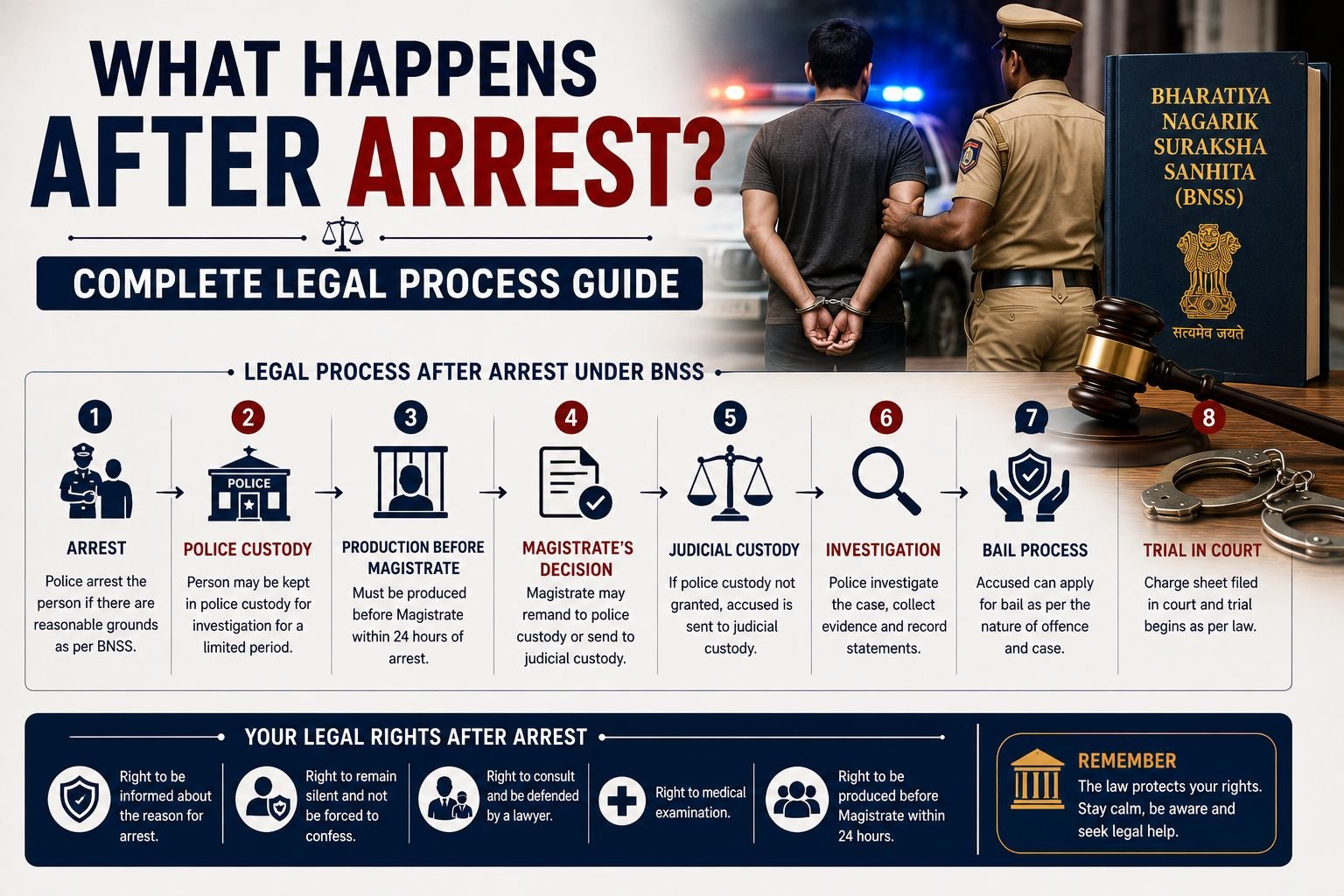
Arrest Procedure
Registration of an FIR does not automatically mean that the accused will be arrested.
The police consider factors such as:
- Nature of the offence.
- Available evidence.
- Possibility of absconding.
- Risk of tampering with evidence.
- Threat to witnesses.
- Legal provisions governing arrest.
Supreme Court judgments have emphasised that arrests should not be made mechanically and must comply with statutory safeguards.
Police Powers During Investigation
The police may exercise several powers during the investigation, including:
- Visiting crime scenes.
- Recording statements.
- Conducting searches.
- Seizing evidence.
- Arresting suspects where legally justified.
- Requesting forensic analysis.
- Recovering stolen property.
- Filing reports before the court.
All such actions must comply with the BNSS and constitutional protections.
Duties of the Police
The investigating agency has important legal responsibilities.
These include:
- Registering FIRs in appropriate cases.
- Conducting fair and impartial investigations.
- Preserving evidence.
- Protecting victims and witnesses.
- Maintaining investigation records.
- Respecting constitutional rights.
- Avoiding unnecessary delay.
- Filing the final report before the court.
A fair investigation is essential for maintaining public confidence in the criminal justice system.
Rights of Victims During Investigation
Victims have several important rights during the investigation.
These generally include:
- Right to fair treatment.
- Right to receive a copy of the FIR.
- Right to provide evidence.
- Right to submit additional documents.
- Right to legal representation.
- Right to seek compensation where permitted by law.
- Right to receive updates in accordance with applicable procedures.
Victim participation contributes to an effective investigation.
Rights of the Accused During Investigation
The accused also enjoys important legal protections.
These include:
- Right to legal representation.
- Right against unlawful arrest.
- Right to be informed of the grounds of arrest.
- Right to be produced before the competent Magistrate within the prescribed time after arrest.
- Right to apply for bail where legally permissible.
- Right to a fair investigation.
- Right to challenge illegal police action before the courts.
The criminal justice system aims to ensure fairness to all parties.
Charge Sheet
If sufficient evidence is collected during the investigation, the police submit a charge sheet before the competent court.
The charge sheet generally contains:
- Details of the accused.
- Nature of the offence.
- Witness list.
- Documentary evidence.
- Forensic reports.
- Investigation findings.
- Applicable legal provisions.
The court then decides the next stage of criminal proceedings.
Closure Report
If the investigating agency concludes that sufficient evidence is not available, it may submit a closure report before the court.
The Magistrate may:
- Accept the report.
- Reject the report.
- Direct further investigation.
- Take cognizance if appropriate.
Thus, a closure report does not automatically end the matter.
Time Taken for Investigation
The duration of an investigation depends on factors such as:
- Nature of the offence.
- Availability of evidence.
- Number of witnesses.
- Forensic examination.
- Complexity of the case.
- Cooperation of the parties involved.
Some investigations conclude within weeks, while others may take several months depending on the facts.
Common Mistakes After Filing an FIR
After registration, informants should avoid:
- Destroying evidence.
- Contacting witnesses improperly.
- Sharing confidential investigation details publicly.
- Ignoring police notices.
- Failing to cooperate with investigators.
- Providing inconsistent statements.
- Withholding relevant documents.
Cooperation with the investigating agency generally helps ensure a smooth investigation.
Practical Tips for Victims
After filing an FIR:
- Preserve all original documents.
- Save electronic evidence in multiple locations.
- Keep copies of medical records.
- Maintain a record of communication with the police.
- Attend proceedings whenever required.
- Inform the investigating officer about new evidence.
- Consult a lawyer if legal issues become complex.
What If the Police Refuse to Register an FIR?
One of the most common issues faced by victims is the refusal of the police to register an FIR despite disclosing a cognizable offence.
If the information clearly reveals the commission of a cognizable offence, the police are generally required to register an FIR in accordance with the BNSS and the law laid down by the Supreme Court.
A refusal does not mean that your legal remedies are exhausted. The law provides several options to seek registration of an FIR.
Step 1 – Request the Duty Officer to Record the Information
If an officer refuses to register your FIR, politely request that the information be recorded and explain why you believe the offence is cognizable.
Carry supporting documents, if available, such as:
- Identity proof
- Medical records
- Photographs
- CCTV footage
- Electronic communications
- Property documents
- Witness details
Providing clear and complete information may help resolve misunderstandings.
Step 2 – Approach the Station House Officer (SHO)
If the duty officer does not register the FIR, you may approach the Station House Officer (SHO) or the officer in charge of the police station.
The SHO can examine the facts and take appropriate action if the information discloses a cognizable offence.
Step 3 – Approach Senior Police Officers
If the police station still refuses to register the FIR, you may approach senior police authorities such as:
- Superintendent of Police (SP)
- Deputy Commissioner of Police (DCP)
- Commissioner of Police (where applicable)
You may submit:
- A written complaint.
- Copies of supporting documents.
- Details of the refusal by the local police.
Senior officers have supervisory powers and may direct registration of the FIR if appropriate.
Step 4 – Approach the Magistrate
If police authorities fail to act, you may approach the jurisdictional Magistrate.
The Magistrate has powers under the BNSS to pass appropriate orders in accordance with the law, including directing further action where legally justified.
Seeking legal assistance at this stage is often advisable.
Can an FIR Be Registered After a Delay?
Yes.
Although an FIR should ideally be lodged as soon as possible after the incident, a delayed FIR may still be registered if there is a reasonable explanation.
Common reasons for delay include:
- Medical treatment.
- Trauma or fear.
- Threats by the accused.
- Lack of awareness.
- Difficulty reaching the police.
- Natural disasters or emergencies.
Courts generally consider the explanation for the delay while assessing the facts of the case.
Important Supreme Court Judgments
Several landmark judgments have clarified the rights of citizens and the duties of the police regarding FIR registration.
1. Lalita Kumari v. Government of Uttar Pradesh (2014)
This landmark judgment established that registration of an FIR is generally mandatory when information discloses a cognizable offence.
Key Principles
- Police cannot ordinarily refuse to register an FIR where a cognizable offence is disclosed.
- Preliminary inquiry is permissible only in limited categories of cases.
- Prompt registration protects the rights of victims and preserves evidence.
2. Arnesh Kumar v. State of Bihar (2014)
The Supreme Court clarified that registration of an FIR does not automatically require the arrest of the accused.
Key Principles
- Arrest should not be mechanical.
- Police must follow statutory safeguards.
- Courts should ensure compliance with legal procedures.
This judgment protects individual liberty while allowing lawful investigation.
3. D.K. Basu v. State of West Bengal (1997)
This case established important safeguards during arrest and detention.
The Court directed that:
- Arrest procedures should be transparent.
- Family members should be informed.
- Arrest memos should be prepared.
- Medical examinations should be conducted where required.
These safeguards continue to protect constitutional rights.
4. Joginder Kumar v. State of Uttar Pradesh (1994)
The Supreme Court held that:
- Police cannot arrest a person merely because they have the power to do so.
- Arrest must be justified based on the facts of the case.
The judgment emphasises that personal liberty is a fundamental constitutional value.
5. Sakiri Vasu v. State of Uttar Pradesh (2008)
This judgment clarified the remedies available where police fail to register an FIR or conduct a proper investigation.
The Court recognised that affected persons may seek appropriate directions from the Magistrate in accordance with the law.
BNSS vs CrPC – Important Changes
The Bharatiya Nagarik Suraksha Sanhita, 2023 (BNSS) replaced the Code of Criminal Procedure, 1973 (CrPC).
Some important procedural changes include:
| Feature | CrPC | BNSS |
|---|---|---|
| Governing Law | Code of Criminal Procedure, 1973 | Bharatiya Nagarik Suraksha Sanhita, 2023 |
| Digital Processes | Limited | Greater use of technology and electronic records |
| Electronic Communication | Limited | Wider recognition in criminal procedures |
| FIR Registration | Available | Continued with procedural updates |
| Investigation | Traditional procedures | Greater emphasis on technology-assisted investigation |
While procedures have evolved, the fundamental purpose of an FIR remains the same—to initiate investigation into cognizable offences.
False FIRs and Legal Consequences
Filing an FIR based on knowingly false information can have legal consequences.
Examples include:
- Fabricating evidence.
- Making intentionally false allegations.
- Impersonation.
- Forging documents.
- Misleading investigating authorities.
False complaints may expose the informant to criminal or civil proceedings depending on the facts and applicable law.
At the same time, merely failing to prove allegations does not automatically mean that the FIR was false. Each case is decided on its own evidence.
Common Myths About FIR Registration
Myth 1: Police Can Refuse Every FIR
Reality: Where information clearly discloses a cognizable offence, the police are generally required to register the FIR.
Myth 2: Only the Victim Can File an FIR
Reality: Any person with knowledge of a cognizable offence may provide information to the police.
Myth 3: FIR Means Immediate Arrest
Reality: Registration of an FIR does not automatically result in arrest. The police must act in accordance with the BNSS and judicial guidelines.
Myth 4: FIR Is Proof of Guilt
Reality: An FIR only records allegations. Guilt can be determined only after investigation and trial.
Myth 5: Delay Always Invalidates an FIR
Reality: A delayed FIR may still be valid if the delay is reasonably explained.
Role of a Criminal Lawyer
Although a lawyer is not mandatory for filing an FIR, legal assistance can be extremely valuable in serious or complex cases.
A criminal lawyer can help:
- Determine whether the offence is cognizable.
- Draft a detailed written complaint.
- Advise on legal rights.
- Assist if police refuse to register the FIR.
- Represent clients before the Magistrate.
- Protect the rights of victims and accused persons.
- Guide clients through investigation and trial.
Professional legal advice reduces procedural errors and strengthens the legal strategy.
Practical Do’s and Don’ts
Do’s
- Report the offence promptly.
- Preserve all evidence.
- Keep copies of documents submitted.
- Read the FIR carefully before signing.
- Cooperate with the investigating officer.
- Maintain records of communications with the police.
- Seek legal advice in complex matters.
Don’ts
- Do not exaggerate facts.
- Do not conceal important information.
- Do not destroy electronic evidence.
- Do not sign documents without reading them.
- Do not threaten witnesses or interfere with the investigation.
- Do not file knowingly false complaints.
Practical Case Examples
Example 1 – Refusal to Register FIR
A victim reports a robbery, but the police refuse to record the FIR.
The victim may:
- Approach the SHO.
- Submit a complaint to the Superintendent of Police.
- Approach the Magistrate for appropriate legal remedies.
- Consult a criminal lawyer.
Example 2 – Delayed FIR
A victim of assault remains hospitalized for several days before reporting the offence.
The police may still register the FIR, and the medical records can explain the delay.
Example 3 – Cyber Fraud
A person loses money through an online investment scam.
The victim should:
- Preserve transaction details.
- Save emails and screenshots.
- Report the incident immediately through the appropriate police or cybercrime portal.
- Cooperate with investigators.
Frequently Asked Questions (FAQs)
1. What is an FIR?
An FIR (First Information Report) is the first official document recorded by the police when information about a cognizable offence is received. It forms the basis of the criminal investigation under the Bharatiya Nagarik Suraksha Sanhita, 2023 (BNSS).
2. Who can file an FIR in India?
Any person who has knowledge of the commission of a cognizable offence may file an FIR. The informant does not necessarily have to be the victim.
3. Can I file an FIR online?
Yes. Many State Police departments provide online FIR or e-FIR facilities for specified offences. The availability and procedure vary from State to State.
4. What is a Zero FIR?
A Zero FIR is an FIR that can be registered at any police station regardless of territorial jurisdiction. It is later transferred to the police station having jurisdiction over the offence.
5. Is there any fee for filing an FIR?
No. Filing an FIR is free of cost. The police cannot charge any fee for registering an FIR.
6. Can police refuse to register an FIR?
If the information clearly discloses a cognizable offence, the police are generally required to register an FIR in accordance with the BNSS and Supreme Court guidelines.
7. What should I do if my FIR is not registered?
You may:
- Approach the Station House Officer (SHO).
- Submit a complaint to the Superintendent of Police (SP) or Commissioner of Police.
- Approach the jurisdictional Magistrate.
- Consult a criminal lawyer.
8. Can an FIR be filed against an unknown person?
Yes. If the identity of the accused is unknown, an FIR can still be registered and the police may identify the accused during the investigation.
9. Can a family member file an FIR on behalf of the victim?
Yes. A family member or any person with knowledge of the offence may provide the information to the police.
10. Can a minor file an FIR?
Yes. A minor may report a cognizable offence. Where necessary, parents, guardians, or appropriate authorities may assist in the process.
11. Is documentary evidence mandatory for filing an FIR?
No. An FIR can generally be registered based on information about a cognizable offence. Supporting evidence may be submitted later during the investigation.
12. What documents should I carry while filing an FIR?
Useful documents include:
- Identity proof.
- Medical reports.
- Property documents.
- Bank records.
- Photographs.
- Videos.
- Emails.
- WhatsApp chats.
- CCTV footage.
- Witness details.
13. What happens after an FIR is registered?
The police generally:
- Begin investigation.
- Visit the crime scene.
- Collect evidence.
- Record witness statements.
- Conduct searches where authorised.
- File a charge sheet or closure report after completing the investigation.
14. Does filing an FIR mean the accused will be arrested immediately?
No. Registration of an FIR does not automatically result in arrest. The police must follow the BNSS and Supreme Court guidelines before making an arrest.
15. Can I withdraw an FIR?
The possibility of withdrawing an FIR depends on the nature of the offence and the applicable legal provisions. In certain cases, the competent court may permit compounding or quashing where the law allows.
16. Can I amend an FIR after registration?
The FIR itself is generally not amended. However, additional facts, evidence, or statements may be provided during the investigation.
17. How long does a police investigation take?
The duration depends on factors such as:
- Nature of the offence.
- Availability of evidence.
- Number of witnesses.
- Complexity of the case.
- Forensic examination.
There is no fixed timeline applicable to every investigation.
18. Can I obtain a copy of my FIR?
Yes. The informant is generally entitled to receive a free copy of the FIR after registration.
19. Can police investigate without an FIR?
In cognizable offences, investigation generally begins after an FIR is registered, except where the law provides otherwise. For non-cognizable offences, police usually require the Magistrate’s permission to investigate.
20. What is the difference between an FIR and a complaint?
An FIR is registered by the police to initiate the investigation of a cognizable offence, while a complaint is filed before a Magistrate seeking judicial action.
21. Can I file an FIR from another city?
Yes. In urgent situations, you may file a Zero FIR at the nearest police station, which can later be transferred to the police station having jurisdiction.
22. What if I do not know the legal sections applicable to my case?
You do not need to identify the legal provisions yourself. The police determine the appropriate sections based on the facts disclosed.
23. Is legal representation necessary while filing an FIR?
No. A lawyer is not mandatory for filing an FIR. However, legal assistance may be helpful in serious or complicated matters.
24. Can electronic evidence be submitted with an FIR?
Yes. Electronic evidence such as emails, CCTV footage, WhatsApp messages, audio recordings, videos, and digital documents may be submitted, subject to applicable legal requirements.
25. Can a delayed FIR still be registered?
Yes. A delayed FIR may still be registered if there is a reasonable explanation for the delay, such as medical treatment, trauma, or other valid circumstances.
26. What is a charge sheet?
A charge sheet is the report filed by the investigating agency before the court after completing the investigation where sufficient evidence is available against the accused.
27. What is a closure report?
A closure report is submitted when the investigating agency concludes that sufficient evidence is not available to proceed with prosecution. The Magistrate decides whether to accept the report or direct further action.
28. Can a false FIR lead to legal consequences?
Yes. Knowingly filing a false FIR or making false allegations may result in legal consequences under the applicable laws.
29. Which law governs FIR registration in India?
The Bharatiya Nagarik Suraksha Sanhita, 2023 (BNSS) governs the procedure for registration of FIRs and criminal investigations in India.
30. Where can I obtain legal help?
You may consult an experienced criminal lawyer or seek free legal aid from the National Legal Services Authority (NALSA) or the relevant State Legal Services Authority if you are eligible.
Conclusion
Knowing how to file an FIR in India is essential for protecting your legal rights and ensuring that criminal offences are reported promptly. An FIR serves as the foundation of a criminal investigation and enables law enforcement authorities to collect evidence, identify suspects, and initiate legal proceedings in accordance with the Bharatiya Nagarik Suraksha Sanhita, 2023 (BNSS).
Whether you are reporting theft, assault, cybercrime, financial fraud, or any other cognizable offence, understanding the correct procedure can help avoid unnecessary delays and procedural mistakes. Citizens should also be aware of their rights, including the right to receive a free copy of the FIR, the right to seek registration of a Zero FIR, and the right to approach senior police officers or the Magistrate if an FIR is wrongly refused.
While an FIR is only the beginning of the criminal justice process and does not establish guilt, timely reporting and cooperation with the investigating agency are crucial for ensuring a fair and effective investigation. If you are unsure about the legal process or your rights, consulting an experienced criminal lawyer can help you navigate the proceedings and protect your interests.