Being named in a First Information Report (FIR) can have serious legal and personal consequences. An FIR may lead to a police investigation, arrest in certain cases, and criminal proceedings before a court. However, not every FIR is legally sustainable. Sometimes, an FIR is filed based on false allegations, personal vendettas, business disputes, matrimonial disagreements, or facts that do not disclose a criminal offence. In such situations, the law provides a remedy through the quashing of an FIR.
The High Courts in India have the power to quash an FIR in appropriate cases to prevent misuse of the criminal justice system and to secure the ends of justice. This power is exercised cautiously and only after considering the facts, applicable law, and judicial precedents. It is not available in every case, especially where the allegations involve serious or heinous offences affecting society at large.
In this guide, you will learn how to quash an FIR in India, the legal grounds, the step-by-step procedure, important Supreme Court judgments, documents required, and answers to frequently asked questions.
What Does Quashing an FIR Mean?
Quashing an FIR means that the High Court sets aside the FIR and any criminal proceedings arising from it. Once an FIR is quashed, the investigation and related criminal proceedings generally come to an end, unless the court directs otherwise.
Quashing is different from an acquittal or discharge. It is an extraordinary remedy exercised before or during criminal proceedings when the court finds that continuing the case would amount to an abuse of the legal process or would not serve the interests of justice.
Can an FIR Be Quashed in India?
Yes. An FIR can be quashed by the High Court in appropriate cases under its inherent jurisdiction. The court exercises this power sparingly and only when there are compelling reasons.
The High Court may consider quashing an FIR if:
- The allegations do not disclose any cognizable offence.
- The FIR is false or malicious.
- The dispute is essentially civil in nature.
- The parties have lawfully settled the dispute in appropriate cases.
- Continuing the proceedings would amount to abuse of the legal process.
The court examines each case individually and does not quash an FIR merely because the accused requests it.
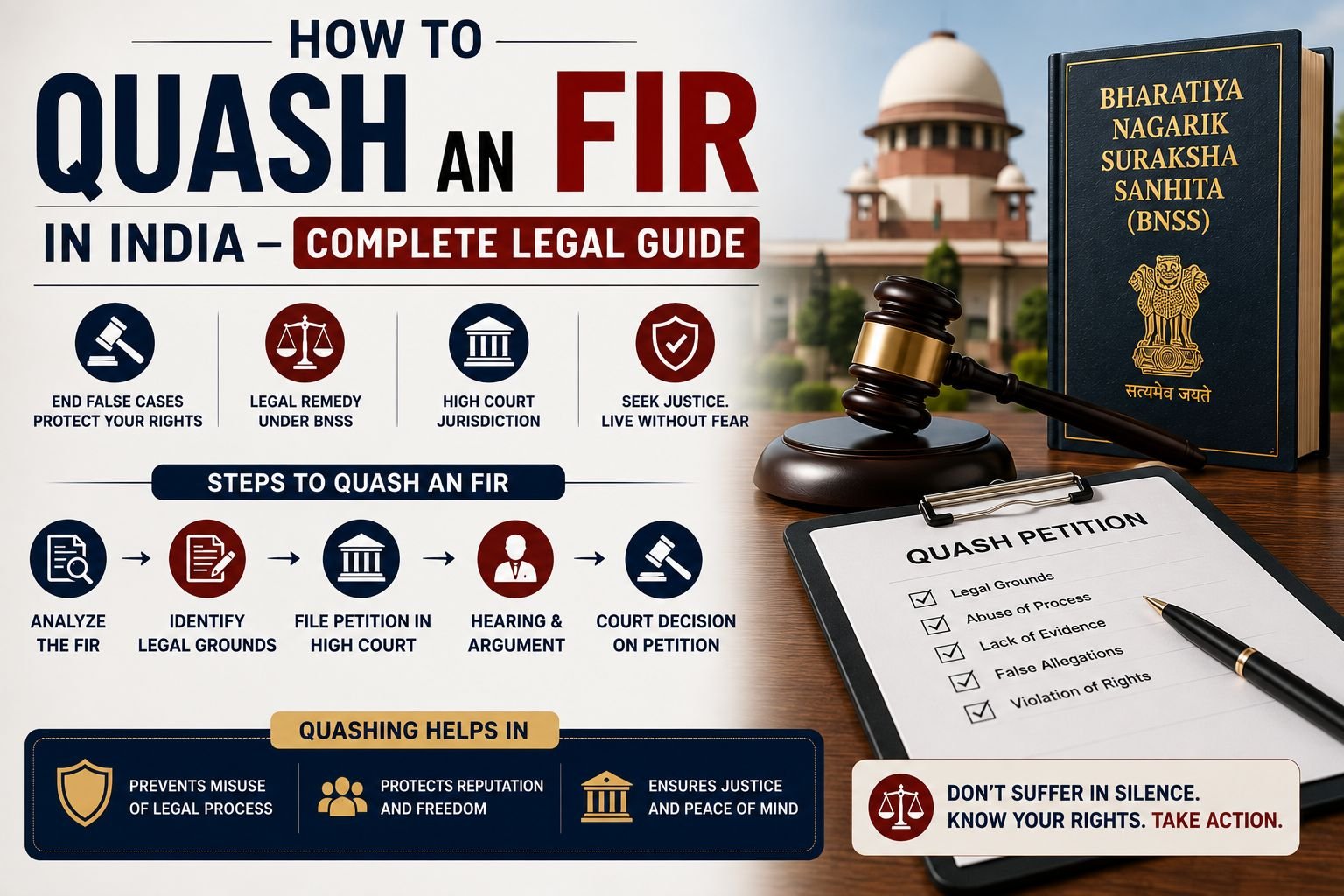
Grounds for Quashing an FIR
The High Court considers various legal grounds before deciding whether an FIR should be quashed.
1. False or Malicious FIR
Sometimes an FIR is filed to harass an individual due to personal rivalry, family disputes, political differences, or business competition.
If the court finds that the FIR has been filed with malicious intent and lacks genuine criminal allegations, it may consider quashing it.
2. No Prima Facie Offence
The court examines whether the allegations, even if accepted as true, disclose the commission of a criminal offence.
If the complaint does not establish the essential ingredients of any offence, the FIR may be quashed.
3. Civil Dispute Given Criminal Colour
Many property, commercial, contractual, or partnership disputes are essentially civil matters.
If criminal proceedings are initiated only to pressure the opposite party in a civil dispute, the High Court may intervene.
Examples include:
- Breach of contract.
- Property ownership disputes.
- Recovery of money.
- Partnership disagreements.
4. Settlement Between Parties
In certain cases, particularly matrimonial and commercial disputes, the parties may resolve their differences amicably.
Where the dispute is private in nature and the settlement is genuine, the High Court may quash the FIR to promote peace and avoid unnecessary litigation.
However, compromise alone is generally not sufficient for serious offences affecting society.
5. Abuse of the Legal Process
The criminal justice system should not be used as a tool for harassment or coercion.
If the court concludes that the FIR has been filed solely to misuse the legal process or exert undue pressure, it may quash the proceedings.
6. Lack of Evidence
Where the available material clearly indicates that the allegations are baseless and continuation of the proceedings would serve no legal purpose, the High Court may exercise its inherent powers.
The court, however, does not conduct a full trial while deciding a quashing petition.
Step-by-Step Procedure to Quash an FIR
Step 1 – Consult an Experienced Criminal Lawyer
The first step is to seek legal advice. A lawyer will examine the FIR, supporting documents, and applicable legal provisions to determine whether a quashing petition is maintainable.
Step 2 – Collect Relevant Documents
Important documents generally include:
- Copy of the FIR.
- Identity proof.
- Complaint, if available.
- Charge sheet (if filed).
- Settlement agreement (if applicable).
- Relevant correspondence.
- Supporting evidence.
Step 3 – Draft the Quashing Petition
Your advocate prepares a petition setting out:
- Facts of the case.
- Legal grounds for quashing.
- Relevant judicial precedents.
- Relief sought from the High Court.
The petition should clearly explain why continuation of the criminal proceedings would be unjust.
Step 4 – File the Petition Before the High Court
A petition for quashing an FIR is filed before the High Court having territorial jurisdiction over the police station where the FIR was registered.
After scrutiny, the matter is listed for hearing.
Step 5 – Notice to the State and the Complainant
The High Court usually issues notice to:
- The State Government (through the Public Prosecutor).
- The complainant or informant, where necessary.
Both parties are given an opportunity to present their case.
Step 6 – Hearing Before the High Court
During the hearing, the court considers:
- The FIR.
- Supporting documents.
- Legal submissions.
- Nature of the allegations.
- Applicable Supreme Court judgments.
- Public interest.
The court may also verify the genuineness of any settlement between the parties.
Step 7 – Final Order
After hearing all parties, the High Court may:
- Quash the FIR.
- Dismiss the petition.
- Grant interim protection in appropriate cases.
- Pass any other order permitted by law.
The decision depends entirely on the facts and circumstances of the case.
Documents Required
While the exact documents vary from case to case, the following are commonly required:
- Certified copy of the FIR.
- Identity proof of the petitioner.
- Copy of the complaint, if available.
- Charge sheet or final report, if filed.
- Affidavit.
- Settlement deed or compromise agreement (where applicable).
- Copies of relevant court orders.
- Supporting documents and evidence relied upon in the petition.
Important Supreme Court Judgments
The Supreme Court has laid down important principles governing the quashing of FIRs.
State of Haryana v. Bhajan Lal (1992)
This landmark judgment identified illustrative categories where the High Court may exercise its inherent powers to quash criminal proceedings, such as when the allegations do not disclose any offence or where the proceedings are manifestly malicious.
Gian Singh v. State of Punjab (2012)
The Court held that the High Court may quash criminal proceedings in appropriate cases involving private disputes if doing so would secure the ends of justice. However, serious offences affecting society generally should not be quashed merely because the parties have settled.
Narinder Singh v. State of Punjab (2014)
The Supreme Court laid down factors to be considered while quashing criminal proceedings based on compromise, including the nature of the offence, stage of the proceedings, and impact on society.
Parbatbhai Aahir v. State of Gujarat (2017)
The Court summarised the principles governing quashing petitions and reiterated that the High Court must balance individual rights with public interest before exercising its inherent powers.
Can an FIR Be Quashed After a Charge Sheet Is Filed?
Yes. Filing of a charge sheet does not automatically prevent the High Court from exercising its inherent jurisdiction.
However, once the investigation is complete, the court carefully examines:
- The material collected during the investigation.
- Nature of the allegations.
- Stage of the proceedings.
- Public interest.
- Applicable judicial precedents.
Each case is decided on its own facts.
Cases Where Courts Generally Refuse Quashing
The High Court is generally reluctant to quash FIRs involving serious offences affecting society, such as:
- Murder.
- Rape.
- Terrorism.
- Corruption.
- Organised crime.
- Large-scale financial fraud.
- Offences against the State.
- Heinous offences involving public interest.
Even if the parties settle such disputes, the court may refuse to quash the FIR if it believes the offence has a broader societal impact.
Common Mistakes to Avoid
When seeking quashing of an FIR, avoid the following:
- Filing the petition without valid legal grounds.
- Concealing important facts.
- Producing false documents.
- Assuming every compromise guarantees quashing.
- Delaying legal action unnecessarily.
- Filing before the wrong court.
- Ignoring legal advice.
Proper preparation and honest disclosure improve the credibility of the petition.
Frequently Asked Questions
1. Who can file a petition to quash an FIR?
Generally, the accused or any person directly affected by the FIR may approach the High Court through an advocate.
2. Which court can quash an FIR?
The High Court having territorial jurisdiction over the concerned police station has the power to quash an FIR.
3. Can an FIR be quashed after arrest?
Yes. An arrest does not prevent the accused from seeking quashing of the FIR if valid legal grounds exist.
4. Can the complainant withdraw an FIR?
Withdrawal depends on the nature of the offence and applicable legal provisions. In many cases, the complainant alone cannot terminate criminal proceedings.
5. Is a settlement enough to quash an FIR?
Not always. The court considers the nature of the offence, public interest, and whether the settlement is voluntary and genuine.
6. How long does a quashing petition take?
The timeline varies depending on the complexity of the case, court workload, and procedural requirements.
7. Can the High Court stay the investigation?
In appropriate cases, the High Court may grant interim relief, subject to the facts and circumstances.
8. Is hiring a lawyer necessary?
While there is no legal prohibition on appearing in person, quashing petitions involve complex legal principles, and professional legal assistance is highly advisable.
9. What happens if the petition is dismissed?
If the petition is dismissed, the criminal proceedings generally continue in accordance with law.
10. Can a fresh FIR be filed after quashing?
Whether a fresh FIR can be filed depends on the court’s order, the facts of the case, and applicable legal principles.
Conclusion
Quashing an FIR is an extraordinary remedy designed to prevent abuse of the criminal justice system and to ensure that criminal proceedings are not continued where they are legally unsustainable. The High Court exercises this power cautiously after examining the allegations, available material, and settled legal principles laid down by the Supreme Court.
Not every FIR can or should be quashed. Serious offences affecting society are generally allowed to proceed through investigation and trial, whereas private disputes, false allegations, or cases lacking a prima facie offence may justify judicial intervention. If you believe an FIR has been wrongly registered against you, consulting an experienced criminal lawyer at the earliest stage can help you understand your legal options and pursue the appropriate remedy before the High Court.