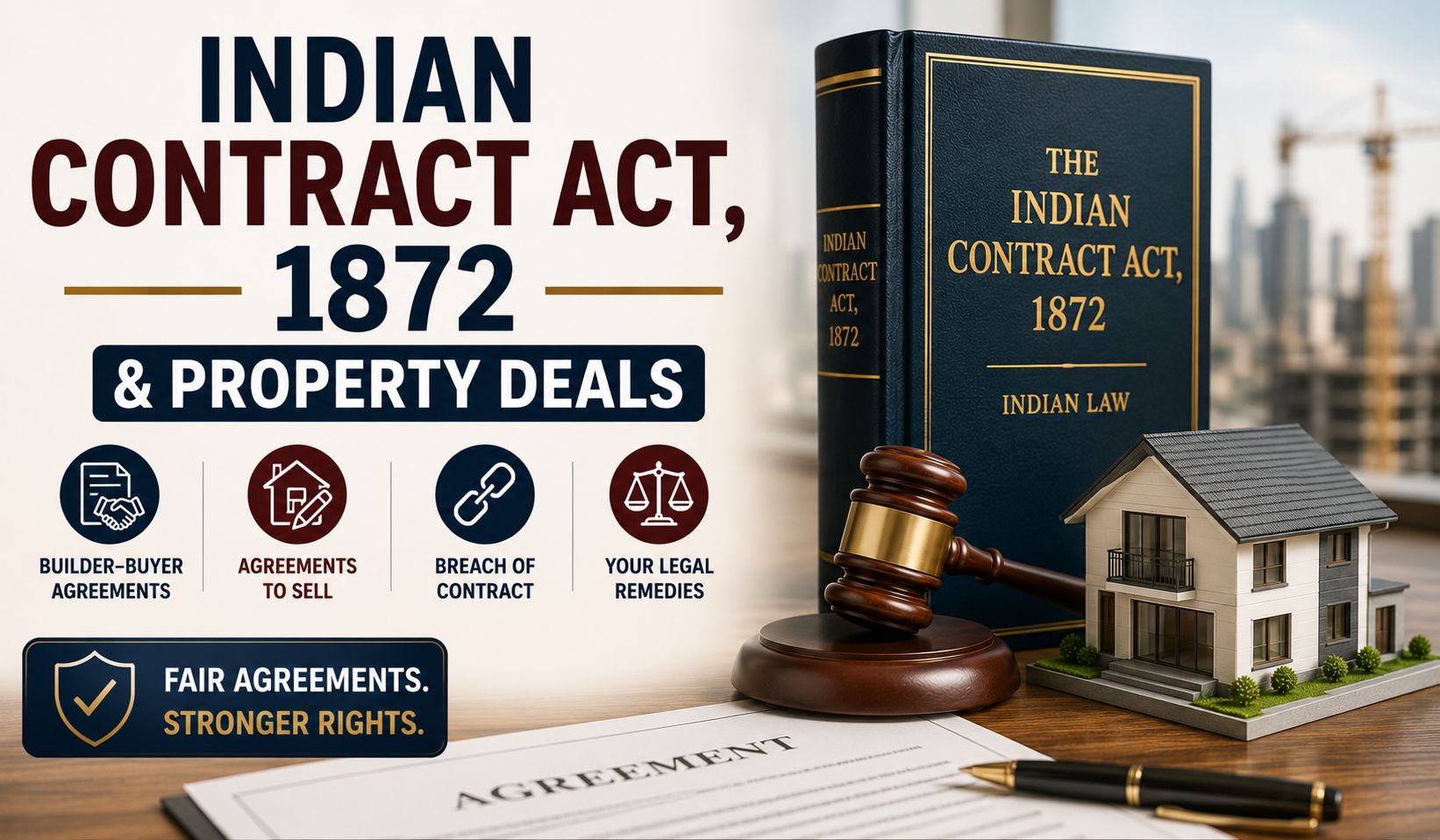
Every builder-buyer agreement, every “agreement to sell,” every payment schedule you’ve ever signed — none of it means anything unless it satisfies one 150-year-old law first. Not RERA. Not the Transfer of Property Act. The Indian Contract Act, 1872.
If TPA governs what gets transferred and the Registration Act governs how it’s recorded, the Contract Act governs something more fundamental: whether the agreement itself was ever legally valid to begin with.
What Is the Indian Contract Act?
Enacted in 1872, the Indian Contract Act is the foundational law governing agreements in India — property-related or otherwise. It defines what makes a promise legally binding, what happens when one party breaks that promise, and what remedies are available when things go wrong.
In real estate specifically, this Act is the invisible skeleton underneath every builder-buyer agreement, every sale agreement, and every memorandum of understanding you sign before a property deal closes.
What Makes an Agreement a Valid Contract?
Not every signed piece of paper qualifies as an enforceable contract. Under the Act, a valid contract needs:
- Offer and acceptance — one party proposes terms, the other accepts them
- Lawful consideration — something of value exchanged, like the sale price
- Free consent — no fraud, coercion, undue influence, or misrepresentation
- Capacity to contract — both parties must be of legal age and sound mind
- Lawful object — the purpose of the agreement must not violate the law
- Not expressly declared void — the agreement mustn’t fall into a category the law voids outright
Miss even one of these, and what looks like a binding agreement can unravel entirely — sometimes exactly when you need it most.
Where This Shows Up in Real Estate
Builder-Buyer Agreements
This is the contract that defines your entire relationship with a developer — payment schedule, possession date, penalty clauses, and what happens on default. Its enforceability rests entirely on Contract Act principles. A builder can’t simply walk away from committed terms; a valid contract binds both sides.
Agreement to Sell
Before a registered sale deed is executed, buyers and sellers typically sign an “agreement to sell” — a contract promising a future transfer. This document is governed by Contract Act rules on valid agreements, and its terms often determine what happens if either party backs out.
Earnest Money and Forfeiture Clauses
Ever wondered whether a builder can legally keep your token/booking amount if you cancel? The answer lies in contract law principles around penalty clauses and reasonable compensation — not arbitrary builder policy.
Free Consent: The Clause That Protects You From Pressure Tactics
One of the Act’s most buyer-relevant provisions is the requirement of free consent. An agreement signed under any of the following can be challenged:
| Vitiating Factor | What It Looks Like |
|---|---|
| Coercion | Being pressured or threatened into signing |
| Undue Influence | A dominant party (e.g. builder) exploiting a position of power |
| Fraud | False statements made knowingly to induce signing |
| Misrepresentation | Innocent but false statements that influenced your decision |
| Mistake | Both parties fundamentally mistaken about the subject matter |
If a builder pressured you into signing under a rushed deadline with incomplete disclosures, that agreement’s validity may itself be questionable — a fact many buyers don’t realize until a dispute forces them to look closer.
What Happens When a Contract Is Broken?
This is where the Act becomes a buyer’s most practical tool. When a builder or seller breaches an agreement, the Contract Act provides for remedies including:
Compensation for loss — financial damages for losses directly resulting from the breach.
Specific performance — in certain cases, a court can compel the defaulting party to actually fulfill the contract, rather than just paying damages, particularly relevant when a specific property (not a fungible asset) is involved.
Rescission — the injured party can treat the contract as cancelled and seek restitution of what they’ve already paid.
This is precisely why RERA lawyers examine your builder-buyer agreement through both lenses — RERA compliance and Contract Act enforceability. A technically RERA-compliant project can still involve a poorly drafted or unfairly weighted contract.
Why “Standard Form” Agreements Deserve a Second Look
Builders often present buyers with pre-printed, non-negotiable agreements — take it or leave it. While such standard-form contracts aren’t automatically invalid, courts have repeatedly scrutinized one-sided clauses that unfairly favor the party with greater bargaining power.
If your agreement includes clauses like disproportionate penalty terms for buyer delays versus minimal penalties for builder delays, that imbalance can become a legal argument in your favor during a dispute.
Common Contract Pitfalls Buyers Should Watch For
- Signing without reading the fine print on possession delay penalties and forfeiture clauses
- Assuming verbal builder promises count — under the Act, only what’s documented typically holds up
- Ignoring vague or undefined terms around “reasonable time” for possession or amenities
- Ambiguity over refund clauses, especially the exact rate and timeline for interest on delays
The Bottom Line
Every property transaction ultimately runs through the Indian Contract Act’s DNA — it’s the law that decides whether a promise is legally enforceable or just words on paper. RERA gives buyers regulatory teeth; TPA and the Registration Act govern the property transfer itself. But it’s the Contract Act that determines whether the underlying agreement was ever valid to begin with.
About to sign a builder-buyer agreement or agreement to sell? Get it reviewed for contractual soundness before you sign — not after a dispute forces you to find out the hard way.
FAQs
Q1: Can a builder-buyer agreement be challenged in court? Yes. If the agreement was signed without free consent, contains unlawful terms, or one party breaches its obligations, the Indian Contract Act provides grounds to challenge or seek remedies.
Q2: Is a verbal agreement to sell property valid? Generally, agreements involving immovable property are expected to be in writing and often registered, especially for enforceability in disputes. Verbal promises are difficult to prove and rarely hold up on their own.
Q3: What is “specific performance” in property disputes? It’s a legal remedy where a court orders the defaulting party to actually complete the contract — such as executing a sale deed — rather than simply paying monetary compensation.
Q4: Can a builder forfeit my entire booking amount if I cancel? Not necessarily. Forfeiture clauses must reflect reasonable compensation for actual loss under contract law principles; excessive or punitive forfeiture can be legally challenged.
Q5: What’s the difference between fraud and misrepresentation under the Contract Act? Fraud involves a knowingly false statement made to deceive, while misrepresentation involves a false statement made innocently, without intent to deceive. Both can affect the validity of consent, but they carry different legal consequences.